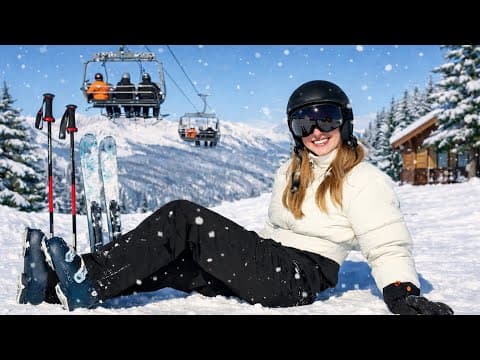
[0:00]Hey everybody. It's Arianita La Gringa and welcome back to my YouTube channel. Today, we're doing a special kind of video. I'm doing a ski trip vlog. Yes, I'm here in Denver, Colorado at Copper Mountain. Let's start skiing.
[0:35]Before skiing on the mountain, you need to buy a lift ticket. Yes, I bought a four-day pass and that cost me around $400. This is my little ID card, it's my lift ticket, and it'll go right in my jacket. And I'll scan it before getting on the lift. And where do I buy a lift ticket? This is the correct place. Yes, you'll walk inside, go to the customer service desk, and they have several different options like a one-day pass, a two-day pass, a four-day pass, or a season pass. After picking up your lift ticket, you need to go and rent skis or a snowboard. Over here they have different snowboards, they have junior, basic, performance, and demo. I do not know how to snowboard so today, I'm going to rent a pair of skis. Over here, you're going to rent some skis, poles, a helmet, as well as boots. This is the place to grab your ski boots or your snow boots for snowboarding. So, they have different kinds of boots for skis versus a snowboard. I'm a nine and a half or a 10, but I usually go with a 10 because I wear thick socks when I ski. As you can see, they have different sizes of skis. Some are shorter and some are taller. I picked up my skis yesterday, and normally, if you do ski, they should go up to your chin level. Snowboarding is way different than skiing. For example, you have two skis, one for each leg. But with snowboarding, your feet are sideways on one board. And when you rent a snowboard, they'll ask you how you want your foot position. For example, they'll say, are you a regular or are you goofy? If they ask you if you're goofy, that doesn't mean you make a lot of jokes. No. They're talking about the foot position. For example, if you're goofy, your right side, your right foot will be at the front. But, if you're regular, your left side will be at the front. Are you goofy or are you regular? Let me know down below. These are my rental skis as well as my poles, and I'm going to leave them over here by the racks to show you guys around this ski resort. When you rent skis, how do you know which skis are yours? Because look, there are snowboards here, multiple skis and sometimes it could be difficult to remember. Well, when you rent skis, you have your initials. My initials are A. D., so that way I'll remember them. And I'll also remember the color of my skis as well as the color of my straps, which are red. Let's leave these skis here on the rack. Let's walk around a little bit before we go ski. Copper Mountain, Colorado is one of the most popular ski resorts in the Rocky Mountains. It's about 75 miles west of Denver and sits at 9,700 feet. It's known for great snow and beautiful views. With over 150 trails and 24 lifts, there's something here for everyone. Copper Mountain also hosts international competitions and is a popular training spot for Olympic athletes. This place is not only known for skiing or snowboarding. No, they have many different restaurants or cafes in case you get hungry. And if you do get cold. So, let's go ahead and check out a coffee shop. Something I've noticed here at this ski resort is that the prices are a bit expensive. For example, if I want to buy a bottle of water, this will cost $7. Would you pay $7 for a bottle of water? Let me know down below. At this resort, they also have a huge store that sells jackets, vests, hats, just in case if you forgot anything at home or in case you just want a souvenir from Copper Mountain. Something that I've noticed here at this store is they sell oxygen, so I'm going to ask Emma. So why do people buy oxygen here? Yeah, honestly, we get a lot of people who are coming from lower elevation, and literally the air is thinner, so they can get elevation sickness or they find it hard to breathe, takes a couple days to get used to it. I don't know if this actually does anything, but it does make them feel less like they're dying. After giving you guys a tour around this ski resort, I think we're ready to hit the slopes. But first, I need to put on my ski boots, as well as change my gloves because I have heated gloves, and the last thing is a helmet. So, let's go inside and change. This area is where you can put on your ski gear, like your snowboarding boots or your ski boots. If you guys need extra help with your skis or snowboards, then you can come to the tuning center. Where they have a full tune. They'll give your skis or a snowboard a hot wax. They can also bind your skis, and they can also adjust them as well. And if you already know how to adjust your skis or your snowboard, you can just come over here and adjust them with a screwdriver. I changed into my ski boots. I finally am wearing gloves that are nice and warm. I have a helmet on and I also have my ski goggles. I think it's time to hit the slopes. Let's start skiing. Today is one of the coldest days. It's 18 degrees. The snow is so fresh and light, we call this powder, which means it's perfect for skiing. I'm carrying my skis and poles, and I'm heading to the lift line. Right now, I'm waiting in line to go up the lift. As you can see, the line is pretty long. But that's okay. We have time to wait. And before getting on the lift, you have to remember to bring your lift ticket or your ID card. And I have that right in my pocket to scan. We are getting on the ski lift.
[6:19]You let the chair come behind you, then you sit down. I am sitting on a chair lift. This is a safety bar, so I don't fall off the chair lift. And this is a blue covering to protect me from the snow and the wind. This chair lift is very nice. You have a beautiful view of the trees, of skiers, and the snow. And it's very safe and it takes about five minutes to get to the very top of the mountain. I just went up the ski lift. That's the ski lift and a ski lift takes you all the way up to the top of the mountain. And this is the unloading area. As you can see, snowboarders and skiers are unloading and they are going on to their trails. Let's take a look at the map of Copper Mountain. It's all the way over here and it'll show you which trails are blue, red, black, et cetera. Now, why are these slopes different colors? This is the map of Copper Mountain. Some runs are open, but some are closed. But, what is a run? Well, a run is a specific path all the way down the mountain. This is a green run. This is a blue run, and this is a red run. And they have different colors because some are more difficult than others. A green run is an easy run and it's great for beginners. This is a green run. But a blue run is a little bit more difficult. This is a blue run. I am going to go down a run. We are going down a blue run. And you know it's blue because it says Wind Song and it has a blue color and it says it's more difficult. So, let's go down the more difficult run. I'll see you guys down there.
[8:19]I'm stopping at a mountain restaurant halfway down the slope. I'm heading upstairs to order a drink. You'll see a lot of people drinking beer, even in the cold weather. That's very common when skiing. I'm getting hot chocolate to warm up. It's perfect on a cold day.
[8:40]I'm halfway down the run, but it was getting a little bit difficult. And over here they have a bypass. What is a bypass? A bypass is kind of like a detour. It's also called a cut off and it's basically an easier part of the trail. So, I'm not going down that way. Instead, I will be going this way. Now, I'm in the middle of the bypass. And since there aren't many people around me, I'm going to teach you guys how to ski. First things first, if you want to slow down, make a pizza or a triangle, and that will allow you to slow down. But if you want to go really fast, you want your skis to be parallel like this and that's called French fries. So remember, French fries to go fast and pizza to slow down. Now that you guys know how to ski, let's go down the bypass.
[9:47]Now, I'm at the day Lodge. This is where you'll find the cafeteria, bathrooms, and places to rest. I'm filling up my water cup. If you don't want to pay $7 for a water bottle, this is a great and free option. This small hill is called the bunny hill. It's perfect for beginners and new skiers. This is a chair lift and that is a gondola. A gondola is a closed cabin that takes people up the mountain. Now I'm riding the gondola up to the top of the mountain. And here we are at the top of the mountain, also called the peak at 12,441 feet above sea level. At this height, it's very important to talk about avalanches. An avalanche is when a large amount of snow slides down the mountain and it can be very dangerous. This is an avalanche rescue dog. These dogs are trained to find people trapped in the snow. Now, let's meet the trainer and learn how these amazing dogs help save lives. She does avalanche, drowning and missing people in the wilderness. Wow. How do you guys train a dog like that? You, it's all in little bite-sized pieces, you know, visual drills where you like, somebody runs and hides behind that barrel. Something she can see. You like, get their hunt drive and then. It's like hide and seek. Yeah, and then you started skiring them and hiding them. And so you just, you just manipulate the game and bite-sized pieces to where she's just like, just her hunt drive and that she knows her nose is the best. How many people has she rescued? Oh, you know, terminology, I guess. Um, we've recovered like six people, rescued one. Wow. So, but because a lot of times people we go to, we're already dead, something happened and so we just need to find where they are. So, avalanches, you know, high percentage of fatalities and avalanches. All right. We need to, so an avalanche happens because of just a lot of snow compacted at the top of the mountain. Yeah, and then steep slopes. If a slope can't support it and so it wants to slide down and gravity just overtakes it. People a lot of times it needs a trigger somebody skiing. And then if they get on that slope it may be the thing that takes the balance. Um, if they don't have an avalanche transceiver then we have no other way to really find them other than using her nose and the odor that comes up through the snow from their body. Okay, everybody, I hope you guys enjoyed my ski trip vlog. Let me know down below how many new words you guys learned. And if you guys like this video, go ahead and give me a like, subscribe, and I'll see you guys next week. Bye.


