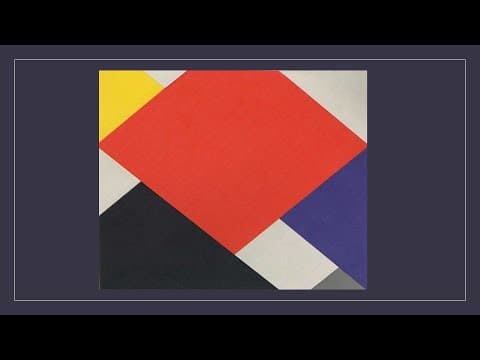
[0:00]Theo Van Dusberg, Counter Composition V. Created in 1924, this painting is currently housed in Stedelijk Museum in Amsterdam, Netherlands. As a leading figure of De Stijl and a close collaborator and eventual ideological rival of Piet Mondrian, Van Doesburg used this series to challenge the strict vertical-horizontal framework that had defined Neo-Plasticism. The painting is composed of a number of rectangular color fields—predominantly red, blue, yellow, black, and white. Unlike Mondrian's compositions, where vertical and horizontal black lines structure the space, Van Doesburg rotates the entire composition on a diagonal axis. The lines and color blocks are no longer restricted to right angles relative to the canvas edges; instead, they are arranged with a 45-degree rotation, creating a sense of movement and tension. The rotation of the rectangular forms within the diamond-shaped frame (lozenge format) breaks away from the static balance of Mondrian's symmetrical layouts. The result is an image that feels like it is in flux, constantly shifting, yet paradoxically balanced. Van Doesburg believed that the diagonal was essential to introduce dynamism and vitality into abstract art. He coined the term "Elementarism" to describe this new visual language—one that embraces asymmetry, vitality, and the dynamic rhythms of modern life. Despite the deliberate disturbance of order, the painting maintains a careful internal balance. The size, spacing, and positioning of each rectangle are meticulously calculated to create a sense of harmony through contrast. Large red and black fields dominate the composition, while smaller blue and yellow shapes offer counterbalance. The artwork is an exploration of the potential for abstraction to communicate universal concepts and emotions. Theo van Doesburg's painting is a synthesis of theory and aesthetics. The composition marks a turning point in the evolution of geometric abstraction. It represents Van Doesburg's redefinition of De Stijl principles that influenced subsequent movements and artists seeking to break away from traditional representational art. It is the belief in the creation of a worldwide visual language that could transcend cultural and national boundaries.
2m 57s330 words~2 min read
YouTube auto captions
Transcript source
YouTube auto captions
This transcript was extracted from YouTube's auto-generated caption track. The transcript below is server-rendered so it can be read, searched, cited, and shared without opening the original YouTube player.
Pull quotes
[0:00]Created in 1924, this painting is currently housed in Stedelijk Museum in Amsterdam, Netherlands.
[0:00]The painting is composed of a number of rectangular color fields—predominantly red, blue, yellow, black, and white.
[0:00]Unlike Mondrian's compositions, where vertical and horizontal black lines structure the space, Van Doesburg rotates the entire composition on a diagonal axis.
[0:00]The lines and color blocks are no longer restricted to right angles relative to the canvas edges; instead, they are arranged with a 45-degree rotation, creating a sense of movement and tension.
Use this transcript
Related transcript hubs
Watch on YouTube
Share
MORE TRANSCRIPTS


