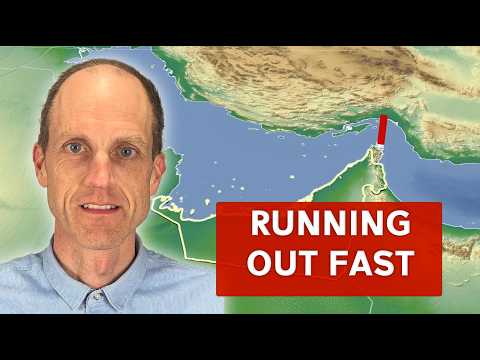
[0:01]Oil prices have risen by around 80%. Yet markets appear relatively calm. But this calm is misleading. Because the effective closure of the straight of Hormuz threatens up to 20 million barrels of oil per day. Now, for now, this shock is been absorbed by spare OPEC capacity, extra pipelines, oil already in transit, and an unprecedented release of inventories. And these factors are helping to mask the true scale of disruption. But this is only temporary. JP Morgan warned that inventories have been rapidly depleted and are approaching a minimum operational level. In the United States, both gasoline and distillate stocks are falling sharply. Whilst the volume of oil at sea is also declining. And as these buffers are exhausted, the supply shortfall could increase from roughly 4 million to 8 million barrels per day. At which point the crisis is likely to intensify significantly. And there's also another problem. We might like to think what oil is like producing widgets. You stop and then restart, but oil isn't like that. Because oil can't get out, oil storage in the Gulf is now close to full capacity. So it means that oil wells in Iraq, Kuwait and UAE need to be turned off. There's nowhere for oil to go. But with the crisis ends, you can't just turn them back on and return to the old flow levels. They are like low pressure reservoirs, which require precise gas injections to maintain flow. And estimates suggest the world could lose 4 to 6 million barrels per day of capacity even after the Straits reopens. But even if the straight were to open pretty soon, how long would it take to clear the minds? Who would want to crew the tankers? Who will ensure the cargo? It's going to take a long time to restore confidence. Supply chains like that can take months to fully restart. It's a bit like watching a very slow motion car crash, slightly reminiscent of COVID, where everything was fine until suddenly it wasn't. Because the trading price of oil doesn't fully reflect what is coming in the next months. Already we see physical shortages of oil in Asia. Where a barrel has traded for $210 per barrel in Singapore and a stunning $286 per barrel in Sri Lanka. And it's not just for all prices are rising, we're seeing a rise in the cost of transport, a rise in the cost of insurance, and difficulties at refineries. Seeing a shortage of oil, so big shortages of things like jet fuel. Now the shock of Hormuz closing is the biggest loss of oil in modern history. Fati Birol, chief executive of the IEA, calls it the greatest energy security crisis in history. Insisting it is more serious than the previous energy shocks in 1973. By the way, in 1973, stocks fell 40%. Today they just keep reaching record levels. And it's such a big shock that there is the assumption that there has to be a solution because the consequences of remaining closed are too bad to contemplate. Yet President Trump recently warned that the straight could remain closed for months in a bid to destroy the Iranian oil industry. But another couple of months takes us into June and July where the reality of shortages will really start to bite. And as oil supply falls and prices rise, the pressure on the global economy will keep increasing. If you look at the future's prices for oil, it does suggest that markets are pricing in a very quick resolution, assuming that everything will get back to normal pretty soon. But the problem is that markets have been pricing in a quick resolution ever since the 1st of March. It's now two months of optimism that haven't yet been realized. But if it is such a crisis, why haven't oil prices risen more? After all, they're still lower than in 2008 or 2022. Well, firstly, an 80% rise in prices is pretty significant. It's greater than 2022. Inventories are helping, the US is exporting more and the oil squeeze has led to a bonanza for Russian oil, with a price of Russian oil climbing as countries like India rebuy previously sanctioned oil. But with a loss of 4 up to 8 million barrels a day in the future, the market can't forever manage on this fundamental disequilibrium. And it's not just that oil prices will rise further, but also there will need to be a rationing of oil use. At the moment, the biggest costs of the crisis has been felt in Asia and Africa. Asia is most reliant on oil from the Gulf and shortages are leading to rationing already with a four-day week coming in some countries. But of course, the impact of the oil crisis doesn't stop at petrol. Oil is intrinsic to food prices. The price of urea fertilizer has doubled, meaning higher food prices in the coming year. And not only will the price of food rise, but also the rise in the price of diesel and jet fuel will increase transport costs. Don't forget that plastic is dependent on the price of oil and other things like helium that we never really knew how widespread oil is to the global economy. And all this increasing costs and increasing prices is causing a jump in inflation, and it's likely to get worse before it gets better. Now, what happens when there's a shortage of oil? Well, in the short term, many uses of petroleum products are very inelastic. Lories and trucks use diesel. But if you're a firm and you want to transport goods to supermarkets, you need to keep buying diesel, whatever the price. And this is one reason why diesel prices have risen faster than petrol. Households may well be able to cut back on some non-essential travel. Rather than going through a road trip around the country, you stay closer to home. But for farmers and food transit firms, there's no viable alternative to diesel in the short term. So prices have to rise very high to reduce demand. And ultimately, we may get to a point where there just isn't enough oil and refineries run dry. And it is already manifesting itself in products like jet fuel and diesel. Even though we haven't yet reached a critical mass, some European airlines have started canceling flights. And this is the kind of thing that will escalate as shortages get more real. Now, back in 2022, the default response of Western governments was to subsidize energy prices to prevent prices going up too much. But the problem with subsidies is that they don't work when there's an actual shortage. Because you have to actually reduce demand. And if you want to keep prices artificially low, you'll have to rush and demand like in the 1970s. Now, one issue that might force a resolution in the Gulf is when the price of gas in America reaches a critical level that leads to widespread political angst. And already gas prices in the US have reached their highest level for quite a few years. But overall, the United States is a bit more insulated from this crisis than other countries. At the moment, they've been exporting more oil and that's helped the dollar become stronger, making US imports cheaper. But the US have warned that they could start to export less oil to keep more oil in the US. And that would cause the crisis to be felt more by other countries. But it is worth pointing out, whatever they do with exports, the US is dependent on some types of oil imports, the heavier crude oil to make things like diesel. So how is this going to affect the economy? Well, despite a fall in oil dependency since the 1970s, oil use does have a strong correlation to GDP. And past oil shocks have strongly correlated with recession. Because remember, it's not just about oil prices. Also, the oil shortages will cause demand destruction. That's lower GDP, lower economic growth. And it means that prices will have to rise really very high to reduce demand. And this is when commodity prices can go hyperbolic as some suggest oil prices of $150, even $200. Now, in the long term, you could say there's a a silver lining or a green silver lining in that it will supercharge a switch away from oil. Norway has already achieved 98% electric car sales. The UK lags behind at just 24%. But when you see soaring petrol prices, understandably, an increase in demand for solar panels and electric cars. But ironically, petroleum is still an input in solar panels, batteries and electric cars, with the cost of transport rising, so it's not all good news. But in the short term, the oil crisis is a real headache for the economy. It gives central banks that unwelcome headache of stagflation. Rising inflation, but falling disposable income and lower growth. And this crisis comes after many recent crisis and a time of weak economic growth and high government debt. The scope for government bailouts is much weaker than in 2022. But as mentioned, you can't bail your way out of an oil shock. On the positive side, it may help a transition to a less oil dependent economy. But in the short term, there'll be a lot of economic pain to get there. And this crisis is linked to issues in government bond markets. Because in recent years, bond yields have risen, meaning the cost of borrowing is going up, just as the oil crisis may lead to higher government borrowing. And this video looks at issues around bond yields. Anyway, thanks for watching, do subscribe and see you soon.
The Oil Crisis Is Already Worse Than It Looks
Economics Help
10m 8s1,631 words~9 min read
Auto-Generated
Watch on YouTube
Share
MORE TRANSCRIPTS