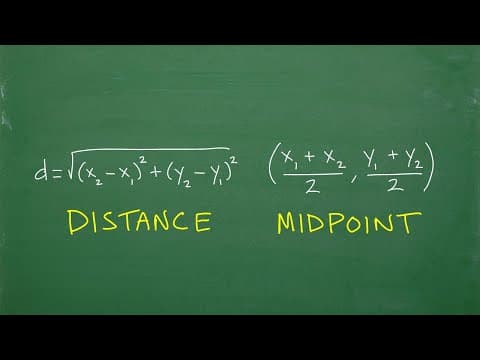
[0:00]Okay, so if you're in any sort of algebra course, you're going to definitely be familiar with these two formulas. And the first formula here is called the distance formula, and this other formula is called the midpoint formula. And at first glance, they look a little intimidating, but actually they're quite easy to use. And I have a question for you, uh, do you know what the distance formula does for us? I mean, it's kind of, you know, self-explanatory, but if you know what the distance formula does for us, put that into the comment section. Likewise, if you understand, uh, the midpoint, uh, formula, what it does for us, put that into the comment section as well. Now, I'm doing these, uh, two formulas together because again, they're often times, uh, taught at the same time you, you know, learn about one, you learn about the other. But uh, students tend to confuse these two formulas, but I'm going to clear up any confusion on how to use these formulas and what these formulas do for us in just one second. But first, let me quickly introduce myself. My name is John, I'm the founder of TC math Academy. I'm also a middle and high school math teacher, I've been teaching math for decades and I'm telling you right now, there's no such thing as a bad math student. Okay, there's people out there that are struggling in math, but it doesn't have to be that way. So, if you want to be successful in math, that requires two things, okay? One, you got to be willing to work really hard at the subject. So if you're not really working out hard and you're failing, well, start working, uh, harder, okay? You'll get better results, the second thing you need is great math instruction, clear and understandable and that's where I can help you out. So if you're at the middle school, high school, or even college level and you need, uh, you need assistance in your math course, check out my math help program. I'm going to leave a, uh, link to it in the description of this video, but it can really, really help you out. Also, if you're preparing for any sort of test with a math section, things like the GED, ASVAB, SAT, maybe a teacher certification exam, I can help you out there. And if you homeschool, I have great middle and high school math courses for homeschoolers that can help you out. And if this video helps you out, don't forget to like and subscribe to my YouTube channel. As that helps me out big time. Okay, so let's get into the distance and midpoint formula, and here they go, uh, this is of course, the distance formula, this is the midpoint formula, but I want to, um, kind of clarify the application or the understanding of this here right now. Okay, so what does this have to, uh, you know, what are we talking about here? Well, we're talking about distance, obviously, that's one thing, that's one formula, and the other formula is the midpoint, okay? So here's a good illustration of what we're talking about. All right, so here we have two points, two ordered pair on the XY plane. Okay, so you could plot, let's say, for example, this point five, eight, and here we have a, uh, another point negative four, one for example. Now, if I wanted to find the distance between these two points, I.e, from this point all the way over to this point, I want to find the actual distance. Well, we have a lovely formula for that, and you might have guessed it, that is in fact the distance formula, okay? So the distance formula tells us the distance between two ordered pairs, two points on the XY plane, um, uh, axis, okay? The XY coordinate or Cartesian plane, there's a lot of different, uh, names for it, but it's really the XY plane. Okay, so that's the distance formula. So what is the midpoint formula tell us? Well, let's just kind of think about the name midpoint, maybe like the halfway point between these two points. Well, that's exactly what the midpoint formula tells us, the, the distance formula is going to give us actual distance, it's going to give us, uh, length, okay? So the units of measure here is like taking a tape measure or ruler going from here to here. So we're going to get some sort of, uh, um, you know, whatever number here is actually telling us the, the actual distance. The midpoint formula entirely different, okay? The midpoint is going to give us the point in between these two points, midway through, okay? So maybe like right here would be the midpoint, and we're talking about is another XY point, okay? Like, what is the location of the midpoint that's between this point and this point? Okay, so maybe it would be like right here. So, you can kind of guess, uh, the values of, you know, what coordinate, you know, maybe it would be like one, oh, I don't know, 1 six or something like that, if you kind of, you know, guess the, the, uh, the point that is between this point and this point. So that's what the midpoint does for us, it's going to give us an XY ordered pair, okay? So, the, uh, distance formula and midpoint formula, that's what it is. So let's go ahead and actually, uh, do this problem with these two coordinates, -4, 1, uh, 5, 8. We'll go ahead and first find the distance between these two points, and then we'll find the midpoint between these two points. And let's go ahead and get into this right now.
[6:42]Okay, so here is our two points, -4, 1, 5, 8. Let's say we want to find the distance between these two points. So here is our lovely formula, and what is it saying? Okay, well, it says here, x 2 - x 1, that's just fancy algebra talk to subtract the, uh, the x coordinates of these respective, uh, ordered pairs of these two points. So what are the x values? Well, this is x, and this is x. Remember, you know, when you're talking about an ordered pair or an XY point, this is a point that we plot. Now, listen to what I'm going to say, I'm saying this is called an ordered, ordered pair, okay? There's a pair of values and there's a specific order, okay? Ie x first, y second, but this is, uh, just basically, um, the way we describe the location of a particular point on an XY plane, okay? So here, they're saying just subtract the Xs. The great thing about the distance formula is order doesn't make a difference. You can go -4 minus 5, that's what I have here, I can go 5 - 4. This is unlike, say, the slope formula, um, determining the slope, which is completely different than this because order does make a difference. Here, you can be kind of loose with your values, okay? As long as you subtract the Xs, that's what this means. So we're going to find the differences of the Xs and square them, okay? And then over here, we're going to find the differences of the Ys and this, uh, part of the problem, so the Ys are what, 1 and 8. So we just subtract one and eight right there, and we're going to square that. So this is the basic setup with the distance formula, okay? You find the differences of the Xs, we're going to square that, differences of the Ys, we're going to square that. We're going to do all this math and then we're going to finally take the square root of this. So let's go ahead and proceed. So -4 - 5 is -9, we're going to square that, and then 1 - 8 is -7, and we're going to square that. So -9 squared is -9 * -9 is a positive 81. -7 squared is -7 * -7, of course, that's a positive 49. So 81 + 49 is 130. Then finally, after you have all this internal stuff done, uh, we're going to go ahead and take the square root of 130, and that's approximately 11.4. Okay, that's our answer. So our distance is approximately 11.4, meaning, if we were going to come up here, we would have the distance between this coordinate and this coordinate would be around 11.4 units. Now, if you, um, have graphing paper and you just, you know, you want to just test this, you know, um, you can actually plot two points like this on your graphing paper then measure this with like a piece of paper or ruler and you're going to see that in fact, the distance formula actually works. Now, the, why the reason why it does work and just as a kind of an extra little aside here, this has to do with the Pythagorean theorem, okay? A squared plus B squared is equal to C squared, if you can kind of see here, if I had a little, um, uh, right triangle, I could use the Pythagorean theorem to get the length of my hypotenuse. This is, uh, how, uh, the, uh, distance formula is, um, kind of created or derived. So, um, in some strange way, maybe not strange way, this is kind of a fancy, uh, way of using the Pythagorean theorem, a squared plus b squared is equal to c squared if you were just curious about that. Okay, so that's the distance formula, and let's go ahead and take a look at the midpoint formula. Okay, so what does midpoint formula says? Well, here, we're going to add our Xs and divide by two. That's going to be our X coordinate. Remember, um, to find the midpoint, our answer is going to be some sort of XY, uh, ordered pair, okay? So to find the X, uh, coordinate of the midpoint, we simply average the Xs. In other words, we're going to, uh, take our X values and divided by two, that's how we get our X coordinate, and to find the Y coordinate, we're simply going to take our, uh, Y coordinates and average those, okay? So we're going to add those up and divided by two, that's the way I kind of like to teach it is it's simply the average between these two points is going to be the midpoint. All right, so let's go ahead and add the Xs, so here, -4 and 5 is our Xs. So we're going to take -4 + 5, divide that by two, and then our Ys is going to be 1 and 8, uh, we'll add those up and divide by two, and what do we get? We get, -4 + 5 is, of course, positive one or 1/2, okay, is our X coordinate, and then 1 + 8 is going to be 9 over 2. 9 halves, and we can just think of this as a decimal, so we have, uh, 1/2 or 0.5 and 4.5, okay? So this is our XY, uh, value or XY ordered pair for the midpoint. Now, let's go back to our graph and let's see if this makes sense. 1/2, 4.5. Now, this graph here that I, uh, wrote was, you know, just a rough estimate, you know, I'm just kind of sketching values here. But, you know, of course, I'm trying to be as accurate as possible, let me erase this. So I said 1/2, so yeah, 1/2 is pretty close to, um, it's pretty, uh, inward right here, close to the Y axis. And if this is 4, so this, this distance is 4, so maybe like this would be 4.5, so this this point here seems like it would make sense, it would be close to the Y axis, not too far off, you know, just looking graphically here, it's definitely, if this is 8, maybe halfway through, maybe 4.5, so that point makes, uh, you know, it makes sense, right? So, 1/2, uh, 4.5 or 9 halves, uh, is a reasonable answer for our midpoint. Of course, this is a sketch, uh, but if you had, uh, graphing paper, you would see how this would exactly be the midpoint between these two, uh, points right there. Okay, so that is it, okay? Distance formula and midpoint formula, absolutely critical, algebra skills, must know stuff. Um, again, don't let formulas in mathematics intimidate you, okay? I know these things seem scary, uh, you know, like, oh my goodness, a lot of students though, you know, at first glance, they'll they'll see a formula and they might have, they'll have, you know, this kind of a look, they'll be like, I don't know, I'm going to run away from this. Listen, the the way to approach any, you know, sophisticated looking, complicated things in mathematics is to take, uh, a deep breath, understand what the variables are telling you, understand the purpose of the formula, and just look at the examples step by step. All right, so hopefully this video helped you out and if that is the case, don't forget to like and subscribe. And if you need additional help on the distance and midpoint formula, um, I got three recommendations for you. One, I have additional videos on my YouTube channel on this topic. Two, you can check out any one of my algebra courses, pre-algebra, algebra 1, algebra 2, and all my other courses, I teach this as well. And three, I do have math notes you can check out, I'll leave descriptions, uh, or, uh, links to those in the description of this video as well. Okay, so with that being said, I definitely wish you all the best in your mathematics adventures. Thank you for your time and have a great day.


