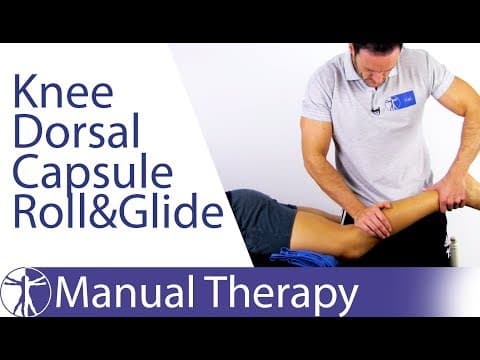
[0:00]In this video, you are going to learn how to do arthrokinematic assessment and treatment for the dorsal capsule of the knee joint.
[0:19]Hi and welcome back to Physiotutors. The aim of roll glide assessment is to gain information on reactivity of the joint and of course articular problems such as capsular limitations. To assess the dorsal capsule in severe limitations from 60 degrees of flexion to hyper extension, have your patient in prone position with his femur fixated on the table and the tibia and patella hanging freely. The other leg should be supported by a stool for example. The condyles of the femur are the convex joint partner and the tibia is concave. So while moving the tibia, we have to roll and glide in the same direction. Now induce a ventral roll with one hand above the patient's ankle and at the gliding component with your other hand on the patient's dorsal tibia into ventral and increasingly proximal direction perpendicular to the tibia.
[1:23]For end range limitations from around zero degrees to hyper extension, there are two options. Have your patient in supine position with a sandbag under the proximal tibia of the leg to be examined. Grab on to the patient's distal tibia above the ankle with one hand from medially. This hand will induce a ventral roll into extension. Place your other hand on the patient's distal femur. This hand will glide the femur dorsally in relation to the tibia as the tibia is blocked by the sandbag. Then perform an equal rolling glide with both hands.
[2:09]The alternative is to have the sandbag under the distal tibia, which will induce the roll component. Then grab on to the proximal tibia from medially and dorsal with one hand and place your other hand on to the distal part of the femur. The hand on the femur will induce the dorsal gliding component of the femur in relation to the tibia, while the hand on the tibia translates the tibia into the opposite direction. An equal roll and glide movement is performed by moving both hands towards the table while the hand on the tibia is pulling the tibia minimally into ventral direction. For both techniques, it's important to grab on to the tibia from medially in order to facilitate external rotation of the tibia on the femur on terminal extension, also called screw home mechanism. For all techniques, assess for movement quality during roll and glide, possible pain provocation, and end feel. For end feel assessment, roll and glide to end range, then assess if further gliding is possible or not. In a hypomobile joint, the glide is reduced relative to the roll component, so no further gliding is possible. If you feel that the end feel or movement quality is abnormal, you can directly move further from assessment to intervention, as the techniques are identical. When used as an intervention, make use of the maitland grades of mobilization to dose your techniques according to your goals. Check the video in the top right corner to learn more about that. Okay, you've reached the end of this video and if you like, you can check out more videos on manual therapy in the playlist to my left. Again, check the info icon in the top right corner for the featured videos and also take a look at the links in the video description down below. At last, subscribe to our channel if you haven't yet and hit the bell icon next to the subscribe button. This will let you know when we release new videos. As always, this was Kai for Physiotutors. I'll see you next time. Bye.