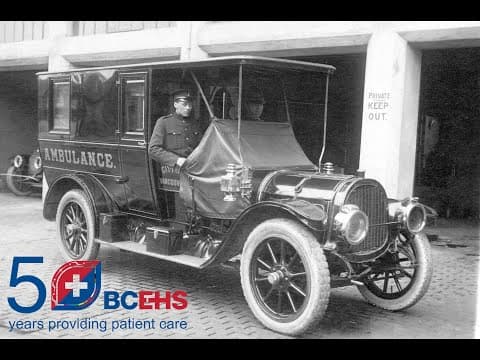
[0:17]As BC Emergency Health Services begins to celebrate our 50th anniversary since the creation of the BC Ambulance Service in 1974. We're going to be taking a look at some of the stories and amazing journeys that have made up our last half century of service to the people of British Columbia.
[0:34]Now, to look really carefully at the history of the ambulance service and to understand how significant an event the creation of the BC Ambulance Service in 1974 really was. It's really necessary for us to go and take a look at what existed before 1974 and how people accessed emergency health care in BC before we had a provincial ambulance service.
[0:56]To really ground us in that story of what things were like before 1974, we're going to go quite a bit farther back. Today we're going to be looking at some of the early 20th century ambulance service that was provided in British Columbia and even some of the services that were provided up into the 1960s and early 1970s.
[1:13]Dating back as early as 1902, the Vancouver Daily Province, the newspaper that most of us now know today as The Province, dedicated nearly their entire front page to a story about a scandal about the mismanagement of Vancouver's only ambulance at the time, a horse drawn vehicle that had been purchased by the Ladies Committee and donated to the city under the express condition that it be used to provide services to anyone in medical need regardless of their ability to pay.
[1:43]The Ladies Committee was critical of the way the ambulance had been used and specifically the barriers to its use and were taking City Council to task,
[1:54]imposing useless and absurd provisions, liable in serious accident cases to result disastrously for patients, and expect hereafter the ambulance will be used in responding to every single call for its service, alike to the poorest victims of accident as to the wealthiest patient in the city.
[2:11]Because the idea of a central ambulance dispatch or or a central ambulance agency hadn't really been conceived of yet, it was unclear who would be responsible for directing the ambulance to be dispatched to respond to whatever medical need it was being called for. The article goes on to describe how someone in need of an ambulance might have to phone four, five, or six different places to find someone with the authority to dispatch the vehicle.
[2:39]Someone experiencing a medical emergency or or otherwise in need of an ambulance might need to phone City Hall, finding no one there, they might have to try phoning the police department, Vancouver General Hospital, maybe the city clerk, or or any number of several other offices to find someone who had the authority to actually send the ambulance out to respond to someone in need. The Ladies Committee was understandably upset about what they perceived as the mismanagement of their donation and planned to take Vancouver City Council to task over the matter.
[3:10]At the same time, Chief of Police Samuel North argued that the obvious solution to the problem would be simply for the city to purchase a new police wagon and to place the ambulance and wagon under the control of the Vancouver Police Department.
[3:24]While that might seem like a strange idea to us today in 2024 to have a police department operating their own ambulance. Police departments of the day were often the agencies that did operate ambulances and that was a practice that continued through much of the 20th century even up until the 1970s in some places. And so, seven years later in 1909, the Vancouver Police Department did in fact get their first auto ambulance. Auto, of course, refers to the fact that this was an automobile motor powered ambulance. It was no longer a horse drawn carriage.
[3:59]This particular vehicle was a Cunningham 740 that cost $4,000 in 1909, equivalent to about 110,000 Canadian dollars in 2024. The vehicle hadn't even been commissioned or deployed yet and was actually being shuttled from the delivery depot where it had been received to another station elsewhere in Vancouver when it was involved in its first traffic accident striking and killing a pedestrian at the corner of Granville and Pender Street.
[4:30]Mr. C.F. Keis, spelled K.E.I.S., was a Texan tourist in Vancouver on route to a hunting trip on Powell River when he was struck. Now, it would be unfair to perhaps leave anyone with the impression that the driver of the ambulance at the time, Mr. Charles Cocking, was at fault for the unfortunate death of Mr. Keis. The news reports of the day do indicate that Police Constable Linton, who was the traffic constable on duty at the corner of Granville and Pender Street directing traffic at the time of the accident, did make his best efforts to stop traffic to prevent the accident, but the two street cars and several automobiles all ignored his directions to stop.
[5:09]Now, with, of course, the new ambulance coming under the authority of the police department and beginning service in October of 1909, plans had to be made as to how to both dispatch the ambulance and how to charge for or not charge for its services. To that end, Mr. W.F. Salisbury and Dr. Whitelaw, or possibly Whitlaw, representing Vancouver General Hospital, engaged with the police department to determine that the ambulance should be both under the control of the police and that service would be provided for free in emergency cases.
[5:43]However, patients requiring medical transport, and in those days that could mean non-trauma or non-emergency cases, would both be sent the old horse drawn ambulance and would also still be expected to pay a fee. While the fee itself isn't actually mentioned in any of the records that I've been able to find, there are records that there was a considerable discussion arising as to what that charge should be and how that charge should be levied with Dr. Whitelaw on behalf of the hospital noting that about two-thirds of calls requiring the ambulance represented pay cases and that the patients or their friends were able to bear the expense.
[6:21]In order to call for an ambulance in 1909, after the procurement of the auto ambulance, people would have to contact the police department or if they were unable to phone the police department themselves, would have to try and find a police officer on the street. That police officer would then be able to use one of the network of police call boxes stationed strategically throughout the city.
[6:42]Now, for those who might not be familiar with the idea of police call boxes, these were essentially a network of private phones controlled with a key or accessed with a key stationed at various places that would allow a police officer in 1909 to use their key to access the phone, place a call back to police headquarters and then arrange for the ambulance to be dispatched on an emergency basis. The main reason for talking about this now is to really drive home how far we've come. Of course, in the 65 years between 1909 and 1974, a number of things did improve.
[7:23]Quite a few private ambulance services came into being around the province most notably in Vancouver with Metropolitan Ambulance and Exclusive Ambulance and also in Victoria with Garden City Ambulance. Around the province, many fire departments began operating ambulance services themselves often in conjunction with the police departments, but those services were scattered, they were disorganized, they were disjointed. The phone number that someone in need or having an emergency would have to call might change or vary from place to place depending on which municipality, city, or town you were in.
[7:54]Areas outside of municipalities might simply not have any ambulance service at all. If they did have service, those services might not be affordable because, of course, in some places these were fee for service models. In other places they were paid for by the municipality. In yet other places they were covered or provided for by charitable entities.
[8:15]That status quo, that patchwork system continued really for for most of the 20th century. Of course, during that time, as with many things when we're looking in history, a lot of things changed and a lot of things stayed the same. There are 1925 reports of motorists refusing to pull over for police, fire or ambulance vehicles and also for failing to yield to the sound of emergency sirens. In 1941 in Victoria, a sailor at CFB Esquimalt enjoyed a few too many alcoholic beverages and stole the base ambulance.
[8:49]He actually managed to get through the gate of the military base with the gate guards obligingly opening it for him as they saw an ambulance approaching before his escape or theft was discovered. Reports at the time indicate that he actually did make it not only downtown but through several blockades erected by the city police and the naval patrol before making it all the way over to Oak Bay on the other side of town.
[9:12]Now, the Oak Bay Police Department, having presumably learned from their colleagues in Victoria that blockades were not effective, engaged in a pursuit with their sirens on when the ambulance didn't pull over. Constable Dan Doswell of the Oak Bay Police Department drew alongside the ambulance and quote, beckoned him to pull over showing his revolver, unquote. Apparently this was enough to prompt the ambulance to stop and the very drunk driver to get out and tell the police officer that he was on his way to the Jubilee Hospital, but I guess I've got lost. The sailor was of course locked up in the city jail overnight and the ambulance was returned undamaged and in one piece to the Navy the next morning.
[9:57]By 1946, ambulance service in Vancouver was again in the news with City Council expressing a desire to have control over the location of ambulance stations in Vancouver. Of course, by then ambulance service was being run in part by a couple of private companies, Exclusive Ambulance being the most notable. City Council wasn't able to direct where private companies could do business or where ambulance stations could be located. There is mention at the time of a committee being struck to look at this issue and this could be interpreted as one of the first suggestions, a formal recognition at a government level, that ambulance service was inadequate in parts of BC specifically in Metro BC and that there was a significant room for improvement.
[10:43]By 1951, we again find news reports of motorists failing to yield for emergency vehicles. This time in Nanaimo, where City Council debated a fine of $25 and up to 21 days of imprisonment for drivers who failed to pull over to police, fire or ambulance vehicles when their sirens or emergency equipment was activated. Needless to say there is no suggestion that this initiative actually went anywhere. Perhaps at the opposite end of the same issue was a 1957 incident or several incidents in Vancouver during which, quote, ambulance men, unquote, as they were referred to in the day, operated their sirens needlessly forcing the City of Vancouver to become the first city in British Columbia to actually have their vehicle for higher board pass a by-law to regulate ambulance operation.
[11:36]It's noted that the board deleted a section from the by-law which would have forced ambulance firms to phone the police to ask permission to use their siren before going out on each call. The police superintendent at the time, Ralph Booth, did note that the complaints about sirens being used needlessly had only really been levied against one company operating ambulances in the city at that time, though sadly for us he did not identify that company at least publicly to the media. The use of sirens by emergency services remained somewhat contentious in the media for several decades after all this. By 1958, Civil Defense forces were arguing that sirens should only be used for air raids and that emergency services should be finding other ways to alert the motoring public of emergency vehicles passing through. By 1960, there were further complaints of sirens being used without due cause or without good reason and by 1963, there was a provincial government investigation about the possibility of replacing ambulance sirens with gongs or bells because those would be better suited to differentiate ambulances from other emergency vehicles on the road. Again, none of these initiatives really went anywhere.
[12:48]By the late 1960s or early 1970s, it was obvious to even the most casual observer that the patchwork way that ambulances were regulated and controlled and providing service to British Colombians was at best untenable and at worst dysfunctional.
[13:04]Following 20 years of governance by the Socred party from 1952 to 1972, the NDP victory in the provincial elections in August of 1972 really set the stage for the government to look more closely at health care and specifically emergency health care and ambulance services in BC. One of the first tasks that new government undertook in 1972 and into 1973 was to look at what ambulance services in British Columbia were at the time and more importantly what they could become.


