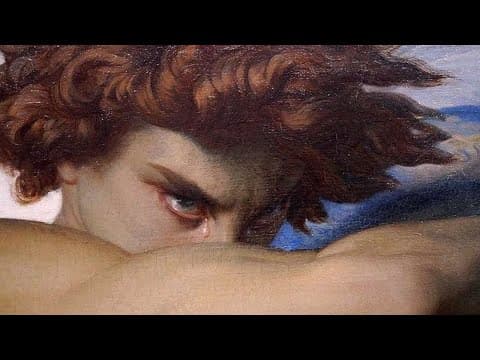
[0:00]God and the devil are the two fundamental patterns of human existence: the path of light, good, truth, beauty, life, heaven, and salvation, and the path of darkness, evil, deception, betrayal, rebellion, negation of life, hell, and damnation. The reality of evil is a source of deep and uncanny fascination. In fact, it seems that while many of us choose good over evil, some of us cannot help but to fall into the temptation of doing evil. Nothing is easier than to denounce the evil doer, nothing more difficult than understanding him. We must be aware of the evil within, so as not to fall prey to its effects. When we merely identify ourselves with the good and deny our capacity for evil, we inevitably projected onto other people. It takes control of us as an autonomous power, often clearly visible to others if not to us. The devil has a character of an autonomous personality, which is greater than man's consciousness and greater than his will. When you point a finger to someone, three fingers point back to you. The only reality is that everyone is capable of evil, and the proper moral position is knowing evil, choosing not to do evil. Belief in demons occur historically throughout the world. They are typically seen as malevolent supernatural entities. The demons of the ancient Greeks, however, are divided into good and evil categories: Agathodaimon and Kakodaimon. The former is a guardian angel or tutulary figure, which mediates between man and gods, while the letter is the adversarial demon. The demon is a higher spirit, constantly aware of its intimate connection with other human beings, with nature, and with the entire cosmos. When our inner demon is in a state of good order, we experience Eudaimonia, a state of good spirit and fulfillment. However, the Kakodaimon brings trouble and distracts us from our path towards wholeness. The devil resembles the fauns and satyrs of Greek and Roman mythology, the latter of whom were companions of Dionysus, the Greek god of wine, intoxication and festivity. On the other hand, the Greek god Pan is associated with the wilderness, goats, shepherds, fertility and music. There's a general theme of worldly pleasures in these mythical beings. The word panic derives from Pan, who was the source of mysterious sounds that cause contagious fear in herds and panic attacks in people who frequented lonely places. While in fear, we know what threatens us, and our perceptions become sharper to overcome the danger. In anxiety, we are threatened without knowing what steps to take to meet the dangers, and instead of becoming sharper, our perceptions generally become blurred or vague. Pandemonium, literally all demons, which refers to wild uprool, confusion and chaos, was first coined by English poet John Milton, to describe the capital city of hell in his epic poem Paradise Lost. These words have remained in our language and still best define the destructive confusion that the devil and his minions can cause in our world and in ourselves. In the Bible, sheep are considered loyal followers of the Son of God, metaphorically a shepherd. Goats, on the other hand, are disobedient and difficult. Goats were used in rituals of atonement as the bearer of the sins of the nation, and were let free to supposedly carry the evil into the wilderness. This is where the term scapegoating comes from. A psychological process in which others are singled out and take unwarranted blame for something. People use others as a scapegoat to hide their own greatest defects. This projection often happens unconsciously because of repressed shadow traits, envy, anger, guilt, lust, etc. Swiss psychiatrist and psychoanalyst Carl Jung makes a profound statement. "This is the deeper meaning of the fact that Christ as the redeemer was crucified between two thieves. These thieves in their way were also redeemers of mankind, they were the scapegoats." In shadow projection, one is tied to others in hatred. The lower classes, racial and national minorities, and other faiths, are likely to become targets of repressed psychic contents. The shadow is the unknown part of ourselves, which becomes the dark side of our personality when it is ignored. None of us stands outside humanity's black collective shadow.
[4:50]It is a truism of life that when negative aspects of ourselves are not recognized as belonging to us on the inside, they appear to act against us on the outside. To be accused of something you did not do is painful, and this lie creates a wound that can fester for years. When we do something unexpected, we say, I don't know what the devil got into me. The devil is a useful scapegoat. By contrast, in savior projection, one is tied to the other person not in hatred, but in blind and uncritical adoration. Such a leader frequently develops a God complex. Leaders can turn into God-like figures because of their promises to save the nation from poverty, famine, and misery. They are the symbolic carriers of the unconscious of millions of people. The devil goes by many names: Satan, Lucifer, the great beast, Beelzebub, the Prince of Darkness. He is the adversary, the accuser, the tempter, the deceiver, and the one who divides from God. The devil is incredibly wicked and evil, but also intelligent and witty. He is the father of all tricksters, that is what makes him so dangerous. The English word devil derives from the Greek Diabolos, the one who divides. Diabolic is the term in contemporary English. The Greek verb Dia-bollein literally means to tear apart. The antonym to the diabolic is the symbolic, which comes from Sym-bollein, to put together or unite. American existential psychologist Rollo May writes, "The symbolic is that which draws together, ties, integrates the individual in himself and with his group; the diabolic, in contrast, is that which disintegrates and tears apart." When a community forms, it can be a source of brotherly love, to love thy neighbor as thyself. The devil, on the other hand, scatters and produces discord. The scattering is a sign of the darker power, whether it be the division of communities, families or culture, hence, divide and conquer, or united we stand, divided we fall. Rollo May identifies three characteristics of the Diabolic, which are as relevant today, if not more, than they were in the past. Love of nudity, violence, division. Whereas before nudity and the aspects of the body were private and reserved for the sacred act of sexual union within marriage, now clothing is intended to call attention to the private areas of the body. The overall sexualization of culture also ties in with this aspect, exacerbated by the ease of access technology provides to unfulfilled desires of lust. In terms of violence, the 20th century marked some of the most devastating events in human history, and who knows what awaits us in the future. Finally, the devil loves to divide. These divisions occur in almost every facet of our lives: race, sex, religion, politics, and economics. The demonic is an inversion of order. The growth of a peculiarly Western view of exploitation, materialism, and man's ego as being at the center of life is a byproduct of the diabolic. Thus, man has become alienated from himself. Perhaps most relevant to our times, the devil appears as virtual reality, promising a utopia outside of physical existence, or artificial intelligence that has knowledge far superior than humanity, engineered to become humanity's savior, and yet without consciousness has no empathy. This division not only occurs externally, but internally too, as split personality. When Jesus spoke to the Garasean demoniac and asked him, what is your name, he replied, My name is Legion, for we are many. A legion meant three to six thousand soldiers. The possessed man, having been overwhelmed by unconscious forces, no longer has an ego, which functions as an anchor to reality, resulting in schizophrenia. Making a deal with the devil is a universal theme, which appears many times in works of popular culture. Sometimes a deal is done at a crossroads, which symbolically represents liminality, a place neither here nor there, where two realms touch, the physical and the spiritual. The deal frequently begins with a mortal desiring some worldly good, such as youth, love, knowledge, wealth, fame, or power, but in exchange, he must sell his soul to the devil. This is exemplified in the German legend of Faust, based on the elusive figure of Johann Georg Faust, a German alchemist, astrologer, and magician. After the devil serves him with his magic powers for a number of set years, the term of the contract ends, and the devil carries him off to hell. In early tales, Dr. Faust is irrevocably damned because he prefers human knowledge and material gain over divine or spiritual knowledge. This is known as the Faustian bargain. In Goethe's Faust, one of the greatest works of German literature, Faust is a scholar who becomes depressed because of the uselessness of human knowledge, and turns to magic for discovering the ultimate truth. However, his attempts fail. Frustrated, he no longer wants to live. In his desperate moment, a dog appears, which transforms to the devil's servant, Mephistopheles. He tells Faust that he will become his servant on Earth and show him the pleasures of life. At first, Faust refuses. Then Mephistopheles makes a wager: if he should ever experience a moment of ultimate bliss on Earth, so that he would beg for that moment to continue, he would instantly die and serve the devil in hell. Faust, who believes he cannot lose his bet because he will never be satisfied and thus never experience the great moment, accepts the deal, and a blood pact is made. Ultimately, Faust experiences a moment of bliss and dies. However, as Mephistopheles is about to claim his soul, Faust is saved by God's grace. Though he was never satisfied and dies before he could realize his vision of a kingdom of heaven on Earth, Faust learns to find happiness in progress, not just accomplishment. He never gave into lust or idleness, but was focused on justice, prosperity, love, and the improvement of the lives of his people. This constant striving ultimately saves his soul. Interestingly, this wouldn't have been possible without the devil's attempts to have Faust live a wicked and sinful life. The devil's persistence to tempt Faust and Faust's unwillingness to give in leads to his spiritual enlightenment and salvation. As the Austrian poet Rilke wrote in one of his letters after withdrawing from psychotherapy, "If my devils are to leave me, I am afraid my angels will take flight as well." We cannot have one without the other. We have both an angel representing conscience, and a devil representing temptation. Our inner devils resemble our shadow, which retains contact with the lost depths of the soul, with life and vitality, and provides hints for self-realization. As the saying goes, a man that casts no shadow is the devil himself. In the 1814 novella, Peter Schlemihl, the protagonist sells his shadow to the devil for a magical bottomless purse full of gold. However, he finds out that without his shadow, he's shunned by others. Italian violinist Giuseppe Tartini had a dream in which the devil appeared to him and asked to be his servant and teacher. Tartini gave him his violin to see if he could play, and the music was so wonderful that he had never conceived it in his boldest flights of fantasy. He felt enraptured, transported, enchanted, his breath failed him, and he awoke. Immediately, he grabs his violin in order to retain, in part at least, the impression of his dream. It was all in vain. Despite having said that the music he composed is indeed the best that he ever wrote, which he named The Devil's Trill, it was so inferior to what he had heard, that if he could have subsisted on other means, he would have broken his violin and abandoned music forever. The devil is an archetype, a collectively inherited pattern of behavior, and like all archetypes, fascinates us because of its numinosity. Identifying ourselves with an archetype can lead to our psychic destruction, causing ego inflation, in which our sense of identity is excessively amplified, creating delusion and megalomania and an overall self-destructive path. Archetypes are primitive and serve a realm close to the instinct. They are not necessarily concerned with ethical human values. It is as much the ego's duty to bring a sense of moral responsibility to the archetypal images of the unconscious as it is for us to tend to the welfare of our fellow humans in the outside world. The key is not identification, but integration. Jung writes, "The images of the unconscious place a great responsibility upon a man. Failure to understand them, or a shirking of ethical responsibility, deprives him of his wholeness and imposes a painful fragmentariness on his life." In Christianity, the voice of temptation appears at the very beginning of time, represented as the serpent in the Garden of Eden, which was later equated with the devil. The serpent's role was to tempt Adam and Eve, the first humans, to eat of the fruit of the tree that God prohibited, the tree of the knowledge of good and evil, because it would open their eyes to reality, and they would become like gods. The most dangerous lies contain half truths. The serpent promises good things and purposely avoid speaking about the evil that will befall them. Thus, Eve plucks the fruit, eats it, and gives some to Adam. They immediately become ashamed of their nakedness, and experience guilt and anxiety. The sin of pride, to become like God, appears as the first act of disobedience, leading to the original sin of mankind and the fall from paradise. In a similar myth, the Greek god Prometheus steals the fire from heaven for the benefit of mankind and is punished by the gods. Myths are not mere stories or superstition, but perennial patterns that express the human condition. Psychologically, we can view these two myths as the development of consciousness in the human being, which is always followed by feelings of transgression, guilt, and punishment. We are born integrated, in a state of original wholeness, paradise. And as we grow up, become self-aware and acquire the ego, we experience disintegration or the fall from paradise. We go from living under the comforting and nurturing circle of the mother, to having to leave the nest of comfort. If we do not throw ourselves into the fire of life, we cannot become reintegrated and regain our relationship with our natural state of being. Since wholeness only has meaning when we reunite our fragmented self, this event is also described as Felix culpa, fortunate fall or happy fault. Without a fall, we cannot experience redemption. Disintegration represents the necessary condition for all self-realization. Before delving deeper into the psychology of the devil, we must first explore the different meanings behind the names Lucifer and Satan. Lucifer, the lightbringer, is the Latin name for the morning appearances of planet Venus, the morning star, visible before sunrise. The planet also appears as the evening star, visible after sunset, depending on the phase of its orbit around the sun. In Roman folklore, the morning star was personified as a male figure bearing a torch. Stars were then regarded as living celestial beings. In myth, the morning star is interpreted as a heavenly being striving for the highest seat of heaven, only to be cast down to the underworld. The morning star, one of the brightest objects in the sky, is filled with pride. After its brief declaration of victory, it is humbled and vanishes from sight when the all-powerful sun rises and floods everything in its light. The first reference to the morning star as an individual occurs in the Book of Isaiah. "How have you fallen from heaven, morning star, son of the dawn! You have been cast down to the earth, you who once laid low the nations! You said in your heart, "I will ascend to the heavens; I will raise my throne above the stars of God"... But you are brought down to the realm of the dead, to the depths of the pit." Though this passage actually refers to the condemnation of an evil King of Babylon, it has been interpreted as an allegory of Satan's fall from heaven. Considering pride as the major sin, to love oneself more than others and God, Lucifer became synonymous with the devil. Pride was not only what caused the fall of man from paradise, but also what caused the devil and his angels to rebel against God and be thrown out of heaven. This is described in the apocalyptic Book of Revelation, where a past war occurs in heaven between angels led by the Archangel Michael, against the rebel angels, led by the dragon or the devil. "Then war broke out in heaven. Michael and his angels fought against the dragon, and the dragon and his angels fought back. But he was not strong enough, and they lost their place in heaven. The great dragon was hurled down - that ancient serpent called the devil, or Satan, who leads the whole world astray. He was hurled to the earth, and his angels with him." It wasn't just a few angels who were on the side of the devil, but a third of them who refused to unite their free will with the will of God, so they descended into hell as fallen angels. The sorrows of the Prince of Darkness are as immeasurable as eternity itself. Shut out of heaven, to hear all through the unending eons the far off voices of angels, whom once he knew and loved, and to be a wanderer among deserts of darkness. Confusion arises when Jesus is also described as the morning star in the Book of Revelation. However, he is described as the bright morning star. In other words, the devil's light is a poor imitation of the real light of the world, and while both were called morning star, only one of them represents authentic light. It is no coincidence that the devil disguises himself as an angel of light, for he is a deceiver. The devil is also given the name Satan, which means adversary or accuser. He is the one who sets a stone in your path where you least wanted, and blames you for your failure. In the Book of Job, God's most faithful servant, Job, is a righteous man who honors God, and has been blessed with health, family, and wealth. In heaven, God asks Satan about his opinion of Job's piety. Satan says that his servant is only faithful to him because he has been blessed with prosperity, but if he would have everything valuable taken away from him, he would surely suffer and curse God. Thus, Satan is given permission by God to test Job's faith. "Satan is the destructive doubt within God's personality; yet it has a mysterious existential necessity for God and man and their relation to each other." Messengers come to tell Job that his animals, servants and children have been killed. Devastated, Job falls down to the ground and cries, Naked I came from my mother's womb, and naked shall I return there. The Lord gave, and the Lord has taken away. Blessed be the name of the Lord. Job remained strong in his faith. This time, Satan afflicts Job's whole body with boils. As he lies down in excruciating pain, his wife tells him to curse God and die. But Job remains strong in his faith. Three of his friends come to him, weep, and sit down with him for seven days, and none spoke a word, for Job's grief was very great. After this, Job opens his mouth and curses the day he was born, and longs for the death that does not come. His friends cannot comprehend how a just God would punish an innocent and pious man. They think that his suffering must be well deserved and accuse him of committing sin. Knowing his conscience was clear, Job grew weary of their accusations and calls them miserable comforters. Job moves from his past attitude to berating God for his disproportionate and unjustified wrath. The wicked have power over the meek, and God does nothing to punish them. God answers Job's cry and appears in a whirlwind. He describes the complexity of the world he has created. Carrying out justice in a world full of evil is complicated and not black or white like Job and the friends seem to think. Just as there is order in the world, there's also chaos, as seen in the two creatures of Behemoth and Leviathan, which God points to. We live in a world that is not designed to prevent suffering. Job trusts God's wisdom despite his suffering. Finally, God honors Job's struggle and honesty, and his family and fortune is restored. He becomes the archetypal faithful servant of God. The Book of Job, in comparison with the story of paradise, represents a significant advance in God's self-consciousness. Adam and Eve are expelled from God's presence, as if their knowledge of good and evil were an offense against the creator. In Job, one begins to realize that this knowledge is fruitful when free will is combined with the infinite wisdom of God's divine will. It is also interesting that in Job, Satan acts in agreement with God, not behind his back, like the serpent in Paradise. Out of this astonishing self-reflection, inducing God by Job's stubborn righteousness, God develops empathy and love, and out of it a new relationship between God and humankind is born. God is pushed into a process of transformation that leads to his incarnation as Jesus Christ. The crucifixion and death of Christ is the ultimate tragic story, where the worst of all punishments is inflicted upon the one who least deserved it. The answer to Job is given in the supreme moment of Christ's despairing cry from the cross, My God, my God, why hast thou forsaken me? God experiences what it means to be a mortal man, and what he made his faithful servant Job suffer. When Jesus died on the cross, the devil celebrated his victory, but in reality, it was the moment of his defeat, for he did not foresee the resurrection of Christ three days later. The period between the crucifixion and the resurrection of Christ is known as the Harrowing of Hell, where Christ descended into the underworld and brought salvation to the souls held captive there. Dante's Divine Comedy, which portrays a mid-life crisis, in which we must descend to hell, is time to parallel Jesus's harrowing expedition. Jung writes, "Therefore, after his death Christ had to journey to Hell, otherwise the ascent to Heaven would have become impossible for him. Christ first had to become his Antichrist, his underworldly brother." Everyone's journey on the path to self-knowledge and spiritual awakening starts by descending into hell. The formula of a journey to the dark domain of death in search of wisdom is universal. Just as an open wound that is left unattended slowly infects the whole body, so too is sin like an open wound in the spirit, through which the demonic can get in and influence your mind. When someone tells God to get out of his or her life, it allows for the perfect opportunity to invite the devil, who will try to control the person and present himself as one's ally. Satanism is evil disguised as good. The demonic is hidden in secret. God tells us to be careful of going down the path of destruction and stands in front of us, blocking the way. It seems that he is not on our side because we are not free. We cannot do what we want to do. The devil, on the other hand, appears to be on our side and whispers to our ear, Just do what makes you happy, life is too short. Times have changed, we live in a new world with new rules. Everyone else is doing it, why shouldn't you? You obey no one and you are the god of yourself. This is how the devil talks, and when we experience ego inflation, he smiles, because it is only a matter of time till we join his kingdom of darkness. Pride comes before a fall. Satan thinks he is equal to God. Reality revolves around him, and it is his visions that matter above all, leading him to rebel against anyone who disagrees. Pride is the origin of all evil. Before we sin, God seems to be the accuser and the devil our defender. However, after we sin, the roles are reversed. God becomes the defender, and the devil the accuser. God is not a tyrant who says, Do this or you'll be punished, but rather, Do this because it will do you good. The diabolic can be invited indirectly as a result of a person's actions, actions that lead to an increased susceptibility to demonic influence. This is especially terrifying when one is unconscious of it. More rarely, people engage in demonic subjection, voluntarily submitting to the devil, as is typical of cults or deals with the devil. Every person of sin is accepted and taken in, leading to contempt of others and the world. While there are cases of extraordinary activities of the demonic, which can happen in very direct and frightening ways, such as demonic infestation, the presence of evil in a location, animal, or object, demonic vexation, physical attacks by a demon, and demonic possession, when the demon takes complete control of a person's body, we'll be focusing on the psychological activities of the demonic. The line between demonic behavior and mental health issues is blurry, and one has nothing to lose by visiting both a psychologist and priest, for they are complementary to healing our soul and strengthening our spirit. Temptation is the ordinary activity of the devil. It is a real thing for us each and every day. The gate that leads to destruction is broad, and many enter through it, but the gateway to peace is narrow, and none may enter save through affliction of the soul. The devil looks for cracks in one's spiritual armor to try to enter in. The strength of which depends on what Aristotle called the golden mean, the point between a deficiency and an excess of a trait, such as confidence between self-deprecation and vanity. Temptation begins with deception, buying into the lies of the devil, who promises good only to deliver evil. The goal of this is to create division or inner conflict in ourselves, paralyzing our capacity to choose, and causing us to spiral downward. In despair, we look for a substitute in life, and numb ourselves with pleasure or diversion, which can lead to addiction. Hell is that state of mind, which has abandoned itself so completely to a given sin, that it cannot act independently of that sin. By way of illustration, note the difference between the person who drinks, who even chooses to get drunk occasionally, and the alcoholic who has lost the power to choose, who cannot decide not to drink, and who cannot decide to do anything but drink. What starts out as something small, that one thought one had control of, becomes a problem that takes complete control of one's life. When one is trapped in this state, it leads to obsessive behavior, irrational thoughts, rumination, and self-blame. One falls into the vicious cycle of vice. What was believed to be the source of one's freedom, becomes one's prison. The devil tells us that the party's over, and now we must suffer the consequences of our actions, and he fills us with despair. Frequently, this creates oppression, a negative influence on loved ones and friends, leading to further alienation and discouragement. When one loses everything that was valuable in one's life, it leads to a loss of any sense of meaning, direction or purpose in life. This is unbearable, and people lose all desire to live. I don't exist, the thought you are having is just you. So speaks the devil. Sometimes all we need is a helping hand that pulls us out of the quicksand. The devil tempts us in what he thinks are areas of weakness in our lives, and while he cannot read our thoughts, like an all-powerful God, he is an excellent observer. Therefore, if you're going to outwit the devil, it's terribly important that you don't give him any advance notice. In fairy tales, it is the fool that often outwits the devil, usually unintentionally, because he possesses a purity of heart that cannot be corrupted. When the devil identifies our weaknesses, we can also use this to our advantage, for we will know what to focus on. For Jung, one way the devil can be represented is as a neurosis. He writes, "The Devil describes the grotesque and sinister side of the unconscious; for we have never really come to grips with it and consequently it has remained in its original savage state. Probably no one today would still be rash enough to assert that the European is a lamblike creature and not possessed by a devil." "The frightful records of our age are plain for all to see, and they surpass in hideousness everything that any previous age, with its feeble instruments, could have hoped to accomplish." The devil is the diabolical aspect of every psychic function that has broken loose from the hierarchy of the total psyche, and now enjoys independence and absolute power. As such, our inner devils can be equated with the autonomous shadow. This rejection of the shadow occurs in childhood, where our animal instincts are usually punished by social institutions and conventional standards of behavior, the super ego. As we grow up, we suppress much of what we do or think about, since it is deemed unacceptable. This leads to repression, our unacceptable traits returned to the unconscious layer of personality where it remains as the shadow. When it occasionally breaks through the barrier of repression, the shadow manifests itself in pathological ways. By denying our dark side, we neglect half of our existence as human beings. In mythology, the shadow appears personified in a figure of the same sex, as our dark brother, who accompanies and clings to his light counterpart. Cain and Abel, Seth and Osiris, Mephisto and Faust, and Mr. Hyde and Dr. Jekyll. Union analyst Erich Neumann writes, "By accepting evil, modern man accepts the world and himself in the dangerous double nature which belongs to them both. This self-affirmation is to be understood in the deepest sense as an affirmation of our human totality, which embraces the unconscious as well as the conscious mind and whose center is not the ego (which is only the center of consciousness), nor yet the so-called super-ego, but the Self." In tarot, the devil is one of the 22 major arcana cards, and has a different symbolism compared to the Christian view of the devil's pure evil. The imagery is derived in part from Eliphas Levi's famous illustration of Baphomet, supposedly worshipped by the Knights Templar. It is a hermaphroditic figure, who also has goat horns, bat wings, and the talons of a predatory bird. Two fingers on the right point up, and two on the left point down, symbolizing the alchemical maxim, as above, so below. Its arms bear the Latin words, Solve and Coagula, to separate and to reunite. Jung writes, "Such an attempt as the union of opposites appears to the Christian mentality as something devilish, something evil which is not allowed, something belonging to black magic." In Union psychology, the role that the devil plays points to the one-sided Western image of God. In the West, the paradoxical behavior and moral ambivalence of the gods of classical antiquity were not tolerated. In classical Judaism, Yahweh possesses both light and darkness. Good and evil are not separated from one another, but are interrelated aspects of his numinosity. "I form the light, and create darkness: I make peace, and create evil: I the Lord do all these things." In later times, the morally ambiguous Yahweh became a wholly good God, with no particle of evil in his nature. Christianity amputated God's left hand, relegating Satan to the nether regions. Thus, living a holy beneficent God to reign supreme in heaven. Everything changes with Christ's incarnation. God ceases to be ambiguous, and now becomes manifest in the form of man, who is conscious and therefore has to discriminate between good and evil. Christ wanted to change Yahweh into a moral God of goodness, but in so doing, he tore apart the opposites that were united in him. Thus, the first thing Christ did was to sever himself from his shadow and call it devil. The devil became psychologically inevitable, in that he is the personification of Christ's split-off dark side, as a necessary compensation to the light side of God, embodied in Christ. This is the Deus absconditus, the hidden God that lies in the darkness of our Western unconscious. The intermediary of Christ and the Antichrist, as motivating forces, is the Holy Spirit, a process whose psychological equivalent is the individuation of mankind, the journey towards becoming the self, which constitutes our true nature and the wholeness of our personality.
[38:40]The dark side is the missing fourth element of the Trinity: God the Father, God the Son, and God the Holy Spirit. The Trinitarian symbolism lacks the feminine, the material, and hence the dark substance of the flesh and the devil. Jung believed that the Trinity should be supplanted by a quaternity, a common symbol for the self. In Revelation, the devil is locked into a hole without a bottom for a thousand years. After this, he must be free for a while. "When the thousand years are finished, Satan will be free to leave his prison. He will go out and fool the nations who are over all the world." We can find a parallel in Norse mythology, where the trickster god Loki eventually punished and bound by the gods. A serpent hangs above Loki, and drips venom onto him, which makes him rise in agony, making the whole world shake, and bringing about the earthquakes that preceded Ragnarök, the end of the world and the destruction of the gods. But why must the figure of the devil be freed? Jung writes, "The coming of the Antichrist is not just a prophetic prediction - it is an invariable psychological law whose existence... brought him [John, author of the Book of Revelation] a sure knowledge of the impending enantiodromia." If there's any one-sidedness to a pair, a conversion or shift over to the other is likely. This is the fundamental psychological law of the enantiodromia, a running towards the opposite, which Jung discovered from Heraclitus. Life itself is a contest of opposites, birth and death, health and sickness, good and evil. So too is our conscious attitude balanced by its unconscious opposite, in an attempt to restore psychic wholeness. When the conscious mind has severed its unity with the unconscious, an enantiodromia will take place. Polarity and opposition are universal laws, and no growth and development of human personality is possible without consideration of them. As William Blake writes, "Without contraries is no progression. Attraction and repulsion, reason and energy, love and hate, are necessary to human experience. From these contraries spring what the religious call Good and Evil." One can master this polarity only by freeing oneself from them, by contemplating both, and so reaching a middle position, to be at the border between yin and yang. Only there is one no longer at the mercy of the opposites, and for this one must be aware of the duality of one's nature. Whatever leads to wholeness is good. Whatever leads to splitting is evil. Integration is good, disintegration is evil. Sometimes the holiest of people commit the most heinous of acts because they split themselves from necessary evil. The persecution of unbelievers and heretics, the burning on the stake, tortures, crusades, are all partly the result of the one-sided conscious attitude of purity and goodness, which causes shadow projection. Jung writes of the compensatory role of the psyche in John, the author of Revelation, who strove to lead a pure, holy, and saintly life. The "revelation" was experienced by an early Christian who, as a leading light of the community, presumably had to live an exemplary life and demonstrate to his flock the Christian virtues of true faith, humility, patience, devotion, selfless love, and denial of all worldly desires. In the long run this can become too much, even for the most religious... I have seen many compensating dreams of believing Christians... but I have seen nothing that remotely resembles the brutal impact with which the opposites collide in John's visions, except in the case of severe psychosis. However, John gives us no grounds for such a diagnosis... Like Job, he saw the fierce and terrible side of Yahweh. For this reason, he felt his gospel of love to be one-sided, and he supplemented it with his gospel of fear... God has a terrible double aspect: a sea of grace is met by a seething lake of fire... That is the "eternal", as distinct from the temporal, gospel: one can love God, but one must fear him." We must be aware of thinking of good and evil as absolute opposites. They are halves of a paradoxical whole. When we realize this, we can turn inner conflict into inner peace.
[43:16]We experience reality as it is, and allow ourselves to be united with our whole self. However, the complete realization of our potential is an unattainable ideal, and is rarely if ever reached by anyone, except by a Christ or a Buddha, who are embodiments of the self. Then, ideals are only signposts, never the goal. There is no psychic wholeness without imperfection. Only God makes something perfect. It is much better to know that one is not perfect, then one can feel truly at home. Nevertheless, the image of perfection is so ingrained in our culture that we feel guilty when we can't achieve it. By definition, we are all sinners. Like Faust, we must learn to find happiness in progress and learn to live with sin, not in sin, doing our best to live a virtuous life. As we have seen, the devil plays a crucial role in this. He's not just an abstract figure, but represents a real and serious psychological phenomenon, whose temptations can lead to meaninglessness, or can act as that fearful power which drives us towards individuation. Without Satan, as the God opposing will, there would have been no creation and no work of salvation. We must, however, not give the devil more credit than he is due. The greatest trick the devil ever pulled was convincing the world he didn't exist. The second greatest trick the devil ever pulled was convincing the world he is the good guy.


