[0:00]One of my most frequently asked research-based questions is, how do I find a gap in literature? Like I know that I'm interested in this particular topic, I know that this is something that I find so interesting, I'm passionate about it. But how do I find that subset of the topic that I can actually pursue and is a unique part that hasn't been studied yet? So how do I find that and as a new researcher you're probably really struggling as to where exactly to look without being spoon fed and just given the answer? Although it may seem really challenging, a lot of the time it's actually quite easy to find the gap in literature and I'm going going through a few points today of ways that you can find that gap in literature by looking in the right places and asking the right questions. So a gap in literature is a really important aspect because it identifies the key concepts that you are going to be researching within your research field and it's something that has not been addressed before. So it says it in its name, it has to be a gap because it's something that we are not currently aware of, it's something that we are ignorant of, we don't know what it is. And if you are applying for funding or a fellowship, you're most likely going to need to show that there is a gap that is worthwhile putting money into to discover and research. So if you want to see more videos like this, then do press the subscribe button to see more from me. I have a whole research process series, um, that I will just show you over here and it's linked down below. So please make sure to click on that and check out the research process from start to end. Okay, the first way is to use the most relevant articles within your area. So you need to find, I would say the top five, um, most suitable research papers that are relevant to your topic. So this could be measuring them by how influential they are, how important they are, they could be, they should really be as recent and as current as possible. And once you've identified those, you want to look at a few different sections. The first section you want to look at is the introduction section. So taking a look at the last like the first, I would say the last two, I would say the last two paragraphs of the introduction section are really good sections because that is where the authors usually say, this is something that's missing and what they're going to be doing in their paper is identifying one aspect of it. So they'll, they'll basically tell you what the gap in literature is, but their direction and and I guess is their kind of way of looking at that answer is by is by studying one part of it. So that could open the door for you and tell you that actually you can maybe go down a different route. There's always a sentence or two in the introduction, always that says what the gap in literature is because that is what they are going to be researching. The next section to look at is the conclusion. So you have this paper, look at the conclusion. Again, the conclusion will usually say, they have identified X, Y and Z in this research paper. However, there is still this to look at. However, we still don't understand, like my research, my research paper that I published, um, when I finished my PhD, although we gave our results and we gave our conclusion, at the end we did say that we are still unsure about X, Y and Z and why they bind and why they don't bind and why that happened and why this looked like this and that could give you an answer and say actually maybe I'll go in that will be my research question. The next part you want to look at within a paper is sometimes the limitations. So around the results, but normally toward the end of the results, there might be a paragraph or two that talks about some limitations that the authors were faced with whilst they were doing their research. And these are really good parts to look for because they will say that they were faced with these limitations with, it could be the method, it could be something to do with um, the analysis and they weren't able to overcome it or they overcome it in a certain way. However, there's still space to be able to overcome it in a different way and that can give you a gap in literature. And I actually have a few questions that I um have written down within my, um, developing a research question template that I'll leave linked down below, which is really, really helpful if you're someone that's in the research process in general. But if you go to the, the, the fourth page, there is a a whole summary, a page about how you read research papers. So thinking about things like what was really striking about the illustration and what setbacks were there, what did the author learn overall, why does this research matter, how significant is it? And those are some questions that you can think about when reading research papers to maybe pull out the important bits to help you and with the gap in literature. So definitely think about um, getting this, it's in my link down below. Okay, the next way is by using systematic reviews. Now systematic review papers are review papers that are more generalized. They bring together a number of research primary research papers, they bring them all together and they summarize that information within a review paper. Review papers are a good place to start from because they really do summarize everything relevant in the field. And it's a bit of a cheat because someone's done that homework for you. And if you get a review paper that's quite recent, then most likely they've found most of the papers that would be relevant to you and that are current. And in that review paper, they will usually say something like, this is what we know, this is what's still missing, this is what we're looking for, we could still, you know, use this information. And they'll be statements within those review papers that essentially give you gaps in literature. Okay, so what I've done is I have searched for the word understand within this review paper. And this is all about IQ gap one, which is a protein in the cell cortex. And you can see here that by using the word understand to search in this review paper, I've basically picked out all the places that this author has said that more research is needed to understand the effects of XYZ. A better understanding will help us with this. And even in the conclusion here, it's basically given you a ton of ideas, saying additional studies will be needed for X, Y and Z, and this is really how you can use review papers to search for like key terms like understand, lack of, etcetera. And these review papers, they delve really deep into the literature and they look at trends and changes and how things have developed over the years within that research space. I think it's really helpful because it saves you so much time than going through like a bunch of primary research papers, which is also really useful, but if you just want to find like, you know, you want to know that you're more confident in the gap and knowing that that field is really lacking that information, a review paper is a really good way to go. And they're usually written by the most prominent people within the field. So like I said, you know that whatever they're saying is definitely something that you want to go by. The third way is by going onto journal websites. So, um, if you're someone within the sciences, you can go to like nature cell biology, um, whatever journals is that you that are most relevant to your research topic, you want to go to those websites and within those websites you'll find, and I'm going to show it to you over here, you'll find there are different articles that are published aside from primary research papers. So journals are a bit like a, I guess like a newspaper magazine, um, where they don't just have the primary research papers. Those are obviously the key component, but they also have letters that are written by, um, professors, researchers. They also have comments of people that have like research academics that have commented on maybe a a massive, you know, really a big breakthrough that was recently published. And those comments and those thoughts are original thoughts of, you know, people like highly influential people within the field that you want to hear and mention these things. Um, and so by going to the website of the journal, you'll find a lot more information there than in the primary research papers. They often have a key concept section, um, and within that key concepts, they will have an academic speaking about, um, and discussing a topic that is relevant. Um, that's currently relevant. And these topics are usually informed by present debates, present theories, things that are currently being research and looked at. They're really short articles as I mentioned and they're really focused on a very small subset area. So yeah, definitely go to journal websites. They are a mind field for, um, hearing from experts. Okay, the fourth way, what's the number right now? The fourth way is by looking at papers that are called state-of-the-art papers. Now, you may or may not have heard of this type of paper, so it's different to a review paper or a primary research paper. These are state-of-the-art papers which are papers that summarize the state of knowledge at present. So you can see where I'm getting here, we're trying to be efficient and productive and cut out the work that we are going to put into this and try to find ways where people have already summarized the information for us. They look at, um, areas of research that are really fruitful or that are like influential, promising, possibly areas that are like up and coming. So, if you are someone who, um, isn't really sure, maybe even what topic you're interested in, maybe go into state of the art papers is a good way to start and maybe pick out some topics that you are, um, that you think could be could be up and coming. The next way, and this is maybe the an obvious way, but maybe you haven't thought about it is just to ask your research advisor. And I know that we're all really scared to approach our supervisors and our, you know, the academics and the experts, we're scared to ask them, but we shouldn't be. You should have, don't just go to them with nothing, go to them with an idea, say, like this is what I found, this is what I think, what about this, what about this, what about that? And then approach them with that and then sit down and you can discuss it and they will actually help you. Um, a lot of the time, even though they may have set the task, it doesn't mean you can't go to them for help. You can go to them, you can ask them questions, you can say, what do you think they will know? They will know exactly what the state of their academic space is right now. The last way is by attending conferences. And this is something that you may or may not be able to do. I think nowadays you probably are able to do it a lot more than in the past because a lot of uh conferences are, um, online, virtual, streamed virtually. So you can access those conferences for free, so what you can do is, um, if you can get yourself into a conference or a talk session, these academics will usually say something along the lines of this is what we don't know and this is what I aim to elucidate, this is what I aim to look for. Um, and so what you can do is take that, this is what we don't know, look at what they've done, they might have used a particular method, a particular approach and then you take a different approach or you think, okay, that's interesting. What how can I expand on that? Like, how can I extend what they've done? That can be your gap in literature, that can be something original, something new. So by going to these conferences, you will see all these posters, you'll see you'll hear from all these like, um, experts and it'll I think it's a really good healthy space to be in, especially as someone who is an aspiring researcher. Um, it means that you're able to actually hear from those that are in, you know, right now in the trenches. And you can even maybe, if you're confident enough, to speak to them, um, and there's no, you know, there's no accountability really because they don't know who you are. You can just speak to them and say, oh, what do you think about this? And they say, oh, that's a really good idea. There you go. There's your answer. Um, but yeah, I hope you guys found this video helpful. Let me know if any of these are ways that you, that worked for you or ways that you're going to try. I think that finding a gap in literature is, is difficult if you don't know what you're looking for, but if you know what you're looking for, it's in every single research paper. Like it's written everywhere, that is how you justify the work that you're doing is important and significant, it's by saying what the gap in literature is, so it's literally in any academic writing. But yeah, if you enjoy this video, um, give me a huge thumbs up and don't forget to subscribe to see more on my channel and I'll see you guys in my next one. Bye.
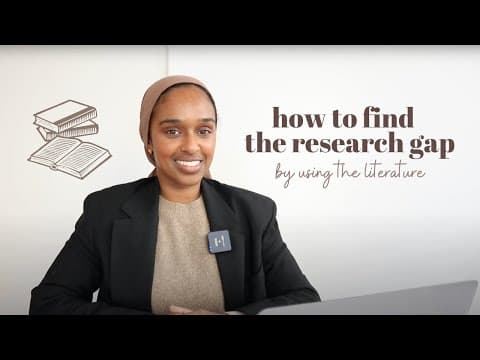
5 Easy Ways To Find The Gap in Literature | How To Identify Research Gaps
Dr Amina Yonis
12m 35s2,434 words~13 min read
YouTube auto captions
Transcript source
YouTube auto captions
This transcript was extracted from YouTube's auto-generated caption track. The transcript below is server-rendered so it can be read, searched, cited, and shared without opening the original YouTube player.
Pull quotes
[0:00]One of my most frequently asked research-based questions is, how do I find a gap in literature?
[0:00]Like I know that I'm interested in this particular topic, I know that this is something that I find so interesting, I'm passionate about it.
[0:00]But how do I find that subset of the topic that I can actually pursue and is a unique part that hasn't been studied yet?
[0:00]So how do I find that and as a new researcher you're probably really struggling as to where exactly to look without being spoon fed and just given the answer?
Use this transcript
Related transcript hubs
Watch on YouTube
Share
MORE TRANSCRIPTS


