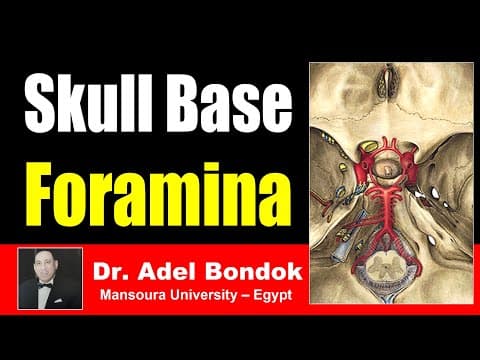
[0:15]Hello, everyone. This is Dr. Adel Bondok, Professor of Anatomy and Neuroscience, Mansoura University, Egypt. I am going to talk about the foramen of the skull and their contents. I will start by the cranial cavity foramen in the cranial cavity. Okay? This is the first foramen. This is the foramen secum. Foramen secum transmits emissary vein between the superior sagittal sinus and the nasal veins. Second foramen or foramina, this one, this plate, is the cribriform plate of ethmoid bone. It transmits the olfactory nerves. We have two canals related to the cribriform plate of ethmoid: anterior ethmoidal canal and posterior ethmoidal canal. This is the anterior ethmoidal canal. It transmits anterior ethmoidal nerve and vessels. And this is the posterior ethmoidal canal. It transmits posterior ethmoidal nerve and vessels. Then this foramen or canal, this is the optic canal. The optic canal transmits the optic nerve and the ophthalmic artery. And actually, the optic nerve is surrounded by three meningeal layers. Therefore, the optic canal transmits optic nerve, ophthalmic artery, which is a branch of the internal carotid artery, and meningeal layers, three meningeal layers around the optic nerve. Then this fissure between the lesser wing of the sphenoid and the greater wing, the greater wing of the sphenoid. This is the superior orbital fissure. This superior orbital fissure transmits seven nerves and ophthalmic veins. The treat: live free to see no insult at all. Lacrimal nerve, followed by frontal nerve, trochlear nerve, superior division of the oculomotor nerve, nasociliary nerve, inferior division of the oculomotor nerve, abducent nerve, and ophthalmic veins. This is an ophthalmic vein, okay? Okay, this is the lacrimal nerve. Frontal nerve, trochlear nerve, superior division of oculomotor nerve, nasociliary nerve, inferior division of oculomotor nerve, and abducent nerve. So, this is the superior orbital fissure. Then this foramen, this rounded foramen, this is the foramen rotundum. Foramen rotundum transmits this nerve. This is the maxillary nerve, branch of the trigeminal nerve. Okay? So, foramen rotundum maxillary nerve. Then this oval foramen, foramen ovale. Foramen ovale transmits four structures, the treat: male. Mandibular nerve, accessory meningeal artery, lesser petrosal nerve, and emissary vein of cavernous sinus. So, again, foramen ovale, four structures are passing through foramen ovale: mandibular nerve, this is the mandibular nerve, okay? And accessory meningeal artery, lesser petrosal nerve, and these are emissary veins, okay, of the cavernous sinus. Connecting the cavernous sinus with the pterygoid venous plexus. Then this small foramen, foramen spinosum. Foramen spinosum transmits artery and nerve. This artery is the middle meningeal artery. And this nerve is nervus spinosus or the meningeal branch of the mandibular nerve. So, foramen spinosum: middle meningeal artery and nervus spinosus. Okay? Then this foramen, this one, this one, this is the foramen lacerum. This one. Foramen lacerum transmits the internal carotid artery after leaving the carotid canal, surrounded by sympathetic plexus. This sympathetic plexus form the deep petrosal nerve. So, foramen lacerum transmits internal carotid artery surrounded by sympathetic plexus, which form the deep petrosal nerve. Then this foramen, this one, this one. This is the internal auditory meatus. Internal auditory meatus transmits two nerves and an artery. The two nerves, facial nerve, vestibulocochlear nerve, and labyrinthine artery from the basilar artery supplying the labyrinth or the inner ear. So, internal auditory meatus transmits this meatus, internal auditory meatus, transmits two nerves, facial nerve, vestibulocochlear nerve, and labyrinthine artery. Okay? Then this foramen between the petrous temporal bone and the occipital bone. This is the jugular foramen. Jugular foramen is divided into three compartments. The three compartments transmit two veins, two arteries and three nerves. The two veins, the anterior compartment transmits the inferior petrosal sinus. The posterior compartment transmits the sigmoid sinus to continue as the internal jugular vein. And the middle compartment transmits three nerves and two arteries. The three nerves: glossopharyngeal nerve, vagus nerve, and accessory nerve. The two arteries are meningeal branches of the occipital artery and ascending pharyngeal artery. So, this is jugular foramen, transmitting two veins. Inferior petrosal sinus anterior, sigmoid sinus posterior, and in the middle compartment, glossopharyngeal, vagus, and accessory. Plus two meningeal arteries from the ascending pharyngeal artery and occipital artery. This is the hypoglossal canal or the anterior condylar canal. This is the hypoglossal canal. It transmits the hypoglossal nerve. And this is the largest foramen: foramen magnum. Foramen magnum transmits at least nine structures. Three nervous structures: the medulla oblongata to continue as the spinal cord. And again, and again, and again. The spinal cord doesn't pass through the foramen magnum because it begins below foramen magnum. So, medulla oblongata, spinal accessory nerves, or the spinal roots of the two accessory nerves, right and left. Sympathetic fibers around the arteries, and you can add meningeal branches of the upper three cervical nerves. Then three arteries: vertebral, anterior spinal, and posterior spinal. Three meninges: dura, arachnoid, and pia. So, these are the foramina in the cranial cavity, norma basalis interna. Now this is norma basalis externa. Start by this foramen, this is the incisive foramen. Incisive foramen transmits artery and nerve, of course on each side. The artery is the sphenopalatine artery and the nerve is the nasopalatine nerve from the sphenopalatine ganglion. So, incisive foramen transmits nasopalatine nerve and sphenopalatine artery. Then this foramen, the greater palatine foramen. Greater palatine foramen transmits greater palatine nerve and vessels. And this small foramina lesser palatine foramina. Lesser palatine foramina transmit lesser palatine nerve and vessels. Okay? Then this foramen ovale, and again foramen ovale transmits four structures that read male. Mandibular nerve, accessory meningeal artery from the maxillary artery, lesser petrosal nerve from the glossopharyngeal nerve, and emissary vein of the cavernous sinus. Connecting the cavernous sinus with the pterygoid plexus of veins. Then this foramen, foramen spinosum. Foramen spinosum transmits the middle meningeal artery and nervus spinosus or the meningeal branch of the mandibular nerve. This is the foramen lacerum. Transmits the internal carotid artery after leaving the carotid canal, surrounded by sympathetic plexus which form the deep petrosal nerve. Okay? This is the carotid canal. Transmitting internal carotid artery surrounded by sympathetic plexus. This is the jugular foramen. Okay? This is the stylomastoid foramen. Stylomastoid foramen between the styloid process and the mastoid process. Stylomastoid foramen transmits the facial nerve and stylomastoid artery which is a branch from the posterior auricular artery. Stylomastoid artery is a branch from the posterior auricular artery. Okay?
[11:29]And this is the jugular foramen. Again, jugular foramen is divided into three compartment. Transmitting two veins, two arteries, and three nerves. The anterior compartment transmits inferior petrosal sinus. The posterior compartment transmits the sigmoid sinus. The middle compartment transmits glossopharyngeal, vagus, and accessory nerves, plus meningeal branch of the ascending pharyngeal artery and meningeal branch of the occipital artery. This is the mastoid foramen. Mastoid foramen transmits artery and vein. The artery is the meningeal branch of the occipital artery, another meningeal branch of the occipital artery. Supplying the dura of the posterior cranial fossa and emissary vein between the occipital veins and the sigmoid sinus. And this is the foramen magnum. Again, transmitting nine structures. At least nine structures. Three nerves: medulla to become spinal cord, spinal accessory and sympathetic fibers around the arteries, plus meningeal branches of the upper three cervical nerves. Three arteries: vertebral, anterior spinal, and posterior spinal arteries. Three meninges: dura, arachnoid, and pia. And this is the anterior condylar canal. Anterior condylar canal is the hypoglossal canal. It transmits the hypoglossal nerve. And this is the posterior condylar canal. Transmits emissary vein between the sigmoid sinus and the sub occipital plexus of veins. And thank you very much. Best wishes and good luck.


