[0:12]And 203. All right, welcome. There's uh, find your picture on the board and then there's a number there and then find your seat, okay?
[0:22]Could I see the hat real quick? Okay. Bulls. Okay. But I don't want it in class though, okay? But it's a nice hat though.
[0:32]Hey, welcome.
[0:35]Guys, as you guys are coming in, please make sure that that is you, right? And there's a number that's by you and then that's where you guys are going to sit, okay? So that's the seating chart for today.
[0:47]Mr. Gomez? Yeah. All right, welcome. How you doing?
[0:53]How you doing? Oh bien? Yeah. How we doing?
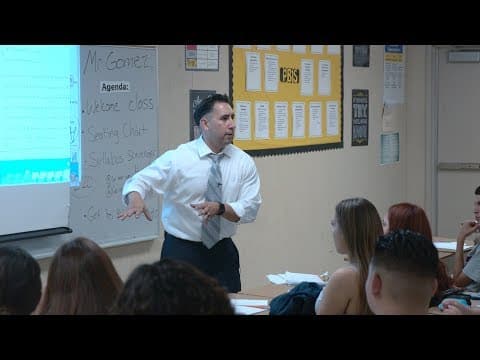
[1:01]I was outside uh greeting students. I definitely was out there just trying to uh establish, build uh relationship because um I have never seen some of these students. So I to say, I really had no relationship. So I was just trying to find something whether it was off their shirt, whether I uh whether it was just something, whether the shirt, just trying to connect with them, even just saying welcome. Uh, but I wanted them to feel safe that this was a place I wanted them to be and I was happy to be there with them. Okay, so real quick, there is a seating chart, okay? Always there has to be, okay, right? Because it gives structure. Because there's there's a reason where you're sitting. I made sure that looking at the mass skills that there's a strong in your group that there there's kids that struggle with math and hopefully my kids that are uh that really are strong in their mathematics, it will help you. This is math three, okay? So it's a little heavier, right? It's a lot more work. So I had the seating chart set because I noticed that that is um day one, I think it gives me more of control. Uh, I think it's very important for uh the students to understand that even though this is our room, I am still responsible. I'm the main person there that uh that I want to establish this learning environment. Yes, it shows authority, which is great, but I think also that I didn't just make a seating chart just to make a seating chart. The seating chart was based on levels, was a language, and I notice as soon as the students uh sometimes come really um uh they come really loud sometimes from the outside to the inside. But as soon as they see the seating chart, they actually start to like, wow, this teacher, he actually is in charge or he's authority. I have a feeling he's um he's going to be addressing the rules. Now, once again, I want you guys to use this syllabus because that obviously all the answers are here, right? And all you got to do is fill them in. For number one, you can see that it says the first two rules in the class are, you will look where it says rules and then you will start to, yes, write number one and two and so on. In a little bit, I will call on your beautiful names and we will hear your answers and then we will make sure that we are definitely uh having the correct ones. Does that make sense?
[3:26]Having the syllabus um could be very dry, could be very boring. Most teachers uh like to have uh their syllabus on the on the PowerPoint and the kids are following. I actually, I think that it's more important to um get a printout. They had to do something with it.
[3:46]So it wasn't like they're just hearing me talk for this whole 50 to 55 minutes. They had a chance to get a sheet that was called the Scavenger Hunt and they had to find the answers in the syllabus. Before we go over this really fast, right? Just really quick, just so that you know little no a little bit about myself. Okay? My name is Mr. Gomez, obviously, right? It's on your schedule, it should be on your schedule, right? Uh and it at the end it has a letter, what, though in in my name? A Z. Very good, yeah, right? I do a lot of uh telling stories, especially in the beginning, um day one, day two, I want them to understand that I am human. Um it's important for them to see that I I did struggle.
[4:26]We have that option to do it though. Okay, I don't think you understand. Let me tell you. My parents, okay? They came, um coyotes over. Okay? When they got here, they didn't have a choice to pick where they work. Do you understand what I'm saying? My mom put oranges in boxes. She didn't speak English. She was not educated. That's what she did. Okay? My dad, right, he worked construction. He wasn't it sounds like he got paid a lot. He didn't, okay? He did like the like mobile home stuff, okay? He didn't speak English. He'll say, oh, because your speaker speak, but he don't know how to speak English, but but he thinks he does and he tries, though. I think it's really really cool. Anyways, those are my parents. There's no education there. Do you understand what I'm saying? But what when you see that, though, like you, if you said, I want to be I want to be a lawyer, I want to be an engineer, I want to own my business, why not? Do you understand what I'm saying? Like, you have the option to say, I could do this or don't do this. That's big. At some point on the first day, it I was really going after what I was really trying to do is of course, you know, you want to let the students understand, what are your rules? What are your expectations? But I think one of the biggest things is um making relationships. I believe that some of these students will um they're just dying to make this connection and I just notice that it just that connection, making them laugh, making them like feel that like uh some of these kids they don't really care about how much math I know. They actually care about how much I care.