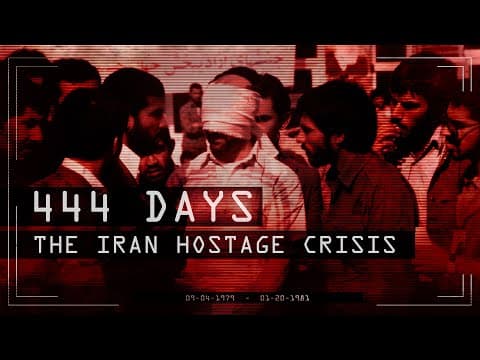
[0:04]During the night of January the 20th, 1981, 52 American diplomats arrive in Algiers from Tehran.
[0:15]They can finally breathe freely after being held hostage in Iran for a very long and difficult time. Feeling great right now. Best I've felt in 444 days. Thank God, we're home! Yankee, go home! The hostage crisis lasted 444 days. Each one an ordeal filled with psychological torture and physical abuse. For the world's most powerful nation, it was 444 days of humiliation that ended with it having to cede to the demands dictated by an Iran in the midst of its own revolutionary uprising. Several decades of resentment towards the United States spurred the events that took place from November 1979 to January 1981. Resentment that's still alive in Iran. The US Embassy, focal point of the hostage crisis, and now a museum named US Den of Espionage Museum, keeps hate towards America alive.
[2:05]The embassy was seized on the morning of November the 4th, 1979. The operation was prepared by Islamic leaders in the universities in Tehran, who incited 400 students to go storm the American Embassy. Despite the revolutionary turbulence and anti-American sentiment in the country, the embassy did not increase security. The Marines who were ordered not to shoot, didn't resist for very long. Yankee, go home! Yankee, go home! Yankee, go home! The American diplomats who'd been controlling Iran for decades, underestimated the siege, carried out by a group of 20-year-olds.
[2:51]I thought that the adults in the room would act and realize this something like this is simply unacceptable. Uh, well, what happened was there were no adults in the room. Or even worse, the adults uh encouraged the children who were uh, who were running amok. I knew that we were in trouble when I heard uh one or two days after the Embassy seizure, that Khomeini had backed the students who had uh invaded our premises.
[3:36]At the beginning of the hostage crisis, Iran had only recently come under the rule of an important religious dignitary, the Ayatollah Khomeini, who quickly donned the cloak of supreme leader of the nation. His followers called him Imam Khomeini. He came to power following the Iranian Revolution that overthrew the Shah of Iran, Mohammad Reza Pahlavi. The Shah had ruled the country with an iron fist for nearly 40 years, backed by the United States for political and security support. Crowds flocked to see Khomeini at each of his appearances, but he knew his power was fragile. He had to walk a fine line to please the people on all political sides who had brought him to power. The Islamists who were devoted to him, the pro-West liberals who supported him, but who wanted to limit his role to that of a moral authority. The movements on the left which hoped to one day control the country. Khomeini decided to eliminate all political forces that stood in his way of securing absolute power. Clever strategist, he asked the Islamist forces to carry out anti-American actions to get the people on his side. He didn't want to leave anti-American sentiment, which was the driving force in Iran, in the hands of the left, which was becoming more and more powerful.
[5:00]After the siege, our only goal was to let the political leaders of the country know that we were not part of the Marxist left movements.
[5:17]We're people, militants who have experience with struggles, the revolution and we clearly and completely support Imam Khomeini. The resentment of Iranians toward the United States in particular was always there. What the revolution changed was now people were able to express this. Something they had never done before. And all of these um, uh pent up as like a pot, the the lid just blew off the pot. The takeover of the Embassy by his followers was the opportunity Khomeini had been hoping for, so he could cement his power. He immediately backed the hostage takers and hailed their action as a second revolution, even bigger than the first. Which had overthrown the Shah just a few months earlier. The massive rallying sparked by the takeover of the Embassy positioned Khomeini as the only protector of the Iranian people. Dispossessed for so long by the Americans.
[6:27]It was also a chance for him to get a bargaining chip. Freeing the hostages in exchange for extraditing the Shah, who had been taken in by the United States. The former monarch had been in New York since late October, receiving treatment for cancer. Khomeini was worried. He feared the Americans would attempt a coup to restore the Shah to the throne. I think there was no question that uh the Americans would return the Shah to Iran. We just weren't going to do that. He had collaborated with us over many years. There'd been many sacrifices. So we owed him a great deal. President Carter, when he agreed to allow the Shah to come to the United States for medical treatment, he was reluctant, but he agreed. And he turned to his advisers and he said, what are you going to advise me to do when our Embassy is occupied and our people are taken hostage? As soon as Khomeini came to power, several embassies were hit with takeover attempts by revolutionary groups. On February the 14th, 1979, the American Embassy itself was the target of an attack by Marxist militants. Khomeini militia quickly had them evacuated. This time the Americans knew that the situation was different.
[7:58]Khomeini's own followers were occupying the Embassy. Jimmy Carter, the American President, sensed that negotiations would be difficult. His National Security Adviser, Zbigniew Brzezinski, suggested there might be another option. A rescue mission that the military had been secretly evaluating.
[8:21]In Tehran, confusion reigned supreme in the streets and within governmental bodies. There was no government. A Council of the Islamic Revolution, whose members were all named by Khomeini, was running the country. This body nominated Abolhassan Banisadr as Minister of Foreign Affairs. I went to see Mr. Khomeini, who told me, we're going to keep the hostages for three or four days, long enough for America to realize it has committed crimes and then we'll free them. So I agreed to become Minister of Foreign Affairs.
[9:00]Two weeks after the takeover and the start of the hostage crisis, Khomeini sent a signal. He instructed his son, Ahmad Khomeini, to free a few hostages. His son decided to release 13 of them, just African Americans and women.
[9:19]Although Banisadr was officially in charge of the fate of the hostages, his hands were tied. Khomeini forbade him from having any direct contact with the Americans. He and his adviser, Ahmad Salamatian, appealed to the UN and requested a meeting of the Security Council. They hoped to obtain a fair and balanced decision, conviction of the United States for their interference under the reign of the Shah, and the release of the hostages. I went to the United Nations with this mission to try to get the UN Security Council to meet to discuss the hostage situation. And the Iranian Minister of Foreign Affairs, Mr. Banisadir, who would also be there in person. And we would come to an agreement. I was convinced that it was possible, that it was doable. When I had to go to the UN Security Council meeting to solve the problem, Mr. Khomeini issued a statement saying, no one will attend the UN Security Council meeting on Iran's behalf.
[10:33]So I resigned as Minister of Foreign Affairs. That morning, around 4:00 or 5:00 in the morning, I read the news about the Minister of Foreign Affairs not coming. Let me tell you that up until the time that I got on the plane and left, I hid from the UN diplomats because I was ashamed. Powerless, the Americans watched the days in captivity rack up as they awaited news from their fellow citizens trapped in Khomeini's grasp. The Iranians watched as authorities played a game of musical chairs. In late November 1979, a new Foreign Affairs Minister was named, Sadegh Ghotbzadeh. An ambitious man who thought his close relationship with Khomeini would afford him some leeway to resolve the hostage crisis.
[11:33]Well aware that it was forbidden to speak with the Americans, he asked two friends, Christian Bourguet, a French lawyer, and an Argentine businessman to contact the American administration.
[11:48]From the outset, President Jimmy Carter gave the Iranian a promising sign. He asked the Shah to leave America and continue his treatment in Panama, a country under American control.
[12:05]On behalf of Iran, Christian Bourguet, the lawyer, wanted to begin the extradition process. The Panamanian president was playing both sides. He told the Iranians that legal action was possible, and he ensured that the Shah was safe.
[12:23]In his dealings with Khomeini, Ghotbzadeh always presented Khomeini with a done deal. Ghotbzadeh wasn't one to discuss taking action with Khomeini, Ghotbzadeh took action first, and then he packaged it up.
[12:43]The United Nations was still looking for a way to resolve this international crisis with unforeseeable consequences.
[12:52]In agreement with the American President, the UN Secretary General traveled to Tehran in early January 1980. Kurt Waldheim hoped to meet with both the American hostages to make sure they were in good health, and Khomeini to negotiate their release. Instead, he was met with an angry mob. Hundreds of Iranians unleashed their hatred of the Shah on him. The same Shah who was accused of committing torture and crimes with the help of the Americans. Give our regards to the American President from the oppressed Iranian people! Kurt Waldheim left Tehran without meeting with Khomeini or the hostages.
[13:40]He later recounted that he was scared for his life.
[13:46]The UN was not giving up. It still attempted to be the mediator. Waldheim accepted Sadegh Ghotbzadeh's proposal to create a commission to mitigate the explosive situation in Tehran.
[14:03]Inside the UN, talks about who should be on the commission went on for several weeks.
[14:11]It was finally formed in February and arrived in Tehran on an official mission to investigate criminal interference by the Americans in Iran during the reign of the Shah. But we went further than that. We had the tacit agreement of everyone, even the Iranians themselves. The commission was looking for a way to free the hostages, and step by step, really wanted to meet with hostages. We students sensed that the hostages and ourselves might be in real danger.
[15:04]So we immediately decided to split up and move the hostages to different regions in Iran. We did this to prevent any military interventions and terrorists and guerrilla operations. I think the first sign that something positive was happening was around uh Christmas time of 1980 when we were visited by um two or three Algerian diplomats. So I told myself, uh this is this is serious now. Something something is going something is going on.


