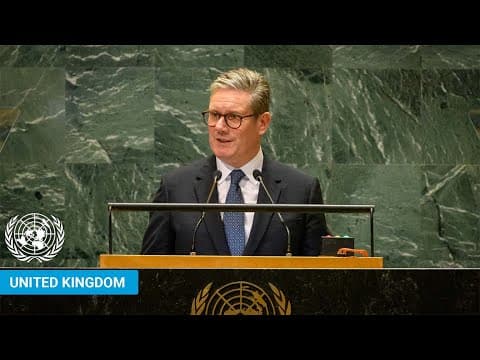
[0:03]The assembly will hear an address by his excellency, Kier Starmer, Prime Minister and First Lord of the Treasury of the United Kingdom of Great Britain and Northern Ireland.
[0:18]I request protocol to escort his excellency and invite him to address the assembly.
[0:37]Mr. President, your excellencies, ladies and gentlemen.
[0:42]I address the General Assembly today as someone with a deep belief in the principles of this body, and the value of international cooperation.
[0:55]I remember reading the Universal Declaration of Human Rights as a student.
[1:02]It had a profound impact on me.
[1:06]I spent my career as a lawyer working to protect those rights, and the declaration still inspires me now as Prime Minister.
[1:15]Because it speaks about our inherent dignity, the very essence of what it is to be human, of equal and inalienable rights, based on a foundation of freedom, justice and peace in the world.
[1:34]Yet, as we meet here today, that can feel like a distant hope.
[1:40]Conflict touches more countries now than at any time in the history of this assembly.
[1:48]Around the world, more fires are breaking out and burning with ever greater intensity, exacting a terrible toll in Gaza, Lebanon, Ukraine, Sudan, Myanmar, Yemen, and beyond.
[2:04]The vast majority of humanitarian need in the world today is driven by conflict.
[2:11]After 20 years of gains in tackling poverty, disease and in health, war is one of the main regions that progress has stalled.
[2:23]That is a catastrophe made by human hands.
[2:27]It has weakened the cause of cooperation, so political division between North and South, and turned the geopolitical dial away from the rule of law towards brute force and aggression.
[2:42]And this matters to us all.
[2:46]It matters to the British people. My government was elected to change Britain, to deliver national missions on higher growth, safer streets, cleaner energy, more opportunity, and a healthier society.
[3:01]But behind every one of these missions sits another insight, something that used to be unspoken, but now needs to be said, that we recognize that our success in Britain can never be separated from events beyond our shores.
[3:22]Global challenges rebound on us at home, and to grapple only with the effects of war, poverty, climate change, pandemics, or irregular migration,
[3:36]when they arrive on our doorstep is to set ourselves up to fail.
[3:41]We must work with others to solve these problems at root.
[3:49]To tackle the causes, Britain is stronger when we do so.
[3:52]So we are changing our approach on the global stage, too.
[3:57]My message today is this: We are returning the UK to responsible global leadership.
[4:05]Because I think the international system can be better.
[4:10]We need it to be better. People talk about an age of polarization, impunity, instability, an unraveling of the UN Charter, and I fear that a sense of fatalism has taken hold.
[4:26]Well, our task is to say, no.
[4:31]We won't accept this slide into greater and greater conflict, instability and injustice.
[4:38]Instead, we will do all we can to change it.
[4:43]This is the moment to reassert fundamental principles and our willingness to defend them, to recommit to the UN, to internationalism, to the rule of law, to work together for peace, progress and equality.
[5:00]Because it is right, yes, absolutely, but also because it is plainly in our self-interest.
[5:08]So we are ready to step up in a spirit of respect and equal partnership.
[5:15]I don't claim that solving these problems is easy, but there are positive practical things that we can do together.
[5:24]This starts with addressing the rising tide of conflict and preventing a regional war in the Middle East.
[5:32]I call on Israel and Hezbollah, stop the violence, step back from the brink.
[5:39]We need to see an immediate ceasefire to provide space for a diplomatic settlement, and we are working with all partners to that end.
[5:52]Because further escalation serves no one.
[5:57]It offers nothing but more suffering for innocent people on all sides and the prospect of a wider war that no one can control and with consequences that none of us can foresee.
[6:10]This is intimately linked with the situation in Gaza, where again, we need to see an immediate ceasefire.
[6:19]It shames us all that the suffering in Gaza continues to grow.
[6:24]The answer is diplomacy, the release of all the hostages, and the unfettered flow of aid to those in need.
[6:34]That is the only way to break this devastating cycle of violence and begin the journey towards a political solution for the long term, which delivers the long-promised Palestinian state alongside a safe and secure Israel.
[6:53]We must also work together for peace in Sudan, and a proper response to the worst humanitarian crisis in the world today.
[7:04]We need to see greater action to deliver aid and to deliver peace.
[7:09]The world cannot look away, and we must stand up for international law.
[7:14]And that's why we are so resolute in our support for Ukraine.
[7:19]They are exercising their right to self-defense as provided for under the UN Charter and recognized by 141 members of this assembly.
[7:33]We will stand with Ukraine for as long as it takes, because the alternative would be to confirm the worst claims about this place, that international law is merely a paper tiger,
[7:47]and that aggressors can do what they will.
[7:51]We will never let that happen because it is our duty to respond to a more dangerous world with strength to keep our people safe.
[8:04]But alone, that's not enough.
[8:08]That's not the limit of our responsibility. We must also work together to make the world less dangerous.
[8:16]And so we have to face some hard truths.
[8:20]The institutions of peace are struggling, underfunded, under pressure and overpoliticized.
[8:28]The entire framework of arms control and counterproliferation painstakingly constructed after decades has begun to fall away.
[8:37]Iran continues to expand its nuclear activity in violation of its international commitments.
[8:44]Incredible new technologies like AI are being deployed for military use without agreed rules.
[8:54]These are difficult challenges to grip and too urgent to ignore.
[9:00]That's why the new pact for the future is so important.
[9:03]We must put new energy and creativity into conflict resolution and conflict prevention, reverse the trend towards ever greater violence, make the institutions of peace fit for purpose, and hold members to their commitments under the UN Charter.
[9:23]But again, reducing conflict is not the limit of our responsibility.
[9:30]Other global challenges impact us too.
[9:33]So we must work to get the SDGs back on track.
[9:37]So Mr. President, under my leadership, the UK will lead again, tackling climate change at home and internationally, and restoring our commitment to international development.
[9:51]Like many of you, in a few weeks time, I will be traveling to Samoa for the Commonwealth heads of government meeting, where a generation of children are having to contemplate fleeing their island of their birth for good.
[10:08]The threat of climate change is existential and it's happening in the here and now.
[10:15]So we have to reset Britain's approach.
[10:18]We have lifted the de facto ban on onshore wind in England, ended new oil and gas licenses, and created great British energy, as we become the first major economy to transition to clean power by 2030.
[10:33]And I'm pleased to tell you that, yes, we will meet our net zero target, backed up with an ambitious NDC at COP 29, consistent with limiting warming to 1.5 degrees.
[10:49]And we'll support others to do the same.
[10:53]I know that finances at the heart of this. So the UK will continue to be a leading contributor to international climate finance, that includes supporting nature and forests, because this is vital for biodiversity and reducing emissions.
[11:08]And it includes funding for climate adaptation because those who did not cause this crisis should not be left to cope with the consequences.
[11:19]And the UK will also continue to be a leading contributor to development, committed to returning to 0.7% when fiscal circumstances allow.
[11:31]But let's be frank. Public finance will never fully meet the needs.
[11:36]So we must use it as a multiplier to unlock much greater levels of private investment, and we have already started this work.
[11:46]I can announce today that we're creating a new facility, the British International Investment, which will work with the City of London to mobilize billions in pension and insurance funds to invest in boosting development and fighting climate change.
[12:03]This is a great British innovation.
[12:06]And if we're going to deliver in each of the areas I've talked about today, with all the benefits that will bring, then this is the kind of approach that we need to take, innovating, thinking differently, moving faster, and being ready to change how we do things in three key areas.
[12:26]First, we must change the international financial system to deliver a fairer deal for developing countries.
[12:34]We will use our seat on the boards of the IMF and the World Bank to argue for a bolder approach to tackle unsustainable debt, which is compounding poverty and inequality, depriving the sick of healthcare and children of education.
[12:51]We must tackle the barriers to investment, which choke off the flow of private finance, and we must put a price on the true cost of emissions through a new levy on global shipping, with the proceeds going to tackle climate change and cut emissions even further.
[13:09]Crucially, we need to accelerate reform of the multilateral development banks, so that they shoulder more risk, unlocking hundreds of billions more to help the poorest and build a low-carbon global economy.
[13:24]A critical milestone in the fight against poverty is approaching, with the replenishment of the International Development Association.
[13:33]This is the chance for everyone to show greater ambition, so the IDA can be a bigger and better, helping more people, especially those in fragile states and conflict zones.
[13:47]On that basis, we will be ambitious, too.
[13:50]We will increase our pledge, and play our part in seizing the potential of this moment.
[13:57]Second, if we want the system to deliver for the poorest and most vulnerable, then their voices must be heard.
[14:06]We need to make the system more representative and more responsive to those who need it most.
[14:13]So we will make the case, not just for fairer outcomes, but fairer representation in how we reach them.
[14:21]And this also applies to the Security Council.
[14:25]It has to change to become a more representative body, willing to act, not paralyzed by politics.
[14:35]We want to see permanent African representation on the council, Brazil, India, Japan, and Germany as permanent members, and more seats for elected members, as well.
[14:48]Finally, to support this, we will also change how the UK does things, moving from the paternalism of the past towards partnership for the future.
[15:01]Listening a lot more, speaking a bit less, offering game-changing British expertise, and working together in the spirit of equal respect.
[15:15]Joining the Paris pact for people and planet, pursuing a new global clean power alliance, standing for the new term on the Human Rights Council, and joining forces to tackle the toughest challenges like anti-microbial resistance, preparedness for the next pandemic, and outbreaks of deadly diseases like Mpx.
[15:39]We are ready to work with all UN members, because the scale of the challenges we face demands it, and our prosperity and security depends on it.
[15:50]I say it again. All this matters to Britain.
[15:56]Mr. President, by tackling conflict, making progress in the fight against climate change and poverty, and reforming the international system so that it's fit for the 21st century, we can realize the hope and the promise that shine through the founding documents of this organization.
[16:16]Together, in all our interests, we can change direction from the dangerous, destructive path we find ourselves on, and turn instead towards the rule of law, towards cooperation, responsibility and progress, towards peace.
[16:36]Thank you.
[16:39]Thank you.
[16:43]On behalf of the assembly, I wish to thank the Prime Minister and First Lord of the Treasury of the United Kingdom of Great Britain and Northern Ireland.


