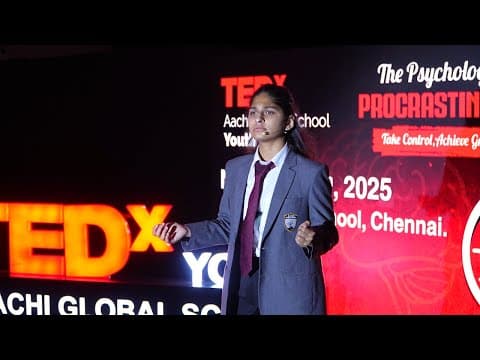
[0:04]Next, let's hear from Mugdha, a 15-year-old student who remains un-faced even in times of adversity.
[0:13]She prefers to encounter any problem with audacity and emerges victorious. She is affable and aspires to become a leading entrepreneur and a social activist.
[0:27]Besides being an academic prodigy, she is pursuing spirituality and yogic practices.
[0:33]Before I start, I have a confession to make. I procrastinated writing this speech.
[0:39]When I first got invited to speak at TEDX, I was thrilled. I opened a new document titled, The Psychology of Procrastination final draft. And then I thought, I'll watch YouTube for just five minutes and then start.
[0:53]An hour later, I found myself lost watching shorts on productivity while doing absolutely nothing productive.
[1:01]Sounds familiar, right? Congratulations. You, like me, are a card-carrying member of the Procrastination Club.
[1:08]A club with unlimited memberships and no meetings because, well, we keep postponing them. So here I am, talking about procrastination after procrastinating writing this very speech.
[1:20]And honestly, I couldn't have asked for a better example of research in action. Let's begin with basics.
[1:27]Procrastination isn't just being lazy or careless. In fact, people who procrastinate often care too much.
[1:35]Psychologists define it as the voluntary delay of tasks you intend to do, even after realizing that delaying it will make things worse.
[1:43]Think about all those times you said, I'll do it after lunch. I'll do it after dinner. And after watching a whole Netflix series, you finally said, I'll do it tomorrow. And you believed it.
[1:56]But procrastination isn't about time, it's about emotion. We don't put things off because we can't manage our time.
[2:03]We put them off because we can't manage how we feel about the task. That essay that makes you anxious, that assignment that feels overwhelming, that test that scares you.
[2:14]Avoiding it gives you a temporary relief. And that relief feels good. The problem is it doesn't last.
[2:21]So what's happening inside our heads? Imagine two people living inside your brain. One is the rational planner, your prefrontal cortex.
[2:31]It is responsible for your goals, discipline, and about your foresight. The other is the emotional child, your limbic system.
[2:40]It only cares about what feels good right now. When you decide I'll start studying tonight, your planner is in charge.
[2:47]But as the evening arrives, your emotional brain takes over and says, wait, let's just watch one episode.
[2:55]And suddenly it's midnight, you're still on Netflix, and your planner is quietly crying in a corner.
[3:02]This struggle is why procrastination feels so illogical. It's not that we don't want to do the task. We want to avoid how doing it feels.
[3:10]Neuroscientists have even found that people who chronically procrastinate have a more active amygdala. The part of your brain that deals with fear and stress.
[3:20]As psychologist Dr. Timothy Pychyl explains, procrastination is not a time management problem, it's an emotional management problem. We aren't avoiding the task, we are avoiding the feeling.
[3:30]So, if it's emotional, what emotions are we really avoiding? First, fear of failure. Sometimes we don't start because we're afraid of how the result might reflect on us.
[3:41]If we never try, we can always say, I could have done better if I had tried. It protects our ego but stunts our growth.
[3:49]Perfectionism. Perfectionists are professional procrastinators. We wait for the right time, the right idea, the right plan.
[3:59]But that moment rarely happens. As one's an author said, if you wait for inspiration to write, you're not a writer, you're a waiter.
[4:07]Third, shame and guilt. After procrastinating, we feel guilty. And that guilt makes it harder for us to start.
[4:14]We criticize ourselves for not starting earlier, creating a cycle of shame and avoidance. Interestingly, researchers found that people who forgive themselves for procrastinating are often much less likely to do it again.
[4:28]So maybe the first step to overcoming procrastination is just being kind to yourselves.
[4:35]Now, let's address one of the biggest lies students tell themselves. I work best under pressure. I have said it too.
[4:42]But science disagrees. That adrenaline rush we feel before a deadline isn't focused, it's stress.
[4:50]Our brains switch to survival mode, not creativity mode. We might complete the task, but its quality suffers, our sleep suffers, and our sanity definitely suffers.
[5:00]The truth is we don't work best under pressure. We just work under pressure because we left ourselves no choice.
[5:07]There's another interesting reason we procrastinate. We're bad at empathizing with our future selves.
[5:12]Studies show that when you think of future me, our brains treat that person as a complete stranger. So when you say, I'll do it tomorrow.
[5:23]Your brain essentially says, let future me deal with it, they'll be fine. But here's the problem, future you is just present you.
[5:32]But more tired, more stressed, and probably holding a cup of coffee at 2 AM.
[5:37]When we procrastinate, we aren't rebelling against anyone else, but betraying our own future.
[5:44]Believe me when I say, the toughest part of any task isn't completing it, it's starting it.
[5:51]Psychologist Bluma Zeigarnik found that once we start something, our brain keeps keeps reminding us to complete it.
[5:59]It's called the Zeigarnik effect. That's why once you write the first sentence of your essay, it's easier to keep writing.
[6:07]So if you can just start, even for a few minutes, you've already won half the battle. Motivation doesn't come first, action does.
[6:14]You don't get motivated and then start working. You start working and then get motivated.
[6:20]So, what can we actually do about procrastination? Here are some simple, science-backed strategies.
[6:27]One, start small. Don't aim to complete, aim to start. Tell yourself, I'll do this just for five minutes.
[6:36]Once you begin, momentum builds naturally. Two, break it down. Big goals scare our brain.
[6:42]Instead of saying, write the essay, say, write the introduction or maybe even write the first line.
[6:48]Breaking things down turn a mountain into small climbable hills. Three, use the two-minute rule.
[6:55]If a task takes less than two minutes, like replying to an email or putting your notes away, do it immediately.
[7:03]This prevents small tasks from causing stress later. Four, create triggers and routines.
[7:07]If you study at the same place and same time every day, your brain starts connecting that environment with focus.
[7:15]Routine reduces decision fatigue. Fewer decisions mean fewer chances to procrastinate.
[7:20]Five, reward progress. Reward yourself not just for finishing, but for starting too.
[7:26]Watch a show, take a walk, or enjoy something small, when you make progress, our brains love rewards.
[7:35]Use that to your advantage. The sixth one, the final one and the most important one. Be kind to yourself.
[7:41]Everyone procrastinates, everyone does. What matters isn't perfection, it's persistence.
[7:48]If you slip, forgive yourself and begin again.
[7:53]As a student, I've realized procrastination isn't about time. It's about fear. Fear of failing, fear of being judged, fear of not being perfect.
[8:01]I used to think procrastination made me weak, but now I see it as a message. A message from my brain that something underneath requires attention.
[8:10]Sometimes it means I'm tired, sometimes it means I'm stressed, and sometimes it means I just need to start small.
[8:17]The moment I stop viewing procrastination as an enemy and start listening to it as a friend, it loses its power.
[8:24]Because awareness, not guilt, is what creates change. So here's what I've learned. We spent so much of our lives waiting.
[8:31]Waiting for the perfect time, the perfect plan, the perfect version of ourselves. But perfection never comes.
[8:39]You don't need to feel ready to start. You need to start to feel ready. Because courage isn't not about feeling fear.
[8:47]It's about doing it anyway. As motivational speaker Les Brown once said, you don't have to be great to get started, you have to get started to be great.
[8:55]So the next time you hear that little voice saying, not now, just smile and reply back, watch me. I am Mugdha, a proud member of the Procrastination Club.
[9:08]Finally finishing my speech, just in time to tell you not to wait too long to start yours. Thank you.


