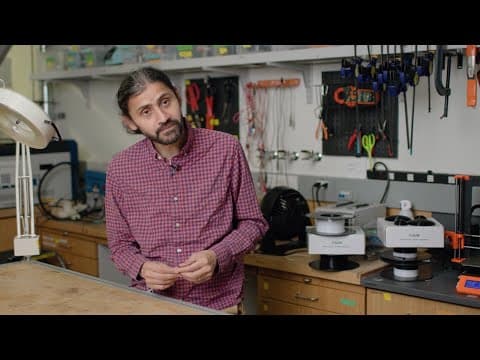
[0:12]Well, there, they're they're the things of your toolbox, you know? And they're the things that kind of get me up in the morning, right? What are the questions and how do I how do I frame them in in such a way that, um, they both energize me and they lead me to other kinds of questions that need to be posed if not answered. So I have lots of questions. I don't have like many answers, but I have lots of questions. And I think that the question, uh, in your toolbox, the questions in your toolbox are important, uh, as the answers. Questions as tools. Yeah. So, um, to me, you know, my the first thing I think of in that context is that a question can be a tool that sort of drives a project towards discovery. And so, you know, we may, in some cases we really start with a question and, you know, as an experimental physicist, you could build an apparatus that's designed to, uh, to answer that question. Um, but I also think of of questions as questions kind of evolve, uh, and I think that's also super important in this role of sort of questions as driving in in driving discovery. And to me, um, I think that's actually, in some sense, part of the joy of science is that we don't always need to have one single question we're going after. I often have in my mind, um, I would say more of a space that I want to explore, right? And as I explore that space, uh, new questions come up. Most of what I've been taught about asking scientific questions was probably quite early in my education. So maybe in elementary, middle school, right, that's, that's when you really learn the scientific method and you're taught that you're supposed to have a hypothesis, right, and you test the hypothesis. And I would say, you know, as I progress towards PhD resource in the research in this amazing field, um, of sort of what I would call quantum engineering, uh, with these laser cooled atoms, um, we weren't always, um, just asking questions. There was also sort of an engineering mentality of, um, we know, in principle, um, if we can control our quantum mechanical systems well enough, we can make resources that will allow us to have better atomic clocks or better computers. Um, and and it's a, it's a matter of, you know, how do we actually, there's a how question there, you know, how do we build the system that will let us do that? Um, but it what it's not always a, I have a hypothesis and I'm testing it. And so, often in sort of the day-to-day research in the lab, the place where we apply the scientific method is, um, you know, why isn't the experiment working the way it should? This coil is supposed to be producing a magnetic field and I don't see it, why not? And in the day-to-day problems, I, I think it's because, um, possibly, uh, this wire is broken, right? And let me test that. And so we use the scientific method all the time in the day-to-day problem solving. In the bigger picture science, it's often a little bit more, um, this, this idea of there's a space I'm exploring, there's a set of, um, long-term, uh, goals of technologies that we might be able to realize if we have sufficient control. And then there's a whole host of, um, questions of, you know, how do I get that control, um, uh, that, yeah, and and so I would say there's a space of questions for us as opposed to sort of, ne necessarily one question that we're answering with a specific, uh, experiment. Do I think of questions as tools?
[3:51]I think very often a question can be a defense mechanism. I am certain that I've done that before. And often times it works quite well, but the purpose of the question is to kind of like, giving a baby a pacifier so it will, you know, be quiet and get on with, uh, get on with what it needs to do so that in the background the larger unasked question can have its way. I think often in the past my questions have been pretexts to occupy a demanding superego who might be nervous at what we're really getting into. Questions as tools doesn't have a particular meaning for me, but it makes me think about the fact that the question is the avenue and the process and the search. And often times we don't find the right question initially. In fact, in my own research, I found that you arrive at an answer and you arrive at something original and only then can you state the question. The question is a tool for exploration. Um, but it's really that search for questions that, that drives us as, as researchers. And, you know, in my own career, I found that it was easiest to discover new questions by combining different disciplines. And so by being an engineer and studying anthropology and archeology, I could arrive at new questions more easily because these were well-established fields, but in between there was all kinds of fertile ground.
[5:58]So the kinds of humble questions that I worked on were things like, how does a grass suspension bridge from the Inca period survive for 700 years in the Andes mountains when the life span of the grass is only about two years before it decays? And the answer, of course, is culture. Or how does the Pantheon in Rome stand through earthquake after earthquake, century after century, with cracks in the ancient Roman brick and concrete? And the answer is through geometry, but also through gaining a new understanding of, uh, historic architecture. And it's almost so obvious, if you take the agricultural metaphor further and say we're plowing a field. We call academic fields a field. We're plowing deeper and deeper into one field. You're plowing deeper and deeper into another field. There's nothing fertile in between these two furrows in the field.
[7:01]Of course, there's a lot, but you need to be able to come up out of the furrow, climb up out, peer across and then see where you want to go next. And universities don't always make it easy and for me the most intellectually stimulating experiences of my life were when you're at a setting or at a table with people from many different disciplines. And then you're probing and questioning and learning from each other through the lenses of different disciplines. That happened to me really for the first time in the freshman dormitory at Cornell, but then it happened most vigorously in my PhD at Cambridge where it, you know, in the hall and your Cambridge College, all the different disciplines are debating everything under the sun. And then most memorably, uh, during four years at the table at the American Academy in Rome where you bring so many disciplines together that the posing of new questions is almost a natural outcome of those conversations at your meals.
[8:14]When Pat and I answer questions, we do it through making things, making a dress, making a shoe, editing our footage, figuring out what's in the background. We do it by making things piece by piece. When the piece is finished, when the overall film is finished, then we will find out what we were asking and if there is any any answering, much less any questioning. So that, that's something that sets artists apart from academics and philosophers is because they do the work of the questioning in the studio and through some form of making.
[9:04]And with that in mind, I feel that to then layer on a bunch of verbal questions like, um, what was the French Revolution about or what is the role of of women at Versailles? I think it's just almost too much and it could potentially come close to suppressing the real mechanism of questioning and answering in an artwork which is which is approached through making. We are certainly not out to make, uh, an empty shell or something that isn't resonant or doesn't have anything important to say. But, I think that to try to find out mid process what it would be would be hubristic, basically, and could risk, um, predetermining, overdetermining or even harming the work by curtailing the making process which is the primary process. I think a lot of the exchange between artists about this like inner flame, the inner question, the most important thing that must be protected, it's almost always an unspoken an unspoken thing, but you recognize someone else's inner kernel, this inner flame and you, you respect it and can be grateful to it. But it is difficult to refer directly to it. And I'm a little astonished that we are talking about it, but, um, but I attribute that to your to your, um, very gentile and understandable curiosity.
[11:13]And, uh, maybe I was just finally, like, maybe I'm just ready to talk about it, but, um, talking about it directly is, is like demanding to know what someone's underwear looks like or, you know, just something kind of wildly inappropriate, um, but I, but, um, you can, you can tell when someone is, uh, has it. Uh, you can tell when someone has this inner question that belongs to them and no other, that hasn't been grafted onto them from the outside. I think it's constantly changing.
[11:59]I, I think that you, you have to, uh, understand your the amalgam of all these kind of experiences and, uh, there should be life lesson all the time. You know, we, on the question idea, I think I, I do prefer the James Baldwin when he talks about the purpose of art. I should get the quote exactly right, and if you could find it, you could have it below this. But I essentially I interpreted what he said, the purpose of art is to excavate the question that's been buried by the answers. I think I think that is entirely, I'm driven by that purpose that, um, yes, because all answers are there to, I think, direct us politically, socially into a certain way of being. And it does not allow for the completion of your own, uh, quest. And so to to find, and also in the true sense, the question is what lives. So engineering the question, creating the questions is is a drive in me, you know. And that can occur in many ways, you know, but, uh, that should be a goal. It's, it's so rare that historians come clean about the initial question that motivated a project. Often that question will be buried under layers and layers of more sophisticated questions that are meant to frame the book that they ended up actually writing. But that isn't always where they began. Um, and I mean that process itself is really, is really fascinating to me, right? Like you start with one question and then you end up with, hopefully, a better question, right? Or at least with an answerable question based on the sources that your disposal. Um, I think to some extent, you know, historians are trained to work that way.
[14:07]Um, it's just that questions are fungible. There isn't kind of the question. Like there sort of just has to be a question. Um, and that question can, you know, can, can change and alter over the course of a single project. And I think we all work like that. Um, it'd be nice, maybe if we kept a record of, you know, kind of stratigraphy of the questions, um, in the process of, of a project. So I think especially as an artist, but I, I think in most fields of inquiry, if we're really honest about it, that sense of kind of play, um, and and being in a space where you don't really know where you're going, um, allows you to come up with those more complicated questions, I think. And so, yeah, I'm really grateful to my parents for, for allowing me to, to validating those kinds of spaces. Um, I've had some really amazing teachers along the way too, who also, um, through the assignments in the classes showed me the value of, of like, what is it to take a question as far as you possibly can? So an assignment or set of assignments as an as an undergrad art student that were super influential to me, um, were from my, um, art professor Ed Epping. It was a drawing class and we had to do, the first assignment was 25 drawings of a glass, like just a drinking glass, a piece of string, and a rock, I think. And you know, we were like, oh God, this is so boring. Oh my God, we have to do this 25. And we came to class the next, whenever the assignment was due, with these 25 drawings and then he said, now you have to do 50. And you it was just like you didn't think you could do it. And then I think we even had a third one where you had to do a hundred, right? But what happened for me was I think why I became an artist, honestly, as, you know, wanting to continue on as an art major, uh, was that you saw yourself like within a certain set of how this glass, rock, and string could be organized, like figuring out all the possible permutations of that and then you are stuck. Like totally stuck. And then like there was this revelation where you're like, oh, I didn't think about like stacking them or I didn't think about like looking through the glass at the other things or something, you would just feel your thought process moves sideways into a whole new vein of inquiry. And then you had you could do like 10 in that, right? But then you get stuck again and then you had to find and so watching how that getting to the like pushing a question as far as you can in one, uh, track and then feeling yourself open up to a whole other question or whole other track within that question was just exhilarating. If you shoot an arrow at the barn and then draw the target around the arrow, then you have, uh, discovered something, but perhaps not much. Uh, if you permit the results to inflect the question, um, then you're liable to produce false positives, um, because of patterns, random patterns, which will just naturally occur.
[17:41]I think some of my teachings, I've been thinking about this idea of context, uh, and this notion that if a question excites you, it's okay to pursue it. Not worry about what is known or not worry sometimes in the early phase too much about that you are either in a new or old territory. So this this almost uh, a personal approach to science or what Tim Mitchison and a couple other people have described as a taste in science. I think I find in my teaching wanting to make sure that the students feel comfortable, that it's not someone else's judgment that provides significance to an idea. It's our own personal drive and how deep you go, because literally every question you ask, it's a bottomless pit. That's what we have learned in science. But this, how much does a question ring almost and shakes your soul and how much would you, how far would you go to pursue it? It's very personal, but I think something that early on we don't share, because it almost feels like science is some kind of a system. You come in someplace, you graduate, you arrive, and you're given a class of questions or what is allowed and not allowed and I think that's that's really is broken. So, it's, you know, trying to blur that boundary and especially making sure that questions people are pursuing are deeply meaningful to them. Not because of society at large, but just deeply meaningful to them is something that I've been thinking a lot about. Not that I'm always successful. There's a lot of pressures in science that push us in directions that you find attractive because of funding or publishing and other sets of approaches. So I'm still fighting, but I think if we can make people appreciate that science is a body of work that's much more of a lifetime expedition, then you get to appreciate that, you know, that marathon does require that you point it in the direction that you care about.
[25:26]How does a question actually manifest into the world, which is like, if I'm making a piece of sculpture, if I'm making a landscape, if I'm making a built thing, we use a matrix, or I use a matrix. And on one side of the matrix, I will list the medium that I'm dealing with. Uh, at the top of the other are my questions for the medium based on the project. And so if I ask right now, we're working on a project in Emery in Georgia, and we're to design these two twin memorials for the enslaved workers that their history has been buried. And one of the concepts that came out of it was dark abodes that we'd just been interviewing people and they were like, it reminds me of dark abodes, you know. And so I'm just writing these things down and so now I'm like, oh, that's a question. What's a dark abode? And then if I ask the ground, if I ask the, so I'm asking them these these things and so I'm coming up with these new things that I would have never thought about. And that to me is how the question manifests in the thing and a lot of people have done this. One of the questions that's in this this big soup of questions is like how to get it done. And so that that that's a little bit of its own little research, um, thing. It it might be you know some you it's finding the right partner, it might be, you know, but, but the goal, I would say the goal is getting something done that is a physical response to that question. And it starts to give you data back. Is it working? How could it be different? How can you iterate on that?
[27:11]Um, but yeah, it it it's part of the whole soup of the questions is like who is going to help you manifest this thing in reality?
[27:27]I I know that I wear most people out, you know, like my friends, my colleagues, my students, you know, no no matter what, no matter what is presented, I always have like a set of questions for them about what it is, no matter what it is. So I'm kind of taxing in in that way, but, um, but it's not, I wouldn't do anything to you that I wouldn't do to myself. I wouldn't do anything to my students, my colleagues, my friends that I wouldn't do to myself. So I'm asking myself all of these kinds of questions as well, why are things the way they are? And is there anything that I can do about how things are the way they are? Is there any way that I might be able to change our circumstance, our condition, is that possible? And who the fuck am I to make that assumption that I can change anything? And yet I do. And yet I do, and yet I do. And I think probably again, the only way that I can understand my influence at this point is, uh, to the extent that I've been able to in some small way, in some tiny way, um, to enlarge the questions of the field. And so I entered at a very particular moment in in time, you know, one of the few African-American women photographers who entered the field in the 1980s. Right? And so usually the first ones through the door, you know, have like, you know, the wounds and the scars of that. And, um, and so I carry some of those wounds and scars, but I do know that in carrying them, I've also made um, things possible for other artists who did not have this chance, but for me. Or I should say, but for the likes of me. So, to me, what I'm about to say is intimately connected with the role of questions, but if it's not obvious how, then please like, you know, press me on it. Um, one of the things that I, uh, regularly have my students do, um, is to write historical fiction because I want them to encounter kind of up close and personal, um, where the gaps are, where they have to use their imagination. And I also want to give them permission to use their imagination. However, what I explain to them is you you're not permitted to go into the imaginative domain until you've really like read everything and uncovered everything. I'll ask them like a sort of small enough problem to begin with where they can really like read all the sources related to it, try to, you know, write some kind of, um, you know, narrative fiction, um, on their basis. Um, but the idea is you don't get to fill in the blanks unless you know that the blanks are really there and there's no information. I hope that somewhere in that process, it also teaches them that it's okay, that you shouldn't shy away from asking questions just because you suspect that they're unanswerable. Right? Even a question that is unanswerable given the state of the sources is still worth asking because you never know where it might lead you imaginatively or otherwise. I mean, not only could I imagine making questions a more explicit part of my pedagogy, I think probably there would be a lot of benefit in doing so, because too often we're kind of focused on the answers to the exclusion of the questions because the answers, we think, are what matters. Questions are at the very heart of why I teach, I mean, and how I present, uh, the studios that I would offer to the students at the GSD, for example, where I teach. Um, it's the whole reason of doing of of offering a design studio is to start probing a question that you have. Um, and then you you start to do the research based on that. So that's kind of my last my last class in, uh, graduate school, um, that was like a year-long thesis project. That just kind of turned into my practice and, and also the way I teach.


