[0:11]I seek refuge in Allah from the accursed Satan In the Name of Allah, the Abundantly Merciful, the Intensely Merciful And all praise is due to Allah. Lord of the worlds O Allah, send Your peace and prayers upon Mohammed and the Family of Mohammed, the Imams and the Mahdis Peace, mercy and blessings of Allah be upon you all And may the peace, mercy and blessings of Allah be upon you Okay, so today we're going to continue the series in which we were delving into and today actually is inshallah quite an interesting topic for you. Because I think today, possibly in this episode, a lot of things are gonna kind of come back home. It's all going to make sense inshallah. The title of this episode or this uh this lecture is Umm al-Kitab, all right? Which means in Arabic, literally, the Mother of the Book. So what is this phrase Umm al-Kitab or the Mother of the Book? This is a phrase which repeats itself quite a few times in the Quran actually. And in this verse, for example, it says, He is the One Who has sent down upon you the Book, whereof are clear signs (i.e.: ayah = verses) that are the Essence (Literally: the Mother) of the Book, and others cosimilar (Or: ambiguous).
[1:50]So, as for the ones in whose hearts is swerving, they ever follow whatever (parts) of it are cosimilar, (inequitably) seeking temptation (to sedition), and (inequitably) seeking its interpretation; and in no way does anyone know its interpretation except Allah. And the ones firmly established in knowledge say, "We have believed in it; all is from the Providence of our Lord." And in no way does anyone constantly remember except the ones endowed with intellects.
[2:19]Another time it appears in the Quran in this verse in which Allah Subhanahu Wa Ta'ala says, Allah erases whatever He decides and He makes firm (whatever He decides), and in His Providence is the Essence (Literally: Mother) of the Book.
[2:37]And then there's this famous verse and it says, And surely it is in the Mother of the Book, close to us, indeed Ever-exalted, ever-wise. Now, in the narrations of Muhammad and the Family of Muhammad, alayhim al-salam, in the interpretation of this particular verse, "And verily he is with us in the Mother of the Book, mentioned as Ali the Wise."
[3:02]They say that this is a reference to Ali ibn Abi Talib, so we have Ali ibn Abi Talib, alayh al-salam, being mentioned in the Mother of the Book as Wise. We also have this kind of verse here that is quite controversial actually, because it's a verse that is basically saying that Allah Subhanahu Wa Ta'ala can decree something, And He can put out a verse decreeing that something and then He can come later and He can change it. So the idea is that there is this Book that's other or something that's other than the apparent of the Holy Quran, That gives God the ability, it's the origin, gives God the ability to change whatever it is that He wants to change and this idea is going to become a little bit clearer for you. So, we have in some of the narrations, like this one from Abu Huraira who narrated that the Prophet Muhammad (PBUH) said, "When you recite al-Hamd (al-Fatiha), then recite 'In the Name of Allah, the All-Merciful, the Ever-Merciful,'
[4:16]for it is the Mother of the Quran, the Mother of the Book, and the Seven Oft-Repeated, and 'In the Name of Allah, the All-Merciful, the Ever-Merciful' is one of its verses." And so, you have a narration from Muhammad (PBUH) allegedly that is stating that the Mother of the Book is actually Surah al-Fatiha.
[4:41]Because Surah al-Fatiha opens up the Book. It's the beginning of the Book. It's a very important surah. And it's a surah that other narrations have stated that all of the Quran is actually in that first verse, Bismillah ar-Rahman ar-Rahim and all of Bismillah ar-Rahman ar-Rahim is in the B, Bismillah and all of the B is in the dot, etcetera.
[5:06]Okay, so what is the Umm al-Kitab? You also have another Book that was written. And it is basically a discourse that takes place between Imam al-Baqir, alayh al-salam, and one of His companions. This Book is a secret Book. It's a secret text that hasn't been public for the majority of the past 1400 years. It's actually been hidden and it only came to surface recently.
[5:37]It's revered by both Nusayris and Isma'ilis. They both think that this is a very holy book or holy text. It's basically a revelation of secret knowledge from Imam al-Baqir, alayh al-salam, to His companion Jabir.
[5:58]It is similar, very similar, actually, to al-Haft al-Sharif in many different ways, especially in its references to the shadows and other aspects of the Book or the discourse, like for example, the seven Adams. It includes in it, in the original version of this Book, includes in it words that are actually Arabic words, Persian words, and also Aramaic words. So, its origin kind of goes back quite far. It was translated to some languages partially, such as German and English. You can't find the entire text in English, But you do have this section of the Book that was translated and it has some commentary on there by a guy named Marfan Mayer. And it contains many Hermetic themes, and that's why we're displaying it today because it goes perfectly along with everything that we have been speaking about. This is actually kind of one of those culmination points of our lectures. So, in the Umm al-Kitab, the Mother of the Book, there is in the Umm al-Kitab, the Mother of the Book, is a primordial, heavenly Quran in the highest realm. What we call the Quran down here is a lower, condensed reflection of that reality, broken into letters, sounds, and stories for the people of the lowest dome. This is similar to Plato's ideas on the worlds of forms and shadows.
[8:05]So, Umm al-Kitab is the heavenly Quran, it's the form. Our recited Quran that we have here, it's the scripture, it's the shadow of the image of that higher Book in the world of mixture and bodies, this physical realm. Is the idea clear? Okay. Okay, so here is a narration from Ibn Abbas. He said about the verse, Allah is the One who created seven heavens, and of the earth the like of them. He says, They are seven earths; in every earth there is a prophet like your prophet, an Adam like Adam, a Noah like Noah, an Abraham like Abraham, and a Jesus like Jesus. And this is a narration that there exists a lot of different versions of it on the tongues of many of the Imams from the Ahl al-Bayt, alayhim al-salam. And people have pondered over this narration and they sought to explain this narration. Most people have thought that it's basically talking about the cycle of time repeating itself. That before human beings, before this Adam of ours, there was another group of creatures that lived on this earth before us and they also started with an Adam and they ended, you know, at some point and before that there was also the same thing. So they take it as Adam being a reference to the first of the species, all right? And that every time God creates a species, He kind of sends to them a character like a Noah, or an Abraham, or a Jesus. But al-Haft al-Sharif and Umm al-Kitab explain it in a much different way. Imam al-Baqir, alayh al-salam, in another narration, he says, Indeed Allah Subhanahu Wa Ta'ala has created on the earth, since He created it, seven worlds.
[10:08]They were not from the offspring of Adam; He created them from the surface (skin) of the earth, and He made them dwell in it, one after another with their own world. Then Allah, Mighty and Majestic, created Adam, the father of (this) humankind, and created his descendants from him. Okay, so this is a screenshot from the table of contents of al-Haft al-Sharif which I translated and we'll see here that al-Haft al-Sharif considers this topic of the seven Adams to be extremely important. There are three chapters concerning this topic in the Haft al-Sharif. You can see them right here. Chapter number 60, it says, on knowing the clarification of the seven Adams and the cycles and numbers. You have chapter 61 on knowing the seven Adams. And you have chapter 65 on knowing what was mentioned concerning the correction of the seven Adams. So, we start to see this theme that arises, all right?
[11:24]And the theme is all around this number seven. The number seven is super important in Islam. Surah al-Fatiha, which we said was called Umm al-Kitab by some people, it has seven verses, okay? There are seven heavens and seven earths. There are seven circuits that you have to make, tawaf, around the Kaaba consists of you going around the Kaaba seven times. There's seven trips between Safa and Marwa. You have to throw seven pebbles three times at the different three columns in Hajj, right? You have to prostrate on seven bones according to a Hadith from the Prophet Muhammad (PBUH) in which he says we should prostrate on seven parts: the forehead, with the nose, two hands, two knees, and the tips of the two feet. And Aqiqa for a newborn takes place and the naming of the child used to take place on the seventh day. And hellfire has seven gates and this is a verse from the Quran, it says it has seven gates to each a group of them is designated. And so you see this number seven appearing over and over and over again. Okay, so what does Umm al-Kitab actually state? What is the easy summary? It's a very complex book actually. And most of those people that attempted to read it, they come out of it not understanding anything because it's it's very complex, very complicated. A lot of allegories and a lot of different topics to go through. But inshallah, tonight, I'm going to try to give you guys a summary of the most important and main themes of this Book. In the Book, basically, there's this high realm that is first created, all right? And this high realm it has a white sea and in that high realm are the first lights. On top of that realm, above that realm, all right, is the high king. The one whom Umm al-Kitab describes as above all description, all right? Beneath Him is the white sea and the white curtain of eternity. In that highest realm are five pre-existent lights: Muhammad, Ali, Fatimah, Hassan and Hussein. Later completed by Abu Talib and Abdullah. So seven lights in the top world. There are also five mighty symbolic creatures: a lion, Buraq, a white falcon, a phoenix, Duldul. That exist in five trees. They are images or reflections of those lights.
[14:43]This is the original, pure world. This is the top world, alayh al-salam. And it reminds us of the Gospel of Thomas because Jesus says something in Saying number 19 in the Gospel of Thomas, He says, Congratulations to the one who came into being before coming into being. If you become my disciples and pay attention to my sayings, these stones will serve you. For there are five trees in Paradise for you; they do not change, summer or winter, and their leaves do not fall. Whoever knows them will not taste death. Okay, so here you have a Christian gnostic writing quoting Jesus. Jesus is saying if you want everlasting life, you have to know these five trees that exist in Paradise. And you have Umm al-Kitab saying that those five trees actually do exist in Paradise, and those five trees have in them these creatures.
[15:50]Now, the text goes on to clarify that basically each one of these creatures is kind of like a reflection of the light of one of the Ahl al-Bayt, alayhim al-salam. So you have the lion, which is a reflection of the light of Fatimah al-Zahra, alayh al-salam. You have the Buraq, who is a reflection of the light of the Prophet Muhammad (PBUH). You have the mule of the Prophet and the mule of Ali, his name was Duldul. He is a reflection of the light of Amir al-Mu'minin, alayh al-salam. You have the white falcon, a reflection of the light of Imam al-Hassan and then you have the mighty phoenix, which is the reflection of the light of Abdallah, Imam al-Hussein. O Allah, send Your peace and prayers upon Mohammed and the Family of Mohammed, the Imams and the Mahdis The five trees that Jesus was talking about. What else does Umm al-Kitab say? It basically says that the original sin was Azazil's arrogance. There's this incident that takes place there basically, in which the High King gives Azazil, okay? He's created in the very beginning. He's one of the first spiritual beings that are created after Muhammad and the Family of Muhammad, alayh al-salam. He gets a chance to have some of the light of God to play with, and he begins to create things. And God watches him as he creates things through the power of the light that God gave him. Azazil begins to create spirits, he creates beings, he creates creatures and then one day God comes to him and he says, Tell me, who am I? He asks him that question, Azazil. Who am I? Azazil looks at him and he says, You're a god and I'm a god. You know, we all we both created together all of this. What do you think? So that claim of being a second God and refusing the unique Lordship is the core sin, the original sin that everything else kind of comes out of.
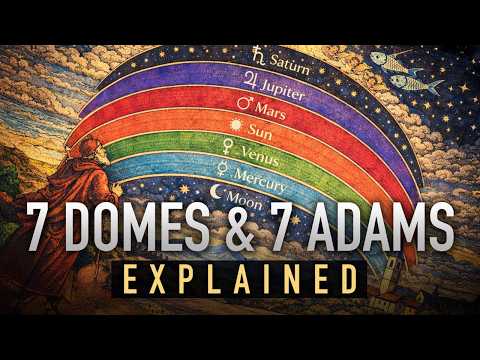
[18:09]For Umm al-Kitab, the original sin is not eating from the tree. It's not refusing to prostrate to Adam. There's something that's taking place actually way before that, in a world that exists before that. To deal with this, Allah Subhanahu Wa Ta'ala creates new, loyal lights - six tiers of spirits - and the chief of them is Salman. So God starts creating all these types of things. He starts creating domes that are made of colors actually. Worlds, and he also starts creating creatures. So, the curtains become stages of punishment. Now the curtains/domes start to function as downward levels, all right? The High King takes back the light He lent Azazil. He thickens the rebellious light into colored curtains/spheres. So they were more they were more light.
[19:42]They were more thin. They were more like light and they became more embodied. They became more coagulated. A ruby red curtain became the first one, or the seventh heaven. A fiery curtain was made under that and that became the sixth heaven. A carnelian sphere was created, the fifth heaven. An emerald sphere, the fourth heaven. A violet dome, the third heaven. A sun-colored sphere, the second heaven. A moon-colored curtain, the first heaven. And then a blue lapis sphere, which is the earth realm. And that reminds me actually of a particular chapter in the Bible. The Covenant confirmed, The Israelites see God. It said, Then the Lord said to Moses, Come up to the Lord, you and Aaron, Nadab and Abihu, and seventy of the elders of Israel. You are to worship at a distance. But Moses alone is to approach the Lord; the others must not come near. And the people may not come up with him.
[21:05]When Moses went and told the people all the Lord's words and laws, they responded with one voice, Everything the Lord has said we will do. Moses then wrote down everything the Lord had said. He got up early the next morning and built an altar at the foot of the mountain and set up twelve stone pillars representing the twelve tribes of Israel. Then he sent young Israelite men, and they offered burnt offerings and sacrificed young bulls as fellowship offerings to the Lord. Moses took half of the blood and put it in bowls, and the other half he splashed against the altar. Then he took the Book of the Covenant and read it to the people. They responded, We will do everything the Lord has said; we will obey.
[22:00]Moses then took the blood, sprinkled it on the people and said, This is the blood of the covenant that the Lord has made with you in accordance with all these words. Moses and Aaron, Nadab and Abihu, and the seventy elders of Israel went up and saw the God of Israel. Under his feet was something like a pavement made of lapis lazuli, as bright blue as the sky.
[22:27]But God did not raise his hand against these leaders of the Israelites; they saw God, and they ate and drank. So here's a reference in this scene of the Old Testament of God making an appearance in this dome, described in the same way as it is in Umm al-Kitab. Okay, so what happens then in the Book? Each time Azazil and his followers rebel again, they're pushed further down, wrapped in a denser, darker dome. Now, here comes the meaning to the secret of the first narration that we mentioned, in which it was said that before our Adam, there was an Adam, then Adam, and seven Adams. So, basically, what takes place in the Book, is that Allah spreads a ruby-red dome over them. And then he leaves Iblis and everybody in there for 1,000 years. After 1,000 years, he comes up to him, veiled behind somebody in that dome, and he says, Who am I? Same thing happens again. Same test is proposed, same refusal takes place, refuses to bow, prostrate to the Hajj of Allah. They don't accept Salman as the door, they don't accept God, they think that they are equals and God ends up pushing them lower. So they go from being above the seventh heaven, to the seventh heaven, to the sixth, and downwards. These domes were part of the cosmic architecture, but after the rebellion they became like prison levels and filters, all right? So, in both books this idea, these seven heavens, these spheres of different colors. This light that started off very white and pure, and as it shoots down and it goes through the different stained glass, or it's influenced by the planets, okay? It changes color. In the Umm al-Kitab, creation unfolds as curtains and spheres (ruby, fire, carnelian, emerald, violet, solar, lunar, blue, etc.). They become stages of fall and also layers of the heavens. In the Hermetica, the cosmos is structured as seven planetary spheres (Moon, Mercury, Venus, Sun, Mars, Jupiter, Saturn). Souls descend through them (taking on traits) and ascend back (shedding them). The soul descends through them, it takes on traits in each level, then it ascends back, it sheds those traits. Remember? Yeah, okay. So, in both of them there is a stepped, a ladder, a sevenfold sky. Each level marking a different quality and density of being, and a path of descent and possible ascent. That is possible in both of them. Okay. So, in both of these ideas, in Hermeticism, the religion of Hermes and also in the mystical gnostic version of religion of Islam, you cannot escape by yourself. You need a revealer, a teacher from above, and inner transformation through knowledge and discipline. You have to know the Imam of your time. In both of these teachings, you have somebody who's present in everyday and age, who acts as the Ark of Salvation, as the rope of Allah, right? That is attached to the white realm, the High King's Throne, up above that is already mixed with the very substance of initial creation. His body has already meshed with his soul, has already meshed with the veil up above. And so, he's present to always guide people that have already fallen down and to lead them back up through the realms that we fell from. The more that we're comfortable here, the more that we fall deeper down and it's impossible for us to rise, all right? And that's why Jesus, Muhammad, and the Imams, alayh al-salam, and the Prophets, they all had this kind of rejection. These teachings that reject the love of the dunya and having hopes in the hereafter. And this is this concept is very key here. I think if we were to summarize salvation in a big way, it would kind of go back to this sentence here, and that is that we want to rise back up through the realms that we fell from. The more that we become comfortable with, we fall in love with the stuff that we see around us, which is all fallen matter, fallen spirit, disobedient matter, disobedient spirit. The more that we're comfortable here, the more that we fall deeper down and it's impossible for us to rise. And that's why Azazil, Muhammad, and the Imams, alayh al-salam, and the Prophets, they all had this kind of rejection. These teachings that reject the love of the dunya and having hopes in the hereafter.


