[0:00]Hey guys, Janice here. As promised, today I'm going to attempt to make history with my revolutionary discovery regarding the male member. Any company, inventor or individual that runs with the ideas I've put forth in this video will become the leading voice of the sexual health industry in the years to come. Make no mistake. Before I am a researcher, I am a philosopher. So, whenever I approach the topic of the male phallus, one of the very first questions I posed to myself was, why? Why does it exist? When I started out, I gave the generalistic and vague answers for reproduction for penetrating the vaginal canal for depositing sperm as closely to the opening of the cervix as possible, et cetera. I gave the usual, logical, age-old answers that really didn't help describe the process very much. After I did some reading, I asked the question yet again. Why? Why does it exist? This time, I gave some more in-depth, though still somewhat worthless answers. The crown is designed to scoop out the semen of other men that have copulated with a female. The penis stopped calcifying slash being a literal bone as a protective measure. The penis is situated in a spot that takes advantage of locomotion, such as walking. Females helped design the male member through the ingenuity of natural selection. The glands exist as a cushion to keep men from all but literally beating female organs bloody during sex. The corpora cavernosa exists as two separate communicable holes to ensure that an erection, even should a blood vessel get blocked, still happens. The corpora cavernosa exists as two blood vessels side by side for added strength and stability. Still pretty general, but just that much further the answers that I was hoping to find. Putting it simply, I was approaching things from a scientific perspective, detached, cold, rational, and sex is none of those things. To understand the reason behind the design of anything, or how to make something better for that matter, you must first look at what it must overcome or otherwise endure. Going even further, and this is very important, how can pleasure be derived from the act for which it was created? After careful thought, I came to understand that within the confines of that last and most important of questions, there was a hidden problem. One last question to be answered, how could something be designed to thrive in the midst of what it was designed to do, not merely derive pleasure momentarily, but for as long as possible to reach even greater heights? For years, that hidden question haunted me.
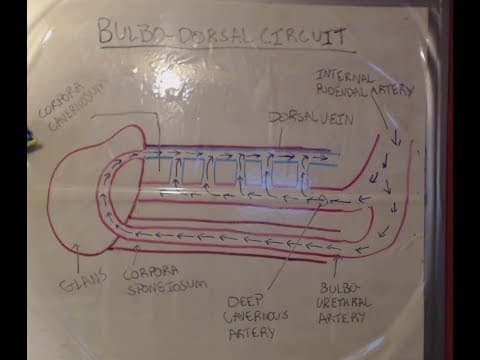
[3:02]I'm not even sure how many tens or hundreds of thousands of times I've repeated that last part back to myself. As it would turn out, I found my ultimate revelation in the midst of hedonism. I would find the answers I've sought all this time in sex. Something I noticed throughout my life is how much more alive and healthy my member would look after sex in comparison to anything I've ever done in the realms of PE. Comparing the two, there was no contest. How it looked and felt after sex, always won out. So I asked myself. I asked myself, why does it exist? This time, my answer resembled nothing I'd ever given prior. It it genuinely stood completely on its own in my mind. It was the singularity I'd been looking for all this time. Ironically, my so-called great answers, it was practically staring me down, waiting for me to notice it. The penis is designed for pleasure, both to receive and give. Though this observation was simple enough, the dominos that set toppling in my mind would lead me to only one conclusion with absolute certainty. The penis is designed to grow from the stimuli which occurs during sex. So, the only question I had left to ask was, what kind of stimulation does occur during sex? This question posed a fairly serious problem for me. Even being realistic, the number of factors that come into play during sex are somewhat overwhelming. I needed to narrow down my focus as much as possible. The only thing that I could think to do was to double down on my understanding of male anatomy. For my troubles, I learned that the male phallus consists almost entirely out of vascular tissue. Starting from the inside, moving out, we have the two cavernosal arteries which run down the middle of the Corpora Cavernosa chambers. Then we had the two bulbo urethral arteries which run on either side of the urethra in the corpus spongiosum. After further study, I would find that all of these arteries were branches of the branches of the internal pudendal's, internal iliacs, and finally the aortic forks. Putting it simply, the male member was positioned in an area of exceptionally high blood flow potential being just above the legs. Returning to the corpora chambers, the distal branches of the internal pudendal arteries, which we would know as the cavernous arteries, exist at the respective centers of each of the chambers as helicine arteries. This means arteries which spiral as they terminate into a bed of capillaries. From the helicine arteries, we have exactly that, a bushy mass of capillaries that radiates out as is typical for the arterial system. Unlike a normal bed, however, these are sinusoidal capillaries, this meaning that the male member is predominantly populated with a communicable capillary bed that exists as a mass of interconnected spaces. Even having understood this much about the male reproductive organs, I still needed to know a great deal more to make any kind of effective headway. Like most, I singled in on how stretch can stimulate smooth muscles, ways to influence collagen wrappings, plastic deformation techniques, ways to elicit growth under continuous tension, all of the common belief systems and research pockets surrounding male sexual health and enlargement. And, like everyone else, I was still coming to the same tired and worn-out conclusions which were producing hit or miss success at best. It was painfully obvious to me that I, along with everyone else, was missing some kind of crucial detail. As many of you now know, that missing link was the glycocalyx and its protein hairs. The glycocalyx is a protein and lipid based shag carpet, also known as the pericellular matrix, which coats the entirety of our vascular system. This special lining serves many important functions, ranging from helping to fight off disease, all the way to being a electromagnetic transport system. For the purposes of this discussion, however, I shall be focusing primarily on its role as a sensing mechanism. Blood vessels must be capable of responding quickly to any and all changes in the rate of blood flow as a mechanism of adaptation, or the vessel becomes damaged by blood flow itself. For these two reasons alone, a straightforward and mechanically automated response is ideal. The first picture I would like to show everyone is a cross section of a blood vessel in a relatively constricted state. Starting from the inside and moving out, I have drawn few arrows along the central channel to show the relatively little amount of blood flow passing through the vessel along with low speed. Going out further, we find the glycoprotein and glycolipid structures of the glycocalyx. Notice how the glycoprotein hairs are barely bent over or are only lazily moving about in the blood flow passing through the vessel. Then, we have the endothelial cells which the glycolipid coats and from which the glycoprotein hairs protrude. Inside the endothelial cell, a mechanism which controls nitric oxide production and release, produces and expels nitric oxide from the cell at a fairly slow rate. This slower rate results in a greatly diminished degree of smooth muscle relaxation. The second picture is a cross section of a blood vessel experiencing a spike in blood flow. Like the first picture, we shall start from the inside and move out from there. In the middle of this vessel, I've drawn a lot more arrows to show the greater amount of blood flow and even made them longer to show the greater speed at which blood is traveling. Going further out, we see the glycocalyx. Notice the sharp angle at which these hairs are bent. Though this is a still image, in real life, these hairs would be whipping about at great speeds. This increase in movement is also transferred intracellularly to the mechanisms responsible for producing nitric oxide. In response to this increase in speed, nitric oxide will be made and expelled from the cell at a much greater speed. Going out further, we can see that nitric oxide concentration levels are much higher in the smooth muscle layer of the blood vessel. This higher concentration, as could be guessed by the picture, leads to a greater degree of relaxation. Now that I've done a bit to describe the dynamic between blood flow and blood vessels, I can begin explaining how blood flow is used to exercise smooth muscles. On the board here, I have drawn head-on pictures of the first two blood vessel examples side-by-side. On the left, we have an example of a blood vessel that is currently in a contracted state. Flow is currently slow and low. Then on the right, we have a blood vessel that is currently in a relaxed state. Flow is high and fast. Before I can go any further, I need to make it expressly clear that a good deal of my research will not make any sense unless you specifically understand that the heart is not a pump. It does serve a very important purpose, however, it is not a pump. The vascular system itself is the pump. The heart, without going too far off topic, is a timing flow regulator/force multiplier and second of three brains in the body. What this means is that what we feel as a heart beat is the equivalent of a bottle uncorking. Blood is being pushed into the heart from the venous side and then forcefully drawn out on the arterial side. What we feel as a heart beat is the blood traveling from a high pressure area, which occurs when the heart temporarily stops and redirects flow, to a low pressure area caused by the arterial system attempting to forcefully suck the blood out of the heart. Looking to the left, this state would occur whenever the heart closes off its chambers to redirect blood. Basically, the blood flow rate slows to a crawl for a very brief moment, greatly reducing shear stress. This causes a sudden fall in nitric oxide production. This fall in nitric oxide production causes smooth muscles to contract. Then, here on the right, this state would occur whenever the heart opens its chamber to accept blood and allow it to be removed. In this instance, flow is higher and greatly increases shear stress. This causes an increase in nitric oxide release and therefore smooth muscles to relax. Let me make this as clear as possible. Smooth muscles are relaxing and contracting in response to shear stress, not pressure. So, that means the key to exercising our blood vessels centers around manipulating the rate of flow. As cool as this discovery is, shear stress causes one more amazing phenomenon that causes the whole of our vascular system to work together. This phenomenon is called endothelial cell migration. Whenever endothelial cells are exposed to growth factors naturally found in our bloodstream and shear stress simultaneously, endothelial cells begin to literally migrate in the direction of flow. Based on my research, I have come to discover that various levels of growth factor release can greatly influence the rate of migration. But, the most important part is shear stress. Whenever shear stress levels rise, endothelial cells get to hoofing it. Not only do they begin to move, they also begin multiplying and boring holes into blood vessel walls so as to radiate outwardly. All of this comes together to cause vasculogenesis coupled with downstream angiogenesis that translates into capillary bed expansion. Putting it as straightforward and as simple as possible, increased shear stress literally pulls endothelial cells into whatever area is experiencing higher amounts of shear stress. This process is what causes arteries to become great bushy masses, much like we would find in our corpora chambers. Returning to the idea that the stimulation which occurs during sex should work to encourage the male member to grow, I began applying my blood vessel research to its structuring. I already knew how a male member looked when stationary, but I had to see it in action to really understand how it worked. So, I started observing sex from as many perspectives as possible with a notepad and pen within reach. Not really knowing exactly what I was looking for, I figured I would start with general observations first. Out of all of my general observations, only one aspect really seemed to capture my attention. Without fully knowing why, I found myself most captivated by the motions inherent to sex. Things like hip tilting, entry and withdrawal, and repetitive movements among other factors. I felt there was more going on than met the eye, but I still needed to know a few more things before I could really piece together why. My next area of study would be cadaver cross-sections of the female pelvis. More than just the vagina being an object of desire for men, I fully believed it held a secret purpose, one that would answer my last and most difficult question regarding how the male member could thrive and grow from sex. Quite disappointingly, I was unable to make much headway studying female cadavers. So, once more, I decided to focus on the motions of sex itself. For this aspect of my research, I decided to utilize Pornhub and began to exclusively focus on the females in any given scene. I I still believed somehow, inherently, they held the secrets I was hoping to find. This avenue of research, well, it almost hit a brick wall until I became more selective and specifically began studying scenes where the arousal of the given female was most evident. This being facial flushing, if visible, pupil dilation, grooming behaviors, proactive participation leading the exchange, et cetera. Literally, within minutes of narrowing my focus, one motion kept repeating itself over and over. Whenever a female is highly aroused, they will attempt to take the position of aggressor during a sexual encounter. They will start to shamelessly pursue orgasm. Their motions thereafter become instinctual and for the express purposes of increasing the intensity of the friction between their vaginal walls and the male member. This desire quickly translates into a very distinct series of motions that are as follows. Upon penetration, the female will tilt her hips in such a way that allows the male member to slide into the depths of her vaginal canal unimpeded. However, upon doing so, she will then tilt her pelvis backwards, thereby placing pressure along the Corpora Spongiosa, and then she proceeds to lift her hips up. This motion is ideal for the female, since it increases the amount of pressure and friction experienced by her G-spot several fold. In in nearly every case where I viewed a female that was the active participant and highly aroused during a sexual encounter, they would eventually resort to a similar series of motions involving pelvic tilting to reduce and increase drag. They would also actively fight for a position of power where they could straddle their partner. At this point, I still really didn't know what I had found, but I knew beyond a shadow of a doubt that it was extremely significant. If not the most important observation I had made in my entire career as a researcher. On pure instinct, these women were accessing ancient knowledge built into their very being. All of this time, the answers I've sought were at last finally being laid bare. All I needed to do now was connect just a few more dots. Last week, I had stated that I found a secret hidden in the male member which was key to its growth. Before I reveal that, I'd like to say a few words. First, I would like to personally thank the members of Thunders Place and Reddit. Your feedback, support, debating, and overall engagement helped me make all of this possible. Second, to all of the researchers throughout the world that have sent me books, research papers and your kind words. Thank you. Every time I received them, I was both humbled and greatly enriched. Now, ladies and gentlemen, allow me the honor of revealing to you and the world something I have decided to call the Bulbo-dorsal circuit. Starting with a bit of a review, I've drawn behind me here a very rudimentary cross-section of the male pelvis. At the top we have a branch of the aorta, which then descends into the internal iliac artery, and then descends into the internal pudendal artery. And then the internal pudendal artery terminates into this top artery, which is the deep cavernous artery, and then the one along the bottom which runs through the spongiosum, the bulbo-urethral artery. To help everyone better understand, I've drawn a picture of the end of a male member so as to focus in on three key areas. Starting from the bulbo-urethral artery, we see that this blood vessel goes down the length of the Corpora Spongiosa, and then straight into the glands, where it radiates out and then comes into contact with the beginning of the dorsal veins, which then runs along the top side of the shaft. Thus far, everything looks pretty straightforward, but there's more to this story. Fairly early on in stepping onto the public scene, many men started to toy with the mechanisms I brought forward. A few had pointed out fairly early on that things may go better if we stroked the Corpora Spongiosa as opposed to the top side of the shaft. And initially, I'd shot the idea down because I believed the glands would be unable to handle a large influx of blood and would be well, become damaged by the high flow. In reality, the glands are designed for exactly that reason. The glands is unlike any other structure of the male member in that it possesses a highly elastic fascial wrapping that allows it to expand, flare, and then discharge the incoming flow of blood through the dorsal veins. If we think back to how a female attempts to take a position of power during a sexual encounter when highly aroused, and then carefully examine the male member, we will find several indicators of selective breeding. Essentially, female-driven adaptations. The first is the direction and shape of the glands. As many may note it has a prominent ridge. This allows for among other things, a softer, textured and more intense point of stimulation for a sporting female, hoping to reach orgasm quickly and without the fear of hurting themselves on a more blunted and narrowed shaft, like we would find without the protection offered by the glands.
[21:09]A next point of selective breeding is the Corpora Spongiosa, along with its placement in relation to the intense displays of female arousal. Whenever a female straddles a male and begins mindlessly pursuing orgasm, she will tilt and then move her pelvis back and forth in an undulating and highly coordinated dance. This dance repeatedly draws blood from the Corpora Spongiosa and up into the glands which harden and then quickly discharges the blood through the two dorsal veins. The next point of selective breeding will take a bit more explanation before it will become entirely apparent. Before doing that, I would like to explain how the first two Angion methods exist in relation to one another. Throughout the Angion method series, we've been stimulating portions of what I've referred to as the Bulbo-dorsal circuit. The first Angion method I released several months ago stimulated the venous portion of the Bulbo-dorsal circuit to fairly great effect. I was able to manipulate the amount of blood that passed through my member. Combining this with changes to my diet and research-driven changes to my cardio routine, I was able to greatly improve my size. However, many found a great deal of difficulty following my example regarding gains. A large portion of this I contributed to differences in diet, activity level, age, and potential pre-existing health conditions. Regardless the case, men were still able to significantly improve their EQ. Few, however, were able to start gaining. While I was happy that men were able to start seeing EQ improvements, Angion method 1.0 fell painfully short of my desired goals. You see, I didn't just want men to have EQ improvements. I also wanted them to gain size, because let's be honest, that's what everybody's really after. So, accepting Angion method 1.0 as a failure, I went back to the drawing board and designed Angion method 2.0. This version was a lot more powerful than the first, but it was difficult to perform. Plus, at this point, I still didn't realize that the glands were a pressure buffer zone. Looking back, however, this became very apparent whenever men would report sudden loss of glands fullness during an exercise session while performing Angion method 1.0. The lessons from Angion method 1.0 became even more solidified by the feedback that men gave about Angion method 2.0. Many frequently reported a great deal of difficulty in attempting to perform the exercise. It was only men who already possessed good arterial development that reported having the most success. Much like the first version, I ended up having to chalk up Angion method 2.0 as a failure. Men needed something extremely simple, streamlined, highly effective and took full advantage of any pre-existing structures. This led me to look more closely at key aspects of human anatomy in light of the dynamics displayed during human mating. As mentioned prior, whenever a highly aroused female takes a position of power during a sexual encounter, they place a great deal of highly coordinated stimuli on the male member, chiefly, the Corpora Spongiosa. This stimuli, if carefully examined, translates into a repetitive upwards motion. A repetitive upwards dragging motion to be specific, among other things. As we know from the lessons learned from the first two Angion methods, this motion would move blood very rapidly through the Bulbo-dorsal circuit. However, there's a hidden dynamic. To help everyone better understand, I have drawn a collection of veins much like can be found running along the top side of the male member. For this demonstration, I have drawn arrows indicating the direction of flow. As we can see in this illustration, as the blood is pushed from the glands, it then flows through the dorsal veins. As the blood moves through this central channel, it creates instances of negative pressure inside the tributary veins. This negative pressure effectively pulls blood through these tributary channels at a speed in proportion to what is achieved in the main channel. The next picture I'd like to show everyone is a cross section that includes sinusoidal spaces along with the tributary veins I showed prior along the outside. In the center of the corpora chamber, we have a helicine artery that spirals and sends blood out in all directions. Then, as we move out from there, we can see the blood spiraling and flowing outwardly in all directions by merit of vortical and centrifugal force. Notice the oppositional spiraling and how they propagate one another like so many gears turning and existing in three dimensions. Ladies and gentlemen, I promised you at the start of this video that I would attempt to make history. I, without one shred of doubt or hesitation, stake my reputation on the following statement. The Bulbo-dorsal circuit and its flow dynamics are purposefully designed to grow the male member. Going even further that it is a mechanically perfected design, finally, that all other methods fall unquestionably short of its power. The only question left to answer is how to utilize this amazing and innate design. Returning once more to human mating behaviors, whenever I examine the technique females instinctively employ while pursuing orgasm, I found a repetitive upwards stroking technique. The final Angion mimics this motion. Once more, another member of Thunders Place had mentioned using his middle fingers to stroke the Corpora Spongiosa. I also found this approach to be ideal. Using my middle fingers, I found that by depressing the Corpora Spongiosa and then stroking upwards towards the glands in a repetitive manner, I was able to powerfully activate the Bulbo-dorsal circuit. It is now that I would like to state that all of the other exercises I have presented fall utterly short of the glory of this final Angion. So far as I am aware, this is the most powerful PE technique in existence, possibly to have ever existed. It is because of this that I have decided to bestow it with its own name. By combining the word scion and vessel, yet still remaining true to the roots of the Angion method, I shall call this last and greatest of techniques the vascion, literally translating to mean scion of blood vessels. Before I go into the demonstration portion, I would like to cover a few things. First, the vascion, much like the other incarnations of the Angion method, is a highly specialized form of blood vessel stimulation. This stimulation taxes your blood vessels in a manner in line with how they grow naturally. However, unlike the other Angion methods, the vascion is a supraphysiological form of stimulation. Like all other exercise-related endeavors, slow and steady wins a lot of races. Even going at a relatively slow pace, the vascion effortlessly outperforms all of the other versions of the Angion method. Also, much like other Angion methods, the vascion is a completely stand-alone exercise. This exercise is purposefully designed to stand completely on its own. You do not need to do any other exercises to see improvements or gains. To demonstrate how to perform the vascion, I have a cucumber with me as I always do for my demonstrations. With this technique, it is not necessary to start with an erection. It will cause one to occur naturally. For expediency sake, however, a partial engorgement is a good start as it will provide much more surface area to work with. First, apply some lubricant to your Corpora Spongiosa. Use it liberally and throughout your session to keep friction low. Then, using your middle fingers, begin stroking your Corpora Spongiosa, starting from the base and stroking towards your glands. The best way to perform this exercise is with nice, long strokes, the longer the better. Do not worry so much about speed starting off. Focus only on the motion and the feeling of blood moving through your Bulbo-dorsal circuit. Within a matter of seconds, you should begin to develop an erection. As the session progresses, your member will expand greatly from the massive increase in shear stress stimulated nitric oxide release.
[30:28]Talking further for a moment, I've used the vascion for as little as a handful of minutes all the way up to a full hour and a half. As of right now, I really don't know an ideal amount of time per session. This exercise will require even further evaluation for that to occur. Right now though, I got to say I'm I'm pretty excited for the future. I feel pretty confident in saying that the era of smooth muscle building has begun. In the coming weeks and months, P shall ascend to greatness and take its rightful place next to bodybuilding as a respected discipline. In the coming years, who knows what's going to happen. If I have any say in the matter, it's going to be do it yourself organ growth next. Well, everyone, I hope you enjoyed this video and that it inspires you to make some of your own breakthroughs. Making this video was an absolute pleasure. Once again, I'd like to give a shout-out to everyone over at Thunders Place. To all the members that have been with me since the beginning, you guys are awesome. As always, I'm your host, Janice, signing off.


