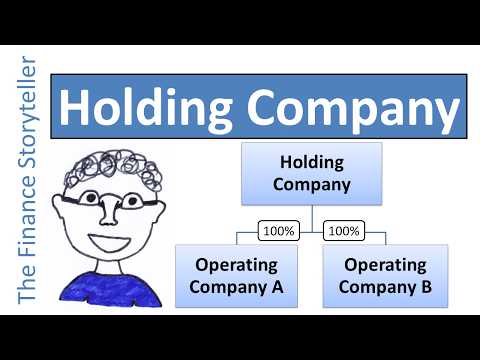
[0:00]How does a holding company work? Here's the simplest holding company structure that I can think of. A holding company that owns 100% of the shares in an operating company. The holding company is the parent. The operating company is the daughter or subsidiary. A common definition of a holding company is a company whose primary business is holding a controlling interest in the securities of other companies. Most often a controlling interest. The operating company is a business entity that conducts day-to-day operations. The holding company hopes to benefit from the profits generated by one or more of those subsidiary operating companies. From that simple holding company structure, we can start to build a more elaborate holding company structure. How about a holding company with two operating companies below it, independent legal entities as part of a group. For example, operating company A is a car dealership. Operating company B owns the building that company A is located in. The car dealership pays rent to the real estate company. However, as both daughter companies are owned by the same parent company, the rent payment is an intercompany transaction that will be eliminated when consolidating group results. It's all within the family. Why would you go through the trouble of setting up and maintaining this holding company structure rather than running it all from just one company? Risk management is a big reason. In case something serious happens in either operating company A or operating company B, litigation or bankruptcy, for example, you will most likely be able to isolate the problem in just that operating company without it affecting the other operating company or the holding company. And in case the operating companies have been generating profits over time, you can decide either to leave those cumulative profits in the operating companies or bring them up to the holding company through an intercompany dividend. Shareholders can then decide to keep these in the holding company or distribute them as a dividend to the owners. If fortunes turn afterwards, then at least you have preserved the retained earnings by transferring them to the holding company. The second big reason is optionality, which comes in many forms. Want to expand into the bicycle business? Just add another operating company below the same holding company, either as a wholly owned subsidiary or a joint venture. Want to sell the car dealership and retire? Sell that operating company but keep the real estate company for a rental income stream. Need financing to grow? Get a loan at the holding company level and invest that money into the operating companies. Or get a loan in an operating company with just the assets in that company as collateral for the loan. Tax efficiency. Example one. Depending on the country, if the holding owns a very substantial majority interest, at least 80% or in some cases even 95% of a subsidiary, they can file a joint tax return, allowing profits of one company to be offset by losses of another. Example two: tax-free reinvestment. Profits can be moved from operating companies to the holding company without immediate taxation, allowing for reinvestment, acquisition, or debt repayment. Let's look at some variations on holding company structures. What is a mixed holding company? This is where the parent company is both a holding company as well as an operating company. A mixed holding company is a corporate structure that both owns controlling interest in other companies and simultaneously conducts its own active business operations. A holding company that only owns interests in other companies would be called a pure holding company. What is an intermediate holding company? This is where the daughter has her own daughter and therefore also becomes a parent. The top level holding company is called the ultimate holding company. Operating company B is an intermediate holding company. In the real world, things can get far more complex. Have a look at the simplified company chart of Exor, one of the world's largest diversified holding companies. The percentage of economic ownership in the portfolio company might differ significantly from the percentage of voting rights in that company. For example, Exor owns nearly 20% of luxury sports car company Ferrari economically, but has 32% of the voting rights. 15 and a half percent economic ownership of one of the world's leading auto makers, Stelantis, but 24% of the voting rights. Majority ownership in some cases, minority ownership in others. If you are looking at financial reports in the holding company structure, it is very important to ask yourself, which financial report you are looking at. The consolidated or group financial statements, the whole family, or just the company only, parent company financial statements. Big difference.
Holding company explained
The Finance Storyteller
5m 30s788 words~4 min read
YouTube auto captions
Transcript source
YouTube auto captions
This transcript was extracted from YouTube's auto-generated caption track. The transcript below is server-rendered so it can be read, searched, cited, and shared without opening the original YouTube player.
Pull quotes
[0:00]A common definition of a holding company is a company whose primary business is holding a controlling interest in the securities of other companies.
[0:00]The holding company hopes to benefit from the profits generated by one or more of those subsidiary operating companies.
[0:00]From that simple holding company structure, we can start to build a more elaborate holding company structure.
[0:00]How about a holding company with two operating companies below it, independent legal entities as part of a group.
Use this transcript
Related transcript hubs
Watch on YouTube
Share
MORE TRANSCRIPTS


