[0:00]Bricks, beads and bones. BP, Before Present. BCE, Before Common Era. CE, Common Era. The present year is 2007 according to this dating system. C stands for the Latin word circa and means approximate. Period of Harappan civilization. Early Harappan civilization before 2600. Mature Harappan civilization 2600 to 1900 BCE. Later Harappan civilization after 1900 BCE. Harappan culture. Archaeologists use the term culture for a group of objects, distinctive in style, that are usually found together within a specific geographical area and period of time. In the case of the Harappan culture, these distinctive objects include seals, beads, weights, stone blades and even baked bricks. These objects were found from areas as far apart as Afghanistan, Jammu, Baluchistan (Pakistan) and Gujarat. Harappan Seal. The Harappan seal is possibly the most distinctive artefact of the Harappan or Indus Valley Civilisation. Made of a stone called steatite, seals like this one often contain animal motifs and signs from a script that remains undeciphered. 1. Beginnings. 1. Pre-Harappan Cultures. There were several archaeological cultures in the region prior to the Mature Harappan period. 2. Distinctive Features. These early cultures were associated with distinctive pottery, evidence of agriculture and pastoralism, and some crafts. 3. Settlement Patterns. The settlements were generally small in size, and there were virtually no large buildings found. 4. Disruption in Continuity. It appears that there was a break between the Early Harappan and Mature Harappan Civilisation. 5. Evidence of Destruction and Abandonment. This break is evident from large-scale burning at some sites, as well as the abandonment of certain settlements. 2. Subsistence Strategies. 1. Cultural Continuity. The Mature Harappan culture developed in some of the areas previously occupied by Early Harappan cultures. 2. Common Cultural Elements. These cultures shared certain common features, including subsistence strategies. 3. Harappan Diet. The Harappans consumed a wide range of plant and animal products, including fish. 4. Archaeological Evidence of Food. Archaeologists have reconstructed Harappan dietary practices through finds of charred grains and seeds. 5. Role of Archaeo-Botanists. Archaeo-botanists, specialists in ancient plant remains, study these seeds to understand plant usage. 6. Crops Grown. Grains found at Harappan sites include wheat, barley, lentil, chickpea, and sesame. Millets were found at sites in Gujarat, while rice remains are relatively rare. 7. Domesticated Animals. Animal bones found at sites include cattle, sheep, goat, buffalo, and pig – all believed to be domesticated. 8. Wild Animal Remains. Bones of wild animals like boar, deer, and gharial are also found, though it is unclear whether Harappans hunted them or acquired them through other communities. 9. Aquatic and Bird Consumption. Remains of fish and fowl have also been discovered at Harappan sites, suggesting their consumption. 10. Role of Zooarchaeologists. Zooarchaeologists, or archaeo-zoologists, study ancient animal remains to understand domestication and dietary habits. 2.1 Agricultural Technologies. 1. Evidence of Agriculture. The presence of agriculture is indicated by the discovery of grains at Harappan sites. 2. Uncertainty About Techniques. While agriculture is evident, it is difficult to reconstruct the exact methods used – for example, whether seeds were scattered (broadcast) on ploughed fields. 3. Use of Oxen for Ploughing. Seals and terracotta sculptures show bulls, suggesting that oxen may have been used for ploughing the fields. 4. Terracotta Plough Models. Models of ploughs made from terracotta have been found at sites like Cholistan and Banawali (Haryana), supporting the idea of plough-based farming. 5. Ploughed Field at Kalibangan. Evidence of a ploughed field has been found at Kalibangan (Rajasthan), with two sets of furrows at right angles – indicating the practice of growing two crops together. 6. Harvesting Tools. Archaeologists are still unsure about the exact tools used for harvesting. Possibilities include: Stone blades set in wooden handles. Metal tools. 7. Need for Irrigation. Most Harappan sites are located in semi-arid regions, where irrigation would have been necessary for farming. 8. Evidence of Irrigation Systems. Traces of canals were found at Shortughai (Afghanistan). No canal traces found in Punjab or Sind - possibly silted over time. Wells might have been a source of irrigation. Water reservoirs at Dholavira (Gujarat) may have been used to store water for agriculture. How artefacts are identified. Ernest Mackay’s report on Mohenjodaro (1937): Explanation of the Source. This source describes how archaeologists identify and interpret artefacts used by the Harappans, especially grinding tools used in food preparation. The observations come from excavations at Mohenjodaro, one of the most important sites of the Harappan civilisation. Key Points from the Source: 1. Food Preparation Tools. The Harappans used different types of tools for grinding, mixing, and cooking food. These were made of: Stone, Metal, Terracotta (baked clay). 2. Saddle Querns. These are a type of grinding stone found in large numbers at Mohenjodaro. There were two main types: Type 1: A larger stone base with a smaller stone rolled or pushed over it. Use: Most likely used to grind cereals/grains. Type 2: A larger base stone on which another stone was used to pound ingredients. Use: Probably used for pounding herbs and spices, like making curries. These are nicknamed “curry stones” by local workers. 3. Material and Usage. These stones were made from hard, gritty rocks like sandstone or igneous rock. The stones showed signs of heavy use, meaning they were important and regularly used. Since their bases were convex (curved at the bottom), they had to be embedded in earth or mud to keep them stable. 4. A Glimpse into Everyday Life. The report gives a human touch to archaeology: Local workers and even the cook recognized the usefulness of these tools and even borrowed one from the museum to use in the kitchen! Conclusion. This source helps us understand how archaeologists study artefacts not just by finding them, but by observing their shape, material, and signs of use, and then interpreting their purpose. It also connects ancient tools to modern uses, showing that some traditional cooking methods have remained quite similar over time. 3. Mohenjodaro – A Planned Urban Centre. Discovery and Urban Development. Perhaps the most unique feature of the Harappan civilisation was the development of urban centres. Although Mohenjodaro is the most well-known site, the first site to be discovered was Harappa. Citadel and Lower Town. The settlement is divided into two sections, one smaller but higher and the other much larger but lower. Archaeologists designate these as the Citadel and the Lower Town respectively. The Citadel owes its height to the fact that buildings were constructed on mud brick platforms. It was walled, which meant that it was physically separated from the Lower Town. The Lower Town was also walled. Several buildings were built on platforms, which served as foundations. Labour and Construction. It has been calculated that if one labourer moved roughly a cubic metre of earth daily, just to put the foundations in place it would have required four million person-days, in other words, mobilising labour on a very large scale. City Planning and Bricks. Once the platforms were in place, all building activity within the city was restricted to a fixed area on the platforms. So it seems that the settlement was first planned and then implemented accordingly. Other signs of planning include bricks, which, whether sun-dried or baked, were of a standardised ratio, where the length and breadth were four times and twice the height respectively. Such bricks were used at all Harappan settlements. 3.1 Laying Out Drains. Street Layout and Drainage. One of the most distinctive features of Harappan cities was the carefully planned drainage system. The Lower Town roads and streets were laid out along an approximate ‘grid’ pattern, intersecting at right angles. It seems that streets with drains were laid out first and then houses built along them. If domestic waste water had to flow into the street drains, every house needed to have at least one wall along a street. 3.2 Domestic Architecture. House Layout and Privacy. The Lower Town at Mohenjodaro provides examples of residential buildings. Many were centred on a courtyard, with rooms on all sides. The courtyard was probably the centre of activities such as cooking and weaving, particularly during hot and dry weather. An apparent concern for privacy: there are no windows in the walls along the ground level. Besides, the main entrance does not give a direct view of the interior or the courtyard. Bathrooms and Wells. Every house had its own bathroom paved with bricks, with drains connected through the wall to the street drains. Some houses have remains of staircases to reach a second storey or the roof. Many houses had wells, often in a room that could be reached from the outside and perhaps used by passers-by. Scholars have estimated that the total number of wells in Mohenjodaro was about 700. 3.3 The Citadel. Public Buildings. It is on the Citadel that we find evidence of structures that were probably used for special public purposes. These include the warehouse - a massive structure of which the lower brick portions remain, while the upper portions, probably of wood, decayed long ago - and the Great Bath. The Great Bath. The Great Bath was a large rectangular tank in a courtyard surrounded by a corridor on all four sides. There were two flights of steps on the north and south leading into the tank, which was made watertight by setting bricks on edge and using a mortar of gypsum. There were rooms on three sides, in one of which was a large well. Water from the tank flowed into a huge drain. Ritual Use. Across a lane to the north lay a smaller building with eight bathrooms, four on each side of a corridor, with drains from each bathroom connecting to a drain that ran along the corridor. The uniqueness of the structure, as well as the context in which it was found (the Citadel, with several distinctive buildings), has led scholars to suggest that it was meant for some kind of a special ritual bath. Citadels. While most Harappan settlements have a small high western part and a larger lower eastern section, there are variations. At sites such as Dholavira and Lothal (Gujarat), the entire settlement was fortified, and sections within the town were also separated by walls. The Citadel within Lothal was not walled off, but was built at a height. The Most Ancient System Yet Discovered. Ernest Mackay’s 1948 work on the Early Indus Civilisation: Explanation of the Source. This source highlights the remarkable drainage system of the Harappan civilisation, considered one of the most advanced and well-planned in the ancient world. Key Points from the Source: 1. A Highly Advanced Drainage System. Mackay described the Harappan drainage as “the most complete ancient system yet discovered.” Every house was connected to a street-level drainage system. This indicates an exceptional level of urban planning and hygiene awareness. 2. Structure of the Drainage System. Main drains were constructed from bricks set in mortar. These were covered with removable bricks or, in some cases, limestone slabs to allow easy access for cleaning. House drains first emptied into a sump or cesspit, where solid waste would settle. The remaining wastewater flowed into the street drains. 3. Maintenance of the Drains. Long drains were equipped with cleaning sumps at intervals. Archaeologists often found small heaps of sand and debris near the drains, suggesting that: People cleaned the drains. However, the waste wasn’t always taken away after cleaning. 4. Not Limited to Big Cities. This advanced drainage system was not exclusive to major cities like Mohenjodaro or Harappa. At Lothal, a smaller settlement: Houses were built with mud bricks, but drains were constructed using burnt bricks, showing the importance of sanitation even in small towns. Conclusion. This source shows that the Harappans developed a highly sophisticated drainage system – far ahead of its time – with a focus on sanitation, cleanliness, and regular maintenance. It also proves that urban planning extended beyond major cities, reflecting a standardized system across the civilisation. 4. Tracking Social Differences. 4.1 Burials – A Clue to Social Differences. 1. Studying Burials to Understand Society. Archaeologists study burials to identify social or economic differences among people. This is a common practice in archaeology – similar to studying Egyptian pyramids, which were royal burials with immense wealth. 2. Harappan Burial Practices. The dead were usually buried in pits. Sometimes, pits were lined with bricks, suggesting possible social variation, though it’s not confirmed. 3. Grave Goods – Belief in Afterlife? Pottery and ornaments were sometimes placed in graves, possibly indicating belief in afterlife. Jewellery was found in both male and female burials. 4. Example from Harappa Cemetery (1980s). A male skeleton was found with: Three shell rings, One jasper bead (semi-precious stone), Hundreds of micro-beads. In some graves, copper mirrors were also buried with the dead. 5. General Pattern. Despite a few decorated burials, precious items were rarely buried, suggesting moderate belief in afterlife wealth. 4.2 Looking for “Luxuries” – Artefacts as Indicators. 1. Two Types of Artefacts. Utilitarian Objects. Used in daily life, made of common materials like stone or clay. Examples: Querns, pottery, needles, flesh-rubbers (body scrubbers). Found widely distributed across settlements. Luxury Objects: Rare, made from expensive, non-local materials or with advanced techniques. Example: Miniature pots of faience (a complex material made from ground sand, silica, color, and gum, then fired). 2. Classification Challenges. Some items like spindle whorls were made from luxury materials like faience. 3. Distribution of Luxury Items. Rare and valuable artefacts were mostly found in large cities like: Mohenjodaro, Harappa. Rarely found in small settlements like Kalibangan. 4. Precious Materials Like Gold. Gold jewellery was very rare. All gold items were found in hoards, not as part of daily use or burials. Just like today, gold was likely seen as a precious item. Hoards: objects kept carefully by people, often inside containers such as pots. Such hoards can be of jewellery or metal objects saved for reuse by metalworkers. If for some reason the original owners do not retrieve them, they remain where they are left till some archaeologist finds them. Here’s your content converted into well-structured points. 5. Finding Out About Craft Production. 5.1 Chanhudaro – A Specialized Craft Centre. 1. Location and Size. Chanhudaro is a small Harappan settlement (less than 7 hectares) compared to Mohenjodaro (125 hectares). It was almost entirely devoted to craft production. 2. Main Crafts Practised. Bead-making, Shell-cutting, Metal-working, Seal-making, Weight-making. Materials Used for Making Beads. 1. Natural and Artificial Materials. Stones: Carnelian (red), jasper, crystal, quartz, steatite. Metals: Copper, bronze, gold. Others: Shell, faience, terracotta (burnt clay). 2. Special Beads. Some were made of multiple stones, or stone with gold caps. Shapes: Disc-shaped, cylindrical, spherical, barrel-shaped, segmented. Some beads were painted, incised, or etched with designs. Techniques of Bead-Making. 1. Based on Material Type. Soft stones like steatite were easily moulded from powder paste into various shapes. Hard stones allowed mostly geometric shapes. 2. Unique Puzzle. Making steatite micro beads remains an unsolved mystery for archaeologists. 3. Colouring Technique. Carnelian (naturally yellowish) was heated to become red. Process: Chipping → Rough shape → Flaking → Grinding → Polishing → Drilling. 4. Specialised Drills Found At: Chanhudaro, Lothal, Dholavira. Coastal Craft Centres. 1. Nageshwar and Balakot. Located near the coast. Known for shell object production: Bangles, ladles, inlays. These objects were exported to other settlements. 2. Product Movement. Finished products like beads from Chanhudaro and Lothal were likely sent to large cities like Mohenjodaro and Harappa. 5.1 Identifying Centres of Production. 1. What Archaeologists Look For. To identify a craft production site, archaeologists search for: Raw materials (e.g., stone nodules, shells, copper ore), Tools used in production, Unfinished objects, Rejected pieces and waste material. 2. Importance of Waste. Waste material is the strongest evidence of production activities. Example: Shell or stone cutting leaves behind discarded pieces. Some larger pieces may be reused, but tiny bits are left behind. 3. Craft Work in Large Cities Too. Such production traces show that craft-making was not limited to small centres. Mohenjodaro and Harappa also had active craft production zones. 6. Strategies for Procuring Materials. 6.1 Local and Imported Raw Materials. 1. Local vs. Non-Local Materials. Locally available: Clay. Procured from outside: Stone, timber, metal. 2. Transportation Methods. Land: Terracotta models of bullock carts suggest use of land transport. Waterways: Likely use of riverine routes (Indus and tributaries) and coastal routes. 6.1 Materials From The Subcontinent and Beyond. A. Harappan Strategies for Material Procurement. 1. Establishing Settlements Near Sources. Shell: Nageshwar, Balakot. Lapis lazuli (blue semi-precious stone): Shortughai (Afghanistan). Carnelian: Near Lothal (sourced from Bharuch, Gujarat). Steatite: South Rajasthan and North Gujarat. Metals: From Rajasthan. 2. Sending Expeditions. Copper: Khetri region of Rajasthan. Gold: Southern India. These expeditions likely established contact with local communities. B. Archaeological Evidence of Contact. 1. Finds Supporting Contact. Steatite micro beads found in faraway regions. Suggests exchange or contact networks. 2. Ganeshwar-Jodhpura Culture (Khetri Region). Non-Harappan pottery style. Rich in copper artefacts. Possibly supplied copper to Harappans. 6.2 Contact with Distant Lands. A. Evidence of Trade with Oman. 1. Chemical Evidence. Harappan and Omani copper both contain nickel, suggesting a common source. 2. Harappan Jars Found in Oman. Large jars coated with thick black clay (to prevent leakage). Purpose unknown, possibly used for transporting goods in exchange for copper. 3. Mesopotamian Texts (3rd millennium BCE). Refer to a region called Magan (possibly Oman). Report copper imports from Magan. Mesopotamian copper also contains nickel. B. Mesopotamian Contacts with Harappans. 1. Mesopotamian Records Mention. Dilmun (likely Bahrain). Magan (likely Oman). Meluhha (possibly the Harappan region). 2. Products from Meluhha (as mentioned in texts). Carnelian, Lapis lazuli, Copper, Gold, Various types of wood. 3. Mythical Reference to Meluhha. “May your bird be the haza-bird, may its call be heard in the royal palace.” Haza-bird might refer to the peacock, possibly named after its call. C. Sea Trade and Communication. 1. Indications of Seafaring. Mesopotamian texts describe Meluhha as a land of seafarers. Harappan seals show ships and boats. 7. Seals, Script, Weights. 7.1 Seals and Sealings. 1. Purpose of Seals and Sealings. Used to facilitate long-distance communication. Example: A bag of goods tied with rope; wet clay seal affixed to the knot and impressed with a seal. 2. Function of Sealings. If the seal remained intact, it showed the bag was not tampered with. Seal impression conveyed the identity of the sender. 7.2 An Enigmatic Script. 1. Writing on Seals. Most Harappan seals include a line of writ. Likely indicating the owner’s name and title. Motifs (usually animals) might have conveyed meaning to non-literate people. 2. Nature of the Script. Inscriptions are short, with the longest being about 26 signs. Not an alphabetical script - too many signs (375 to 400 symbols). Likely written right to left, as seen from spacing patterns on seals. 3. Materials with Writing Found. Writing appears on: Seals, Copper tools, Rims of jars, Terracotta and copper tablets, Jewellery, Bone rods, Even a signboard. Possibility of perishable materials being used for writing suggests widespread literacy. 7.3 Weights. 1. System of Weights. Made of chert, usually cubical in shape and unmarked. Used for regulated exchanges, indicating a standardized system. 2. Weight Denominations. Lower denominations: Binary system. 1, 2, 4, 8, 16, 32, etc. up to 12,800. Higher denominations: Followed decimal system. 3. Usage of Weights. Smaller weights likely used to weigh jewellery and beads. Metal scale-pans have also been found. 8. Ancient Authority. Indications of Central Planning and Organisation. 1. Uniformity Across the Region. Harappan artefacts like pottery, seals, weights, and bricks show extraordinary uniformity. Bricks maintained a uniform ratio from Jammu to Gujarat, suggesting coordinated construction. 2. Strategic Settlements. Harappan settlements were often established in strategic locations for trade, resources, and defence. 3. Labour Mobilisation. Large-scale brick-making and construction (walls, platforms) imply the mobilisation of labour and organised effort. 8.1 Palaces and Kings. 1. Lack of Clear Power Symbols. No obvious centre of power or depictions of rulers have been found in archaeological records. A large building at Mohenjodaro was speculated as a palace, but no remarkable findings were linked to it. 2. The “Priest-King”. A famous stone statue is known as the “Priest-King”. This label comes from comparisons with Mesopotamian “priest-kings”. But Harappan ritual practices are not clearly understood, so it’s uncertain if religious leaders had political power. Theories About Political Authority. 1. Three Main Views Among Archaeologists. No rulers: Harappan society may have functioned without any central ruler. Single ruler: There might have been a single ruler for all Harappan settlements. Multiple rulers: Each major city (e.g., Mohenjodaro, Harappa) might have had its own ruler. Single unified state: Similar artefacts, planned settlements, uniform brick ratios, and raw material sourcing hint at centralised authority. This is the most widely accepted theory, as it explains how complex decisions could be implemented across regions. 9. The End of the Civilisation. 1. Abandonment of Sites. By around 1800 BCE, most Mature Harappan sites, especially in regions like Cholistan, were abandoned. 2. Emergence of New Settlements. During the same period, population expanded into new areas such as Gujarat, Haryana, and western Uttar Pradesh. 3. Change in Material Culture. Harappan sites still occupied after 1900 BCE show a transformation – distinctive artefacts like weights, seals, and special beads disappeared. 4. Decline of Key Features. Writing, long-distance trade, and craft specialisation also vanished. 5. Simpler Lifestyles. Fewer materials were used to make fewer items. Construction quality declined, and large public buildings were no longer built. 6. Rise of Rural Culture. Artefacts and settlements now reflect a rural lifestyle, identified as “Late Harappan” or “Successor Cultures.” 7. Possible Causes of Collapse. Climatic changes, Deforestation, Excessive floods, Shifting or drying rivers, Overuse of natural resources. 8. Limitations of These Theories. While these factors may explain changes at certain sites, they do not fully explain the collapse of the entire civilisation. 9. Collapse of the Harappan State. The most accepted view is that a strong unifying power – likely the Harappan state – came to an end. This is shown by: Disappearance of seals and script. Loss of standardised weights, Decline in uniform pottery and beads, Abandonment of urban centres. 10. Aftermath and Future Civilisations. The Indian subcontinent had to wait over a thousand years for the emergence of new cities in completely different regions. Source 3: Evidence of an “Invasion”. This source discusses different interpretations of skeletons found at Mohenjodaro and the debate over whether the Harappan Civilisation ended due to an invasion. Key Points from the Source: 1. A Skeleton Found (1925). A skeleton was found lying across a narrow lane in Mohenjodaro. Nearby, fragments of a tiny skull was found in the lane (possibly indicating a violent attack). 2. R.E.M. Wheeler’s Interpretation (1947). Connected the skeletons and destruction to the Rigveda, where Indra (the Aryan god) is called Puramdara (Fort destroyer). Believed that Indus cities were citadels attacked by Aryans. Suggested that the Harappan civilisation might have ended due to invasion or massacre. He speculated that Indra “stood accused” of destroying the Harappan cities. Summary: Other Findings in the 1960s. Doubted the theory of a massacre. Found no proof of large-scale destruction like burning or battles. Most skeletons seemed to be from poorly managed burials, not war. Concluded there was no final defence in citadel areas, so likely no invasion. Interpretation. Early archaeologists like Wheeler believed in the invasion theory based on skeletons and Vedic texts. Later archaeologists like Dales rejected this, showing that the evidence was misinterpreted and that massacre stories were likely a myth. Question: What are the similarities and differences between Maps 1, 2 and 4? All are in the Indus Valley Region – the core Harappan zone (present-day Pakistan and northwest India). Harappan sites are present – like Harappa, Mohenjodaro, Dholavira, Lothal, etc. Especially the Indus River and its tributaries (like Ravi, Sutlej). Trade and settlement pattern information. Differences. Time Period. Before 2600 BCE, 2600-1900 BCE, After 1900 BCE. Geographic Spread. Mostly northwestern region, Expansion into Gujarat, Haryana, Shrinking core, rural spread. Density of Sites. Fewer settlements, Dense urban, Fewer, rural settlements. Conclusion. Maps 1, 2, and 4 together show the rise, peak, and decline of the Harappan Civilisation. They reflect changes in location, lifestyle, trade, and urbanisation across time. Understanding these maps helps to visualise archaeological data and how civilisations evolve and decline. 10. Discovering the Harappan Civilisation. 1. Reconstructing History. Archaeologists have studied material remains to uncover Harappan history, but there’s also a story behind how the civilisation itself was rediscovered. Some important issues that lay ignored or were unknown to later generations were some of those significance. 1. Perplexing Artefacts. Strange artefacts would sometimes surface like in floods, soil erosion, or while ploughing fields or digging – but their importance wasn’t recognised. 10.1 Cunningham’s Confusion. 2. Role of Cunningham. Alexander Cunningham, the first Director-General of the Archaeological Survey of India (ASI), began excavations in the mid-19th century. 3. Reliance on Textual Evidence. At that time, archaeology heavily relied on written texts and inscriptions to guide exploration. 4. Cunningham’s Dilemma. Cunningham focused on the Early Historic period (6th century BCE – 4th century CE) and later times, guided by accounts of Chinese Buddhist pilgrims. 5. Unrecognised Harappan Artefacts. He documented inscriptions and artefacts, but his work was centred around places mentioned in historical texts. 6. Overlooked Harappan. Since Harappa wasn’t part of Chinese pilgrims’ travel accounts or known historical records, it didn’t attract much of his attention. 7. Misinterpretation of Artefacts. Even though Harappan artefacts reached Cunningham, he didn’t recognise their true age or significance. 8. Misplaced Context. An Englishman gave Cunningham a Harappan seal, which, when dated but failed to fit into the chronology of the Ganga valley cities – reflecting the limited understanding of Indian prehistory at that time. 9. Missed Opportunity. Because Cunningham believed Indian civilisation began with the Ganga Valley cities, he overlooked the importance of other areas, hindering a full understanding of Harappan sites. 10.2 A New Civilisation. 1. Discovery of Harappa. Daya Ram Sahni began excavations at Harappa in the early 20th century, archaeologist Daya Ram Sahni discovered seals at Harappa in layers older than the Early Historic period. 2. Discovery of Mohenjodaro. Rakhal Das Banerji found similar seals of Mohenjodaro, suggesting that both sites belonged to the same archaeological culture. 3. Announcement of a New Civilisation. In 1924, John Marshall, then Director-General of the ASI, formally announced the discovery of a previously unknown civilisation in the Indus Valley. 4. A Historic Revelation. S.N. Roy famously said, “Marshall left India three thousand years older than he had found her”, highlighting the importance of the discovery. 5. Link with Mesopotamia. Similar seals were also found in Mesopotamian excavations, confirming that the Indus Valley civilisation was contemporaneous with Mesopotamia. John Marshall and His Contributions. 6. Professional Approach. John Marshall was the first professional archaeologist to work in India, bringing his experience from excavations in Greece and Crete. 7. Broader Vision. Unlike Cunningham, who focused on grand artefacts, Marshall also sought patterns of daily life in ancient settlements. 8. Excavation Methods. He excavated in regular horizontal units, measured uniformly across the mound, instead of following the natural stratigraphy. 9. Problem with His Method. This method led to artefacts from different time periods being grouped together. 10.3 New Techniques and Questions. 1. R.E.M. Wheeler’s Contribution. In 1944, R.E.M. Wheeler became Director-General of ASI and corrected earlier excavation mistakes by emphasizing the importance of stratigraphy – digging layer by layer according to the natural accumulation of soil. 2. Military Precision. As an ex-army brigadier, Wheeler introduced systematic and disciplined methods to archaeological excavations. 3. Post-Partition Impact. After the 1947 partition, most major Harappan sites fell in Pakistan. This motivated Indian archaeologists to search for Harappan sites within Indian territory. 4. Indian Discoveries. Surveys and excavations led to the discovery of many important sites in India such as Kalibangan, Lothal, Rakhi Garhi, and Dholavira. 5. Evolving Questions. Modern archaeologists not only seek a cultural sequence but also try to understand: Why settlements were located in specific places, The function of various artefacts found. 6. Rise of Scientific Methods. Since the 1980s, there has been increased interest in using scientific methods in archaeology, like studying animal bones, seeds, and ancient DNA. What aspects of Harappan culture would Cunningham have been most interested in? Textual and inscriptional evidence, Early Historic period (6th century BCE – 4th century CE), Sites mentioned in ancient literary sources like those of Chinese Buddhist pilgrims. Thus, the themes that would have interested him most include: Artefacts that could be linked with written records, Inscriptions or symbols that resembled early scripts, Historical continuity from known civilisations (e.g., Ganga Valley). However, because the Harappan civilisation was prehistoric (with an undeciphered script), Cunningham didn’t recognize its significance. Q2. Which are the issues that have been of interest since 1947? Post-1947, especially after Partition, new areas of interest emerged: Locating Harappan sites in India, since major ones were in Pakistan. Developing Indian archaeology using scientific techniques, Exploring cultural patterns, not just monumental remains, Understanding the daily lives of Harappans through artefacts, Studying environmental factors (like river paths, floods, etc.). Using stratigraphy and precise excavation techniques, Collaborating internationally for more advanced research. 11. Problems of Placing Together the Past. 1. Importance of Material Evidence. Archaeologists rely heavily on material evidence to reconstruct the past. Unlike written sources, material evidence doesn’t speak directly, requiring careful interpretation. 2. Preservation Challenges. Many ancient materials decay, especially in tropical climates. What survives are stone, terracotta (burnt clay), and metal. 3. Nature of Discoveries. Items found during excavations are often: Broken or discarded objects, Lost or hoarded artefacts that were never recovered. Thus, many finds are accidental, not necessarily representative of everyday Harappan life. 11.1 Classifying Finds. 4. First Step – Classification by Material. Artefacts are first grouped based on the material: Stone, Clay, Metal, Bone, Ivory. 5. Second Step – Classification by Function. Archaeologists attempt to understand the purpose of objects: Was it a tool, ornament, or ritual item? Some items may serve multiple functions. 6. Reference to Modern Objects. Archaeologists often relate ancient artefacts to modern equivalents (e.g., pots, beads, tools) to guess their function. 7. Context-Based Analysis. The location where an item is found gives clues to its function: Found in houses, graves, kilns, or drains? 8. Use of Indirect Evidence. When direct evidence is missing (e.g., for clothing), archaeologists rely on: Traces like bits of cotton, pictorial representations on seals and sculptures. 11.2 Problems of Interpretation. 1. Absence of Written Records. The Harappan script is undeciphered, so written sources are unavailable. 2. Interpretation of Terracotta Figurines. Many terracotta female figurines, heavily ornamented and with elaborate head-dresses, were identified as mother goddesses. This was an assumption, not backed by inscriptions or texts. 3. Interpretation of Stone Statues. A rare stone statue of a man, now known as the “priest-king”, was believed to represent a religious figure due to its calm posture. However, its actual role remains uncertain. 4. Ritual Significance of Structures. Some architectural remains have been assumed to have ritual use: The Great Bath – interpreted as a place for ritual bathing. Fire altars at Kalibangan and Lothal – possibility for sacrificial ceremonies. 5. Seals and Religious Scenes. Seals have been used to interpret religious symbolism. Some depict ritual scenes. Plant motifs are thought to indicate nature worship. The so-called “unicorn” may be a mythical or symbolic creature. 6. The “Proto Shiva” Seal. A famous seal shows a seated figure in a yogic posture, surrounded by animals. Often linked with Pashupati or proto-Shiva, but this is highly speculative. 7. Problems with Comparisons to Later Traditions. Archaeologists sometimes use later religious texts (like the Rigveda or Puranas) to interpret Harappan artefacts. Example: Rudra in the Rigveda is not portrayed as Pashupati or a yogi, unlike the figure on the seal. Raises questions: Could this figure be a shaman instead? 8. Caution in Interpretation. Drawing direct links between ancient symbols and modern religious beliefs is risky. Interpretation should avoid projecting modern ideas onto the past without solid evidence.
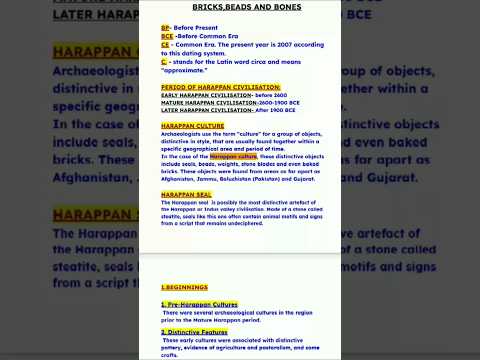
Class 12 History Chapter 1 | Bricks, Beads and Bones | Full Notes | Harappan Civilization| CBSE 2025
StudyNotesForAll
44m 23s5,317 words~27 min read
Auto-Generated
Watch on YouTube
Share
MORE TRANSCRIPTS