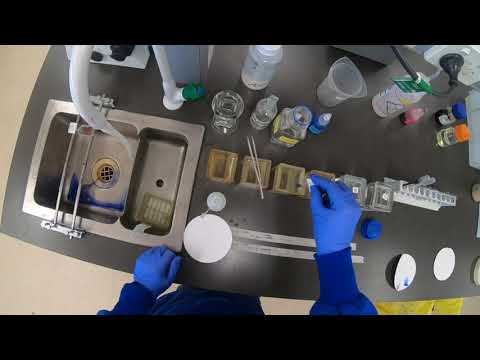
[0:09]So, welcome once again to a staining protocol. And this time we're comparing two types of trichrome, um the Masson's trichrome and the MSB stain. So now all of these four slides that you can see here, they originally stained with the Weigert's Hematoxylin, just as we normally do for Van Gieson stain as well. So they've obviously already been taken down to water. Ordinarily, we'd also employ post-fixation in picric acid, but just for simplicity, we're going to focus here on the more difficult elements of each of these stains. Okay, so all four of these slides have been stained in the Weigert's Hematoxylin for 10 minutes. That's just the standard time. We've stained upside down as you could see, just to limit the amount of stain precipitant onto the slide. Now, differentiation, keep this really brief. I normally just go in, out, straight back to the water bath, but I'm just going to jiggle it a little bit just to ensure that's at least a little bit of mixing on the surface of the slide.
[1:21]That might actually be overdoing it, but I'm just experimenting here for my own, uh, interest. But certainly keep that um a very brief differentiation because you will get more differentiation of the slides when exposed to the other reagents. Because things like the the polyacids used to displace some of the dyes, they will um induce further differentiation. Just complete that process by blueing in the ammonia. Okay, so up to here, this could be a Van Gieson stain, absolutely no difference. 10 minutes in the Weigert's, quick differentiation and then blue in in the ammonia. Then rinse that off in water. Now, I did actually check the level of differentiation on these slides and um it was good. It was fine, but actually I think I would prefer not to do that bit of a sort of wriggle there. It was slightly closer to what a H&E should be than for a trichrome. Now the Masson's Trichrome, we're just applying uh the Masson's red. The actual time that you'll need to apply will vary, so you'll need to um depending upon your batch of stain, you'll need to um, use a bit of trial and error there. But in this case, we're using only about two minutes. Then we tip that off, and then we apply initially enough of the the polyacid, in this case PMA, Phosphomolybdic acid. I'm just adding this first amount just to really complete the rinsing of that stain, so it's really not on for very long, just enough so that I can see the section. So you can see there, uh, there's a section of esophagus actually and um, um, I've forgotten what the second slide is here. I have to check that later and get back to you. But effectively, yeah, just giving that a um enough of a rinse initially so you can see the tissue. And uh then going back with some PMA, um, I did actually have a quick look at both of these under the microscope. Um, and uh they needed just a bit more to um to differentiate. So what the aim is here is for the polyacid, the PMA to displace the Masson's red mixture of dyes from the collagen. Now, macroscopically, you can just see a little bit of red leaching out as I shake, so the PMA solution is slightly yellow. And you can just see there over time the surrounding liquid now is becoming kind of orange. So that's sometimes a good test, especially for something that's taking a long time to differentiate. As long as you see the red leaching out, um up until that point where you can't see it visibly is often a useful indicator. I can see more clearly this is a section of tongue tissue. Um, that's actually looking a lot paler than it should, and I think it's probably because neither of these slides has been post-fixed. So it's just to illustrate the actual steps involved. Okay, so imagining that those have been differentiated sufficiently, and of course you need to use microscope control to check that. I'm actually leaving that esophagus longer because I can see the collagen is still quite red in there when I went through the microscope control. So now, the Methyl Blue has been applied to this slide of tongue tissue. Now, note how the acetic acid just very brief treatment, about a mill or so. Don't keep flushing it with acetic acid because that will remove more of the stain. Now the other option which I quite like is then to use blotting, similar to removing the Van Gieson solution. It's not essential. It's just my preferred technique, and that enables me to just um remove any of that excess fluid. Irrespectively of whether you blot or not, you'll go straight to the absolute alcohol. I'm actually quite concerned with how blue that slide is. And actually, it's it's a it's a terrible outcome. Um, basically this this is not well fixed this tissue, and so the density of skeletal muscle in that tongue is um is very poor, and so a lot of the Methyl Blue's got in there. That's why it looks so blue. So we'll come back and discuss that a bit later in one of the troubleshooting videos. But that's the process anyway. Okay, now, turning our attention to the MSB stain, um it's very similar concepts involved. Now, just taking these out. This is still just only after the step where the Weigert's Hematoxylin has been applied. So the first step now is Martius Yellow. Again, you'll need to play around with your staining times, you know, depending upon the batch. You can actually do this upside down in a Petri dish, that's kind of advisable. You can get a bit of a uh sort of crystal-like precipitate in this stain, is often present. So, but just to do it this way, so you can see the color, it's got a slight yellow tinge to it. It's usually just the red blood cells that end up being being yellow at the end. Then just a uh reasonably quick rinse in deionized water. That's after 10 minutes, and so the red blood cells at that stage should be nice and and bright yellow, but generally not too much color elsewhere. Then we apply the Crystal Scarlet mixture. Again, you need to play around with your staining times here. I think I only used about three minutes on this occasion. Um, ideally it should only be the fibrin that is uh taking up the majority of the stain. The collagen will probably take up a little bit as well, so leave that on. You can see there that's a nice bright red color. Then after we've done that, we need to quickly uh rinse in deionized water. I'll probably do it as quickly as what I did for the Martius Yellow, but just a brief rinse. And you should then check just to see how much fibrin is there and how contrasty it is. But if any of the collagen is clearly holding the color, which on this occasion, I saw quite a bit. So you need to apply the PTA. So it's a polyacid like the phosphomolybdic acid, but in this case, phosphotungstic acid. And so then you'll check again under the microscope just to see whether the fibrin is well differentiated compared to the other structures. Now, I'm not even going to bother to show you there. Unfortunately, what I saw was just a lot of red staining, and that's just simply because I think I've over-stained um with the um the red dye. So rather than waste time on that, just going to go through and complete this now, assuming that we've got good staining with only the fibrin. We put the Methyl Blue on. So this is exactly the same finish as for the Masson's Trichrome.
[11:15]Again, we grab our acetic acid and we just try not to over-rinse. So just about a mill across. Give it a tap. You can see there's still a bit of blue solution sitting on that slide. But if you over-rinse in the acetic acid, you can really remove a lot more of the Methyl Blue. So it's best to keep that down to one, 1 to 1 and a half mils of acetic acid, and then again, um using the um blotting. So this is just to show you that the procedures. I'm not showing any microscopic control or final images for these particular slides because they weren't actually post-fixed. And so the results were really not ideal. Um, again, that looks very blue, so um, but this is just the procedure now. You dehydrate, clear and mount as you would normally.
[12:54]So here's some images of some better stained slides. These were actually post-fixed correctly, uh, before staining. This first one of cardiac tissue with Masson's Trichrome. So note how the uh muscle is red, the collagen is blue. But if we apply the MSB to a serial section from that same block, there we go. So we see the collagen is still blue, but now there's no longer any red staining of the muscle. So they these two stains differ quite considerably in their ability to demonstrate uh the muscle. Now, looking at placenta here, we see post-fixed placenta. You'll see how bright yellow those red blood cells are. The red is the fibrin, and the blue is the collagen. And then now if we get a serial section and stain with Masson's Trichrome, we now lose that selectivity for showing the fibrin. So, sure, the fibrin is still stained red, but there's probably some smooth muscle in there as well. So, post-fixation, I've mentioned why it's important. Here's another demonstration of that. Notice how here the red blood cells without post-fixation are quite variable in their color. The jelly bean effect as as we say. Um, and so it really messes things up if you're not post-fixing, you don't get optimal um differential staining. And now with the post-fixation, just see how bright yellow those red blood cells are. So this completes the fixation, getting a more even result. Okay, so that's all for now. Um, thanks again for watching these videos, and um be sure to ask questions during the prac.


