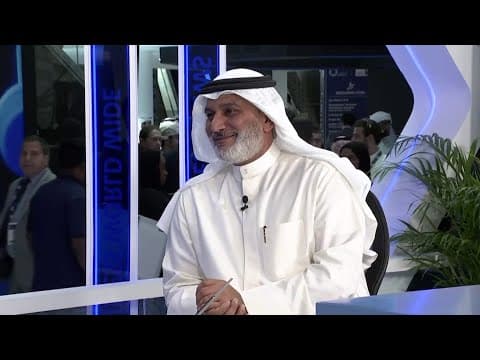
[0:01]Your Excellency, welcome back to CNBC. It's always great to see you. Thank you, Don. It's great to be back with you. Your Excellency, here we are at Adic, just ahead of COP 28. Where do we stand in your view on the energy transition? Well, that's a great question. I mean, um, this morning we heard His Excellency Dr. Sultan lay out his view for how the transition should unfold. And I think it's identical to the view we have at OPEC. As OPEC member countries, we've always been advocating for a just, orderly, smooth transition. And we always say transitions as opposed to transition, with an S at the end, because we do believe that there are many pathways to evolving this energy transition. But ultimately, we all want to land at the same objective, which is we want to have a planet we can live on and thrive on with global economic prosperity for the future, for future generations to come. And that means we have to take care of the climate crisis or the climate issue we have at hand. Um, the beauty about Adpec and being here in Abu Dhabi is I think there is no better place than to showcase what oil producing countries can do to take care of the climate issue. The efforts that are being done in Abu Dhabi, whether it's at Adnoc or other parts of the country and the region at large, I mean, we don't have to look even further away. We have Saudi Arabia right next door, my own country Kuwait, other countries in OPEC member countries where there's a lot being done that is not being seen about how we intend to see this decarbonization effort move faster, stronger, but at the same time, not at the expense of providing energy security to the whole world. So oil and gas now has a seat at the table. How do they use it?
[1:47]Well, we're very happy to have a seat at the table. In fact, OPEC this year, we're going to take up a nice big pavilion at the cop to showcase exactly what I was talking about. All the examples and to demonstrate what our member countries are doing in terms of their objectives, whether to how do they plan to reach their nationally determined contributions, the NDCs, um all the projects that are in place, uh in member countries to reduce emissions in general, greenhouse gas emissions. carb decarbonization efforts in the oil industry, particularly methane reduction. There's a lot of work being done in our member countries and this is a good opportunity for us to showcase it at Cop. Your Excellency, you and I last spoke at the OPEC seminar in fact in Vienna. And since then, I really get the sense that there has been a narrative shift in if you will, in the markets. We're seeing countries basically make U-turn on climate commitments and I want your take on this. Why, why do you think we're seeing these U-turns take place in an era and at a time when climate is undeniably so important. Why have we seen backward steps from leading countries on this issue? Well, I I hope they are not U-turns as much as they are a recognition and the realization that some of the policies may have been a bit overzealous. The timelines, the the deadlines, the time constraints and without having the right infrastructure in place, the right, for example, electrical grids, enough charging stations for electric vehicles, the availability of critical minerals are all things that are, I don't want to say challenges, but things that have to be properly, uh, planned for, uh, and taken care of before this transition can be put with such stringent deadlines. So we're seeing, you're right, if you want to use the term U-turn, in the EU, for example, Poland has filed a lawsuit against the EU. And uh, France and many other countries have also objected some of the Euro 7 specifications for tailgate emissions. The UK latest case in point, uh, the Prime Minister delaying the deadline by five years. Sweden saying that they probably cannot meet the 2045 goals. So I think when it comes to consumers feeling it pinch their pockets, that's when politicians became become aware that it's difficult to implement policies that may be too aggressive or a bit overzealous, without having the right systems in place to make sure that whatever new policies are advocated for, do not affect the consumers ultimately. This is the whole issue. I think a lot of people in Europe now, around the world are worried when they associate transition with higher costs, less savings for individuals, I think people will start to create a negative connotation of how this transition could be perceived. And that's the danger, therefore in OPEC, we've always said that transitions should be smooth, well thought out, well prepared for and orderly because the last thing we want to do is create an additional burden on consumers. Is OPEC also concerned about the impact of higher oil prices and the burden that that has on consumers? Well, I mean, it depends on the state of the global economy. I think there are two camps out there. Some view the global economy as resilient and to be able to go through what it's gone through, whether it's the pandemic or subsequently the high inflation rates and all of that. There's another view out there which still believe that the global economy is in danger. So I think consumers right now globally, you know, with oil demand picking up every year, I think that answers the question itself. I mean, we're seeing it last year, two million barrels a day of oil demand growth year on year. This year our projections are at 2.4. Next year as well, around 2.3.
[5:46]So I think this in itself answers the point about are these price levels affecting demand? We're seeing historically high, phenomenally high growth figures for oil demand and this leads me to the point you remember, Dan, I've always through CNBC and other agencies always advocated for the importance of continuing to invest in oil. This is critically important for the future in terms of energy availability, energy security and affordability. But today, unfortunately, we're seeing a narrative out there that is pushing companies, financing agencies to avoid and stop financing oil and gas projects. And this is I believe counterproductive. We at OPEC preached for advocate for continuation of investments in oil and gas. At the same time, decarbonizing oil and gas industry. And again, I'd like to say that there's no better place than anybody can see, that anybody can see in the world other than come here to the Middle East and see what Abu Dhabi is doing, what Saudi is doing, what other countries in OPEC are doing to really move fast and advance the the decarbonization efforts. And I think that will be a key outcome at the at the upcoming COP in Dubai. So what's happening between OPEC and the IEA? We know there's been, I don't want to call it a war of words, but certainly a disagreement over some of the scenarios and projections. The IEA says peak fossil fuels coming by 2030, OPEC disagrees. Can you expand on some of your commentary in the market on that? Well, we respect the IEA fully, of course. Uh, the projections are that fossil fuel demand will peak by 2030. So let me ask you this and the audience this. This is less than six, seven years from now. Fossil fuels demand has been at 80% for the last 30 years. It hasn't changed in 30 years. And again, goes back to our earlier discussion about the availability of critical minerals, the availability of everything required to move the whole energy system from a fossil fuel-based energy system to a renewables and all of the above. Because this is critical. What we believe in is that we cannot just replace the energy system that has existed for so many years over a decade or even two. And that's why we continue to emphasize the importance of investing in oil, as well as investing in renewable energy, hydrogen and the important thing is the technologies. Because ultimately, we all strive for the same thing, which is meeting the Paris agreement objectives. But to advocate for stopping investments that are critically required by the world, 80% of today's energy is by fossil fuels, 60% is by oil and gas. To simply say that we're going to unplug from that in five, six, seven or even 20 years time, I believe is unrealistic. At OPEC, we are not in favor of such an approach. We believe that that actually endangers energy security. Whereas what we're trying to do is promote the investment of oil and gas with technologies that are widely available to a scalable level so that we can decarbonize as we continue to use oil and gas to promote global economic prosperity and growth. Flagship piece of research coming out from OPEC soon. We're counting down to the World all outlook report. Can you give me a flavor or perhaps a hint on what we can expect inside that report and why it's so critical right here right now? Well, absolutely. Next week, we're going to be launching this jointly in Capsarc in Riyadh. Um, with our updated figures, and I can't share too much because I don't want to spoil the uh the event. But what we can tell you is the elements that we discussed along the lines of what you call the U-turns, the reversal in some of the policies, the delays in some of these deadlines, ultimately reflect on what the world will consume in terms of energy for the future. So we are looking at putting out an outlook that's updated, reflecting the realities on the ground. The pragmatism, if you want to put it, and the way that now countries are beginning to deal with this matter and in a different approach than maybe two, three years ago. And just finally, your Excellency. What needs to happen in this country in order for COP 28 to move the needle on climate? The world is looking for tangible solutions, tangible outcomes. Is the UAE going to be able to deliver? And if so, how? I have full confidence in the UAE's ability. Its leadership has been very clear. Laser focused on the success of COP 28. From the day one, the word was this is going to be a cop of delivery and action. I think it's not just all incumbent on the UAE, to be fair. There are so many parties involved in the cop discussions. We need financing to come through, financing that was pledged many years ago and still is not coming through for people to be able to finance this transition and move to cleaner fuels and renewables, etc., etc. That's a critical element for success that's required financing. Again, the sharing of technology with developing countries, with the global South. This is another critical success factor. I think in the UAE and the cop, Dr. Sultan has managed to bring the industry on board. We saw a big show today at Adpec, meetings before Adpec and I know he's been working so hard from the beginning of the year on this matter. So I am confident in the UAE's ability, in Dr. Sultan personally and with his diplomatic skills, his technical skills, and I believe it is the right choice for a cop to happen in the UAE in an oil producing country to show the world how oil producers can decarbonize, reduce emissions as well as continue to provide stability and security in terms of energy supplies. Your Excellency, we'll leave it there. Thanks so much for speaking with me today. Thank you, Don.