[0:15]Welcome to the series that takes you to the heart of America and reveals the inner workings of our country as you have never seen them before.
[0:26]We're going to go on quite a journey. We'll travel coast to coast across this sprawling land. To discover the habits, the rhythms, and the secrets you only notice when you step back and see the big picture.
[0:47]I'm Neil Kuan. I've worked in law and government, business and journalism. I've even won the reality show Survivor. And in every part of my life, I've been fascinated by the same things: systems and networks. None have shaped us more profoundly than the ones we use to manufacture, to build the things that fill our lives and fuel our economy. Oh, this is hot. In this episode, we'll uncover a revolution, a transformation that's well underway, reshaping who we are and what we make. We'll enter a surprising world of constant change, ruthless competition, and relentless innovation. I love the robots. Step back, just a little bit. From the simplest steel screw to the sleekest new car, from a tiny silicon chip to a behemoth aircraft carrier. We'll explore the interlocking chains of supply and demand, part and assembly, material and manpower that make our country work. 15 seconds. Here, just finish it for me. This is a story of how America creates. This is America revealed.
[2:30]America Revealed is made possible by the Corporation for Public Broadcasting. And by contributions to your PBS station from viewers like you. Thank you.
[3:00]Manufacturing has shaped America. From shore to shore, our identity has been defined by the things we make and the way we make them. But manufacturing is not what it used to be, and this place shows why. This is Savannah, Georgia. It's been a trading center since colonial times, and today it's one of the fastest growing ports in the United States.
[3:35]Things have changed since the days of settlers, corn and cotton. These giant ships come here from all around the world, filled with all kinds of manufactured goods. Like computers, ovens, flat screen TVs, and even American flags. We used to make these things ourselves. Now, they can be made more cheaply abroad, so we import them packed tight inside these containers. We import so much, in fact, that these docks are loaded with more than 130 million dollars worth of goods. And they won't be here for long. Because this port runs 24 hours a day, seven days a week.
[4:25]So before you know it, every container you see here will be gone, headed off to stock America's stores. These ships will be gone, too, but what they take with them may surprise you, because when they go, they'll be filled with America's biggest export. And it's not TVs or computers or ovens. It's something else. This is the only warehouse in the port that stores American-made goods. It's a size of seven football fields, and right now, all it holds is paper.
[5:06]Rolls and rolls of paper. That's because we ship more containers of paper to the world than anything else by far. And one man is responsible for keeping it all moving. So, Larry, everything in here is going to be exported out of the country? That's correct. Here, in this particular facility, we do nothing but export paper. Larry Gurgus manages this warehouse. He knows where all the paper comes from, where it's going, and why. It's going to go to Asia, parts of Europe. A bulk of this goes to China. And what do they do with all this paper? Well, it comes right back to us in boxes. All these different electronics that we import from China is boxed up with this paper we send over to them. So, all this paper is going to China. They take it, they make it into boxes to package all the stuff to import back into the States. That's correct. I would say you hit it on the nail.
[6:09]Looking around, this place seems like a sign of troubled times. Paper is what's called a low-value good. It's a product, unlike, say, a television, that's worth little more than the raw materials that go into it. So, for many of us, this is an unsettling picture, a picture of a country that's importing more than it's making, of a manufacturing system that's dying. But if you look beyond this port, you'll see something very different. Manufacturing is not really disappearing from America.
[6:55]It just doesn't look like it used to. A whole new landscape is emerging, filled with new ideas, new people, and new places.
[7:11]Like here, Chattanooga, Tennessee. This site, from a logistics point of view, it's a beautiful site because it's adjacent to an interstate. You don't have any nearby residential. It's got dual rail access. This is a terrific site. This is Dennis Kunio. He works as a site selector, helping companies find locations for their factories. He specializes in high-value manufacturing, in goods that are worth far more than the cost of their raw materials. And here is what he's so excited about. It's America's newest auto plant, a billion-dollar, state-of-the-art facility, filled with all of the latest technology.
[8:00]But this factory wasn't built by Ford, Chrysler, or General Motors. It was built by Volkswagen. And while you may not think of Volkswagen as an American car maker, maybe you should. These cars are made in America, out of American-made parts, by newly hired American workers,
[8:29]and have been specially designed to be sold in American markets. And Volkswagen isn't the only foreign company being drawn to our shores. What's happening here is part of a much bigger picture. This is what America's auto industry looked like in 1980. Each dot is a factory, run by a US automaker, and in the last 30 years, more than half of them have closed. While companies like Honda, Toyota, BMW and Nissan have opened new factories, spawning a vast network of American-owned auto supply firms. All these dots you see here. It's been a major boost to our economy and a profound change to our auto industry.
[9:23]A change that Dennis Kunio has witnessed first-hand. Most of the new plants built in the United States over the past 20 years have been by foreign auto manufacturers. They have put about 44 billion dollars of new investment in the United States. They employ about 80,000 people. I think a lot of people would be surprised by that because I think the common assumption is that all these manufacturing jobs are going overseas to places like China. The labor intensive, low cost, low wage cost jobs are going to China. But the high value added jobs are still staying here. And the fact that this large multinational corporation, very sophisticated, could build these cars anyplace, has chosen to put a billion dollar investment here, tells us that the United States is still a good place to build stuff, especially high value added stuff.
[10:13]There's one obvious reason that America attracts this kind of investment: We're a huge market. We buy more than 12 million cars a year. But there's another reason that's far more significant. Our factories are in the midst of a revolution. They've embraced a new way of thinking about manufacturing. One extraordinarily focused on efficiency. And here at Volkswagen, you can see that thinking in action. Businesses have always cared about efficiency, but this place has put efficiency on steroids. To be profitable, these people need to make 500 cars a day, and each car has about 20,000 parts. So every movement is coordinated, every action plotted out. Some of this may look familiar because the basic workflow was established over a century ago. Back in the days of the Model T, when Ford auto workers first installed interchangeable parts on a moving assembly line. But don't be fooled. Here at Volkswagen, the assembly line is being utterly transformed.
[11:37]And at the center of it all is something that Henry Ford never dreamed of. Robots.
[11:47]There are robots everywhere in this factory. Welding, painting, riveting. They do more than half the work in the plant.
[11:59]And in many areas, they do all the work. Which is just fine with machinists like Vicki Holloway. What's the stuff that you do versus what the robots do? What I'm doing is just getting it ready. Getting it ready for the robots to work on it? Getting ready for the robots to work on it, right. The robots do the work. Each robot know exactly what move to make. And then they're finished, and then they're waiting on the next car. It's great. I love the robots. Yeah, yeah, yeah. Step back, just a little bit. Okay.
[12:47]The result? Incredible efficiency, but many fewer jobs. It's caused a radical shift in the way our country works.
[16:00]This gentleman, as he was putting the rims in the tire, he would pick this up from here and set it on there and push that down. There's no value in that. The time that it takes him to pick this up, put it back and forth, is unnecessary. What I want him to ask me for is to recognize if this was permanently mounted there, you could completely eliminate them steps, saving a lot of time. That's a little bit counter-intuitive for me. Because I always thought the whole industry was moving towards automation and that the role of the individual is slowly diminishing. But what you're trying to do is sort of the opposite, you're trying to empower these employees. Yes, because robots can't think for themselves. Somebody still has to program the robot. Somebody has to tell the robot what it needs to do. And the only way we're going to know that is to get people to recognize where there's waste. The lessons Albert is teaching his workers echo well beyond these walls. They're part of a new philosophy that's impacting every industry in America. Including one of our most dominant, the arms industry.
[17:10]America makes more weaponry than every other nation on Earth, by far. But historically, this enormous industry has been plagued by inefficiency.
[17:37]From 2008 to 2010, the US defense budget had 135 billion dollars of cost overruns. And with a ballooning national debt, arms makers are under pressure like never before. This is the USS Gerald Ford,
[18:03]a nuclear powered aircraft carrier lying in a dry dock in Newport News, Virginia. Even though it's budgeted to cost 10 billion dollars, and will be the most advanced aircraft carrier on the planet, looking around, this shipyard looks like something from a bygone era.
[18:25]But looks can be deceiving. Beneath all the rust and grime, this place is starting to change dramatically. So this is our main machine shop. What you're looking at here, these are the propeller shafts that connect the main engine to the props at the end of the ship. How long has this building been here? It looks like it's been around for a while. Yeah, this building's over 100 years old. A part of the fascination of this business is the the dichotomy of the old and the new. You have these old buildings, some old facilities, and you're you're doing some of the finest machining in the world.
[19:04]It's a term that came out of the car industry, um, but to us, it's it's all about trying to identify and cut out as much waste as you can to lower your costs and and improve the efficiency and the speed by which you do your work. So basically you're trying to get rid of all the fat in the whole process. That's exactly right. So what are the things that you're doing now that were different from before? We used to do what we call stick-built carriers where you build every piece into the dry dock and build the carrier from the bottom up. Now you see we do a lot more modular construction. What Tim's doing is to use the lean philosophy to reinvent the way warships are made. In the past, they were built like this. The hull was constructed first in one big frame, and everything else was built into the hull as it went up. The work was slow, complicated, and cramped. This is how ships are built today, in hundreds of separate pieces, spread out across the yard. The site is now so sprawling that foremen like Lauren Stard and have to ride bicycles across it, because it takes too long to walk. So, Lawrence, what do you and your crew do here? What I do is similar to putting a house together. You know, you got your home, you got different rooms, and I put all the pieces together till we complete the whole ship. It's very cost efficient and it saves a lot of time. To keep Lawrence and his crews as lean as possible, the engineers here have developed their own computer software, a kind of virtual reality blueprint system that allows designers like Brian Anderson to plan the installation of each piece of the carrier. Commercial ship builders have been using this type of software for years, but in this tradition-bound industry, it's revolutionary. The predecessor of the Gerald Ford was done in pen and ink. So they would they would draw ink in them, and they would draw the drawings. The problem with the ink in them was, the guy designing the piping system would pretty much design in a vacuum. He wouldn't know what everybody else was doing. And that's exactly what the 3D product model gives you is you get all of the systems in in the space at one time. And you start to see where the systems interact and where they're fouls. So this piping system designer, he'll be able to see, do I clear this fire main system? And this prevents you from finding mistakes too late. Downstream. Correct. Uh, the the main thing of it is when you find them here,
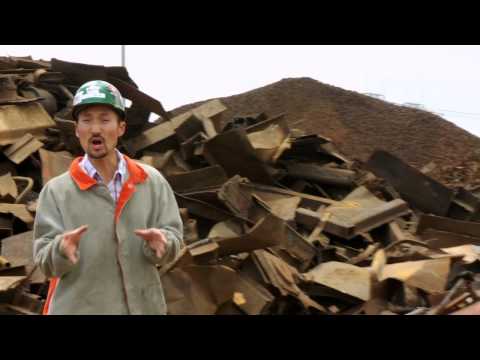
[21:35]it's much more efficient to correct them while they're still digital data before we're actually cutting the steel. It's too soon to tell if the carrier will come in under budget. But the lean philosophy has already saved the shipyard hundreds of millions of dollars, showing that even America's most traditional industries are embracing efficiency. But sometimes, improving efficiency alone is not enough. To survive, some industries have had to abandon everything they do and radically reinvent themselves. This is a scrap yard in Decatur, Alabama. 140,000 tons of rusting metal, baking in the summer sun.
[22:33]We have different types, like this right here is shredded. It's basically your shredded automobiles. And we have plate and structural steel.
[22:45]It's like from bridges, ships, barges, buildings, rail cars that are out of service. They cut them up. This place might seem like a wasteland, but what you're actually looking at is a rebirth of America's most iconic industry. Steel. For more than a century, we were the greatest steelmaking nation on Earth. Then, we grew stagnant. Foreign competitors began producing steel that was better and cheaper, and in the 1980s, America's steel industry simply collapsed,
[23:29]costing over 300,000 jobs. But looking among the ruins, one tiny company saw an opportunity and seized it.
[23:46]The company is called Nucor. As America's steel giants fell, it pursued a maverick strategy, buying up scrap metal yards like this all across the country, and focusing its entire business on recycling. So these mountains of junk are actually raw materials. And they're so important that this scrap yard was built right here to feed that steel mill. It was an enormous risk. Steel was traditionally made from iron ore, and scrap was a fringe ingredient. It was cheap and plentiful, but nobody knew how to make it into profitable steel. Solving that problem was Nucor's big breakthrough. The secret, they discovered, lay in the most basic part of the process: Heat. Right now, you're looking at the furnace, electric arc furnace. Okay, so the scrap metal gets put over here, and then you guys melt it down. Exactly. Dwayne Thomas supervises the melt team here. His job is to make sure that each load of scrap is heated to a precise set of specifications, which means he's constantly on the move between a tiny air conditioned control room and the 3,000 degree furnace. Oh, this is hot. Oh, yes, it is. You ever get used to the heat? Well, some people do, I haven't yet. I just got to used to being hot and sweaty all the time. Oh, my God. This electric furnace is key to Nucor's innovative strategy. In a traditional steel mill, furnaces are powered by burning fuel, and can take days to reach the right temperature. This furnace, which is heated by electrodes, can power up or down in a matter of hours, providing flexibility never before seen in this industry. So that's the electrode. That is the electrode. So basically, there's a big electric current running through that thing. Right, but all around the electrode, it's insulated, so the electricity is directed into the steel. This furnace makes Nucor highly competitive. Unlike a traditional mill, they can make steel to order at a moment's notice, which means that the scrap that Dwayne's melting now won't sit idle for long. Before the day is over, it will be poured, rolled, cooled, and stacked for delivery to the customer. So what was rusting junk in the morning is ready to be transformed into a bus, tank, or refrigerator by evening. The process has been a game-changer for the entire steel industry. It's made Nucor the most profitable steelmaker in the country, and one of the largest recycling businesses in the world. Nationwide, they recycle one ton of scrap every two seconds. They're a triumph of American innovation, and they're not the only ones out there. This is Chandler, Arizona, home to what is perhaps the most innovative manufacturing site on Earth, an Intel microchip factory. If you own a computer, chances are good that its brain was built in here. One foot in, all the way through. It's extraordinarily difficult to get into this place because Intel is obsessed with cleanliness. Back a little bit further. There you go. And the other, I have to put on what they call the bunny suit to keep dust away from the microchips. It means I'm spending more than an hour just preparing to enter the factory, but nothing can really prepare me for what I find inside. It's like I've stepped through a time warp into some sci-fi future. There are little robots running all over the ceiling. Vents on the floor filtering air to keep the place thousands of times cleaner than a hospital operating room. And there are machines everywhere, manipulating chips that are layered with circuitry that's infinitesimally small. When I first started, I could look through a microscope and actually see the printed features. You can't even do that. Not on a regular one.


