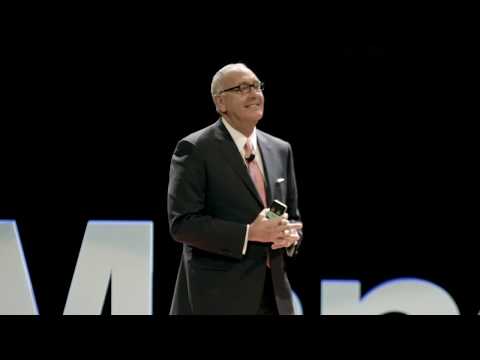
[0:08]Non-verbals is everything that communicates but is not a word. This beautiful theater, it's communicating to us. How you sit is communicating to us. The things that you attach to yourself, a purse, a pen, a fancy car, all these things are communicating. How you look at others communicates. And all day long, we are communicating non-verbally. All day long. You can look in on your child as they sleep, and you can tell if they're having a nightmare or if they're sleeping soundly. As you sit there, and now I'm starting to see some of you. You're giving information up, even as I'm giving information up. You're assessing me. If I can speak to you from an anthropological standpoint, I am transmitting information about myself, my beliefs, the things that I value, even as you are. Now that I can see you a little clearer, how many of you were dressed by your parents today? Raise your hand. Wow.
[1:49]Spouses, that's okay, your spouses can. So you chose to dress the way you did, even as I chose to dress the way I did. They said, well, it's Ted Talks, you can dress down. I said, you know, I was in the FBI for 25 years, I don't know how else to dress. It would be such a disappointment. It's like, on TV they always have suits even when they're walking through the marsh. It's true. It's I can't tell you how many crime scenes I went through that ruined, really inexpensive suits. But we look good, but we look good.
[2:42]I guess humor is allowed. And um, so all day long, we're making choices. We're making choices, they're based on culture. They're based on peer pressure on personal preferences. And so, the things we wear and attach ourselves are transmitting our bodies are transmitting information. And the question that I'm often asked is, well, how authentic is it? How authentic is it? And as I pondered this, I said, you know what, what if we think of the power of nonverbal communication? But let's do it by taking the myths out of it, and plugging in what really values. What really is of value when it comes to non-verbals. How many of you have had a bad handshake? Now normally, of course, now we have the coronavirus, I would I would have you turn to each other and give each other a handshake that's really bad. But I'm not going to do that, I want you to just put your hand in front of you and pretend to give someone a bad handshake, ready? Let's do it. Let's do it, do it, do it.Good. Do you realize the funny faces you make? It's like I didn't ask you to make a funny face and yet you did. Why is that? Because you're human and humans betray what we feel, what we think, what we desire, what we intend, what makes us makes us anxious and what we fear. And we do it in real time. We don't have to wait 20 minutes, it happens now. And our body language, in a way, it's exquisite because there's an area of the brain that is elegant. And it's elegant because it takes shortcuts. It doesn't think. If I bring in a Bengal tiger here and walk it around, nobody sits around and waves at it. That's like, you know, eat me.No. Everybody freezes and that's because of the limbic system. This rather primitive area of the brain that reacts to the world, doesn't have to think about the world. And everything that comes from the limbic brain is so authentic. You hear a loud noise and you freeze. Right?Who was that? You get bad news or you see something on TV and you cover your mouth. When the conquistadores arrived in the new world, they didn't have any problem finding out who was in authority. The same behaviors that they had just left in Queen Isabella's court, they saw in the new world, the king sat higher, had better clothing, had an entourage. Okay, they didn't have their own show on television, but pretty close. So all these behaviors are very authentic because the limbic system resides within that human brain. It's part of our paleo circuits. And so, when we see the furrowed forehead on a baby that's three weeks old, we know that this little area called the glabella, something is wrong, there's an issue. When we see the bunny nose, right, when you wrinkle the nose, yeah, we know what that means. Ew, I don't like that.I don't want that. Ew, right? Did I just say that in public? When we squint, we're focusing, but we have concerns. Ah, when the eyelids close, you want me to do what? And if things are really bad, you want me to talk for 15 minutes? Here's what's interesting. Children who are born blind, when they don't like things, they don't like hear things they don't like, they don't cover their ears, they cover their eyes, they've never seen. This is millions of years old. Smiles are important. In our mouths, the lips begin to disappear when we're stressed. Right?Most politicians look something like that. And right before they're indicted, they look like that.Dramatic lip pulls, jaw shifting, and covering of the neck. You've seen that clutching of the pearls. I go, there's that creep.Oh, he's gone now.He's back. But did you know why? Large feline.
[8:58]We have seen large felines for so long, taking down prey that we immediately cover our necks. How many of you been told that you can detect deception by the use of non-verbals? I'm here to clear that up. When you leave here today, you say, well, I heard that Navarro fellow. And he did about 13,000 interviews in the FBI. He said there is no Pinocchio effect. There's not one single behavior indicative of deception. Not one. And we mustn't propagate that. We must not tell people that we can detect that they're lying because of behaviors. They may be anxious, they may be stressed, but not deceptive. How many of you been told that if you cross your arms that you're blocking people away? Have you heard that? There's a clinical term for that, it's called crap. Yeah, I said it. Get over it. It's crap, it's a self-hug. You're comfortable?Yeah, where does this nonsense come from? You know, I'm asked a question often, so, you know, Joe, you've you were a spy catcher, you use non-verbals every day. What do you use it for? To make sure people are comfortable. To make sure that we are empathetic. The only way to be truly empathetic is by understanding non-verbals. Carl Sagan, the famous cosmologist, said, who are we? What are we? You think about that, it really takes a smart person to ask that question. What are we in this universe? And he summed it up this way, and I think it's rather exquisite. He said, all we are is the sum total of our influence on others. That's all we are. It's not how much you earn, it's not how many cars you have. It's our influence on each other. And what's interesting is that the primary way that we influence each other's through non-verbals. It's that nice handshake, it's a pat on the shoulder, it's that touch of the hand. It is that behavior that communicates love in a way that words simply can't do it. When you leave here, you're going to have choices. You always have choices, you have free agency. And one of the things that you should think about is, how do I change my non-verbals? How do I become that person of influence? Because if there's one thing we need in this world, it's truly to be more empathetic. And so, when I see this, it says it all. That's why we use non-verbals, because they're powerful. Thank you.


