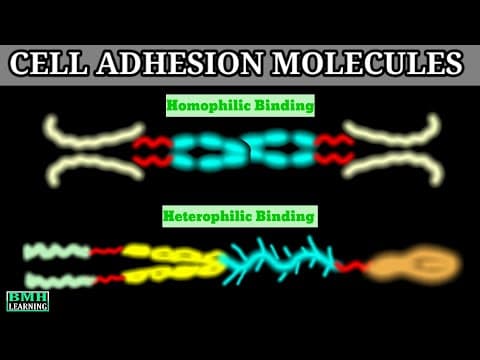
[0:01]Hello friends, welcome to BMH Learning. This tutorial is about cell adhesion molecules. So first thing we need to know is what's cell adhesion. It's a process by which cells interact and attach to neighboring cells. The connection can occur in two ways. The first is direct contact. Where one cell makes immediate contact with the neighboring cell. This is known as cell-cell adhesion. Then we have indirect method. Cells in animal tissues also adhere indirectly to the components of the surrounding extracellular matrix. And this type of adhesion is called as cell matrix adhesion. Now the question is, what mediates the adhesion between the cells? So, cells bind to each other with the help of transmembrane proteins called cell adhesion molecules, also known as CAMs. Now let's talk about the structure of a CAM. They have an extracellular domain, through which adhesive interactions occur. So, with the help of extracellular domain, the CAM binds to another CAM, which is present on the other cell. Then we have the transmembrane segment of the protein, which traverse the cell membrane of the cell. Finally, we have cytosol facing domain. This portion of the CAM recruits multifunctional adaptor proteins. These adapters act as linkers that directly or indirectly connect CAMs to the elements of the cytoskeleton. This proteins can interact in different ways. The first method is homophilic binding. Where one type of the cell adhesion molecules bind to the same type of cell adhesion molecules. They're also capable of heterophilic binding. Meaning a CAM on one cell will bind with the different CAMs on another cell. Now there are four major types of CAMs. The first is Ig-CAMs or immunoglobulin super family of cell adhesion molecules. The second is Cadherin. Then we have integrin. And the fourth one is Selectin. We will discuss about each type in detail in separate videos. Now the CAMs perform very important functions. They are involved in inflammation. They're also responsible for tumorigenesis. They are very much helpful in the establishment of the blood brain barrier. Another function is the lymphocyte homing. Next we can say they are also involved in regulation of the apoptosis. Apart from this, the CAMs provide a means for the bidirectional transfer of information between the exterior and the interior of the cells. In other words, cell signaling. This was all. Thanks for watching.
Cell Adhesion Molecules | CAMS | Cadherin, Integrin, IGCAMS, Selectin |
BMH learning
3m 1s393 words~2 min read
YouTube auto captions
Transcript source
YouTube auto captions
This transcript was extracted from YouTube's auto-generated caption track. The transcript below is server-rendered so it can be read, searched, cited, and shared without opening the original YouTube player.
Pull quotes
[0:01]Cells in animal tissues also adhere indirectly to the components of the surrounding extracellular matrix.
[0:01]So, cells bind to each other with the help of transmembrane proteins called cell adhesion molecules, also known as CAMs.
[0:01]So, with the help of extracellular domain, the CAM binds to another CAM, which is present on the other cell.
[0:01]Then we have the transmembrane segment of the protein, which traverse the cell membrane of the cell.
Use this transcript
Related transcript hubs
Watch on YouTube
Share
MORE TRANSCRIPTS


