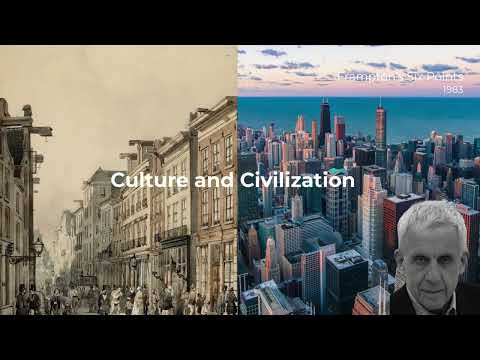
[0:02]“When architecture becomes the medium of capital, the city forgets how to listen to the Earth.” What is the future of housing? As cities densify and global challenges intensify, the question of how we live is more urgent than ever. But perhaps the answer is not only ahead of us, it might also lie behind us. begins by the utopian optimism of modernism to its real-world contradictions and failures. We then revisit an idea that once aimed to resist to anchor architecture in place, culture, and craft. Critical regionalism. This is the path we follow. We begin with the rise of modernism and how it redefined architecture as a machine for living. We then confront the crisis and failure of that vision, revealed through the struggles of residents and cities. Next, we observe the emergence of regionalism, where place and identity return to the conversation. The term critical regionalism is coined, marking a shift in architectural discourse. From there, we explore Frampton's six points, a tectonic and ethical resistance. Then, we turn to Hartoonian's theory of historical consciousness, which reclaims temporality in the act of construction. And finally, we arrive at Quinta da Malagueira, where meaning is made through architecture, rooted in place, memory, and participation. Le Corbusier envisioned a radical break from the traditional city. His plans promoted order, efficiency, and clarity, a utopia built from concrete and geometry. At the Bauhaus, art and technology were unified. Simplicity, function, and industrial materials replaced ornament and tradition, laying the foundation for modernism. CIAM codified the modernist vision through rational zoning. The city became a diagram separated into housing, work, leisure, and circulation. In Dessau's Torten Housing estate, Gropius embraced industrial logic. Prefabricated materials, repeated modules, minimal ornamentation. But soon, residents asserted their own values adding shutters, repainting facades, planting private gardens. The abstract ideal of standardization collided with the messiness of daily life. Corbusier envisioned Pessac as a pure modernist experiment. Modular grids, flat roofs, white volumes, but tenants painted bright colors, added pitched roofs, and enclosed patios with fences and vines. These changes were not vandalism, but acts of habitation, a quiet resistance through use. Brasilia was a modernist dream materialized at the scale of an entire city. Its monumental access, rigid zoning, and isolated superblocks reflected abstract ideals, but ignored everyday life. Long distances, congested traffic, and the absence of street life severed people's connection to place. Lewis Mumford warned that modernism's obsession with order and efficiency risked dehumanizing the city. In his critique of the megalopolis, he described a landscape of relentless expansion, mechanical repetition, and cultural erosion. Mumford called for a return to organic urbanism, where the city is shaped by local topography, social rhythms, and ecological balance. To him, true architecture was not imposed form, but a living expression of place and memory. By the mid-20th century, the modernist ideal began to fracture. Team 10, emerging from within CIAM, questioned the validity of universal space. They argued for urbanism rooted in history, social structures, and the everyday movements of people. Their map building concept emphasized horizontal growth, adaptability, and integration with the context. At the same time, in Egypt, Hassan Fathy turned to the vernacular, out of nostalgia, but out of necessity. He revived ancient techniques, used mud brick and passive cooling, and worked with local artisans. Fathy's work revealed that architecture could be deeply modern while remaining locally grounded. In 1977, a new term would give voice to this emerging sensibility, critical regionalism. Alex Tonis and Leanne Lefavre coined the term to describe an approach that resisted both global homogenization and naive revivalism. Critical regionalism did not reject modernity, but filtered it through the lens of place, responding to climate, topography, local materials, and cultural memory. It was a strategy of mediation, using the universal language of architecture while remaining rooted in the local. In 1983, Kenneth Frampton redefined critical regionalism. In his article, towards a critical regionalism, six points for an architecture of resistance, he called for a tectonic architecture arted in the earth, informed by place, and resistant to the visual and economic flattening of globalization. This was not about returning to tradition, but about cultivating cultural depth through architectural form. Six confrontations between architecture and modernity, not answers but strategies of resistance. Frampton begins by distinguishing culture, embedded in local traditions and symbolic systems, from civilization, driven by global technologies and economic systems. As modernization spreads, culture becomes threatened by uniformity. Architecture risks being reduced to a product efficient, generic, placeless. Critical regionalism counters this by using form and material to restore symbolic depth and local resonance. Modern architecture began with the radical energy of the avant-garde, a desire to liberate space, democratize form, and reshape society. But over time, that energy was domesticated. What was once revolutionary became convention. Frampton locates a renewed resistance not in the spectacular, but in the slow work of construction, where tectonics, craft, and locality regain agency. To Frampton, space is abstract, place is political. Architecture must do more than shape emptiness. It must construct relationships, histories, and meanings. The form of a place is never neutral. Entrances, thresholds, courtyards, and streets. These elements define how we move, gather, and belong. Frampton argues that to build place is to intervene in culture. Architecture becomes a political act, an act of memory, solidarity, and situated resistance. Frampton acknowledges that architecture exists within a world culture, but he rejects both pure modernism and nostalgic revivalism. Critical regionalism mediates the global through the local. This means interpreting universal technologies and materials through local climate, light, topography, and memory. A regional building is not a copy of the past, but a translation inflicted by time, place, and social condition. It resists homogenization, not by withdrawal, but through reinterpretation. Modernism often tried to erase site, flatten the land, standardize the form, isolate the object. Frampton proposes the opposite. Topography, context, light, and wind should shape the building. He praises works like Mario Botta's Church of the Holy Face, where the slope becomes a design constraint and a compositional guide. Critical regionalism uses natural conditions not as problems to solve, but as starting points for poetic engagement. Architecture has become a visual spectacle. Rendered, photographed, shared, but we live in architecture. We touch it, smell it, hear it. Frampton insists that the tactile dimension must return. He calls for material honesty: stone, brick, timber, concrete, materials that age, weather, resonate. Tactility restores the body in architectural experience. It rehumanizes space. Frampton's six points are not prescriptions, they are provocations. They challenge us to build with awareness, to design with depth, and to resist without nostalgia. To build critically is to ask: where are we, who are we, what do we remember? Hartoonian extends Frampton's theory by introducing a deeper historical consciousness. He argues that modern architecture often conceals history behind abstract forms. Critical regionalism, in contrast, must excavate histro-not to romanticize it. But to embed architecture within the long duré of cultural time. For Hartoonian, to build critically means to construct with historical thickness, to let materials carry time, and let tectonics narrate tradition. In this view, every wall is not just structure, but a site of memory. If Frampton and Hartoonian offer theory, then Quinta da Malagueira offers the ground. After Portugal's 1974 Carnation Revolution, housing became a key instrument of social reconstruction. Évora, a historic city in the south, faced growing demand on its periphery. With roots in Roman planning and Renaissance scale, its urban fabric valued continuity over rupture. A different kind of architecture begins here. Quiet, grounded, and rooted in community life. Seizer's sketches do not propose a form, but a position anchored in modesty and public life. He draws not monuments, but patterns of inhabitation. His architecture begins with walking, turning, arriving, a choreography of daily life built with care. Malagueira was not imposed, was discussed, drawn, and revised with its future residents. Cesar met with families, listened to their needs, and designed open frameworks. Here, architecture becomes a shared act, negotiated, slow, and political in the most democratic sense.
[9:31]This is a space that invites a whole range of associations. White rendered courtyards are certainly a feature of Portuguese vernacular architecture, but Caesar also has in mind early modernist sources, such as the work of Adolf Loos. And is the marble fountain that is installed in his own courtyard perhaps reminds us the courtyard house is at root a Roman type. Caesar cited Pompei as a central inspiration for the design of Magarara, and that's a reference with real relevance to this location given Evert's Roman origins. A low concrete aqueduct threads across the site, delivering power and water, but also tracing a path, a line of memory. It does not hide utility, it gives it form, raised on slender columns. It recalls Roman infrastructural clarity, yet belongs entirely to the present. It connects homes, not just technically, but spatially, rhythmically, binding the community through structure. From walls to paths, from water to shade, a different kind of architecture lives here. Malagueira is a lesson in resistance. Not through loud forms, but through quiet conviction. It resists erasure, standardization, and the forgetting of place. Its aqueduct is infrastructure and monument, its courtyards are shelter and threshold. Siza does not romanticize the vernacular. He reworks it carefully into a living framework. Here, critical regionalism is not an aesthetic theory, but a spatial ethics one that grows from the ground and listens to the people who walk upon it. As Romatola Emergeni written Siza was conscious to a certain extent of both the resident's capacity for reception of modern ideas and their sympathy toward national identity. It made a balance between the continuity of tradition and the nihilism of modernization. What is the future of housing? Is it still possible to imagine an architecture that resists the flattening of place and culture? Kenneth Frampton once wrote, the resistance to universal civilization must be embodied in built form. Not as nostalgia, but as a critical act rooted in the tectonic. Today, this question still echoes. Can architecture reclaim its capacity to situate, to connect, to mean? We should go back to future, not to recreate the past, but to recover a path once envisioned, now obscured by speed, abstraction, and forgetting. Critical regionalism was never about looking backward. It was about grounding architecture in place, memory, and care, about resisting placelessness, not with nostalgia, but with depth. It reminded us that building is not only about function or form, but about meaning, about listening before drawing, inhabiting before projecting. The world moves fast, but architecture, at its best, moves deliberately. It roots, it remembers. Thank you for being part of this journey, not just through architecture, but through time, place, and the enduring human desire, to belong, to remember, and to build with meaning.