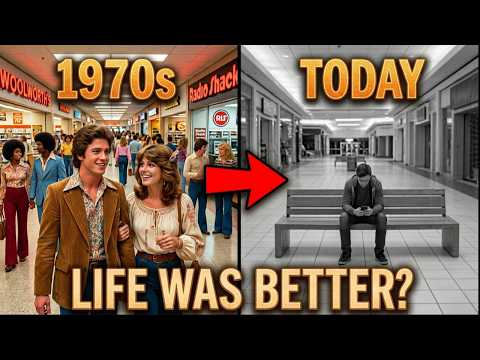
[0:00]The 1970s were the last truly free decade, and I can prove it. We had real music played by real musicians. We had neighborhoods where kids could roam for hours unsupervised. We had privacy, no cameras, no tracking, no surveillance. We had jobs you could get with a handshake and keep for 30 years with a pension. And before you roll your eyes and say rose colored glasses, I'm not talking about nostalgia. I'm talking about measurable improvements in quality of life. There are 15 specific things we had in the 1970s that were objectively, provably better than what we have today. Not simpler, not different, better. Some of you lived it, and you know I'm right. Some of you are going to argue, and that's fine. But by the end of this video, you're going to understand what we lost when the 70s ended. Before we get started, fair warning. This video is going to make some people mad. So if you're ready for some controversial truth, hit that subscribe button and turn on notifications. Because we're not holding back. All right, let's get into it. Number 15: Kids had real freedom. In the 1970s, kids left the house in the morning and came back when the streetlights came on. No cell phones, no check-ins, no GPS tracking. Parents said, "Be home for dinner." And that was it. You rode bikes for miles, built forts in the woods, played in creeks, explored abandoned buildings, and your parents had no idea where you were. And that was normal, expected, good. It taught independence, problem solving, risk assessment, how to handle yourself in the real world. You fell off your bike, you walked it home. Got in a fight, you handled it. Got lost? You figured it out. Today, kids are scheduled, supervised, tracked, helicoptered. Parents get arrested for letting kids walk to school alone. Children have less freedom than they've had in human history, and we wonder why anxiety and depression are skyrocketing. 70s kids learned resilience by being free. Today's kids learn anxiety by being monitored. Freedom was better. Number 14: Music was made by actual musicians. The 1970s produced some of the greatest music ever, and every bit of it was real. Led Zeppelin, Pink Floyd, The Eagles, Fleetwood Mac, Stevie Wonder, Queen, David Bowie, Elton John, The Rolling Stones. Every note played on real instruments. Every vocal sung without autotune. Every album recorded by musicians who could actually play. You couldn't fake it. If you couldn't play guitar, you didn't make guitar music. If you couldn't sing, you didn't have a record deal. Talent was non-negotiable. Albums were complete works of art. Dark Side of the Moon, Rumors, Hotel California, Led Zeppelin 4. You listened start to finish. Today, most pop music is made by producers on laptops. Auto tune everywhere. Artists who can't play instruments or sing without pitch correction. And sure, there's still good music being made, but the standards are gone. You can become a musician with zero musical ability. Just need the right producer and the right look. 70s music was real, made by people who spent years mastering their craft. Today's music is manufactured, and you can hear the difference. Number 13: TV brought families together. In the 1970s, TV was an event. You had three networks, ABC, NBC, CBS. That's it. If you wanted to watch a show, you watched it when it aired. 8:00 p.m. Thursday, everyone in America watched the same thing. All in the Family, Mash, The Mary Tyler Moore Show, Happy Days, The Waltons. Families gathered in the living room, together. No phones, no second screens, just watching and talking. And on Monday at work or school, everyone had seen the same shows, shared culture, shared references, connection. Today, infinite streaming options. Everyone watches different shows at different times on different devices. Families sit in the same room on separate screens. No shared experience, no conversation. What are you watching? becomes a complicated question with 47 streaming services. We have more content than ever, and less connection than ever. 70s TV was limited, and that limitation created togetherness. Today's infinite options create isolation. I'll take three channels and family time over Netflix and loneliness. Number 12: Cars were simple (and you could fix them). In the 1970s, cars were mechanical. Nuts and bolts, carburetors, distributors, points and plugs. And you could fix them in your driveway with basic tools. Engine trouble? Pop the hood, grab a wrench, figure it out. Most guys could do their own tune-ups, oil changes, brake jobs. A Chilton's manual and a socket set could solve 90% of car problems. And cars had character. A 70 Chevelle SS, a 69 Camaro, a 71 Cuda. They looked different, sounded different, felt different. You bonded with your car, because you worked on it, maintained it, understood it. Today, cars are computers on wheels. Engine light comes on? You need a $3,000 diagnostic computer just to read the code. Everything is sealed, computerized, dealer only. You can't fix anything yourself. Oh, and every car looks the same. Grey blobs, soulless, boring. Sure, modern cars are safer and more efficient. I'll give you that. But we lost something, the ability to understand and maintain our own machines, the satisfaction of fixing it yourself. 70s cars put power back in your hands. Today's cars make you dependent on dealerships.
[7:28]I'd take a 70s muscle car over a 2026 Tesla any day.
[7:35]Number 11: You had actual privacy. This one's huge. In the 1970s, you had privacy. Real, complete, unmonitored privacy. No internet tracking your searches, no cameras on every corner, no phones recording your location, no Alexa listening. No data breaches. You could go somewhere and no one knew. You could have private conversations, private thoughts, private lives. If you wanted to disappear for a day, you just did. No one could find you, and no one expected to. Your business was your business. Today, every website tracks you. Every store has cameras. Every phone logs your location. Your smart TV watches you. Facebook knows more about you than your spouse does. Privacy is dead, and most people don't even care anymore because they've never known privacy. But we did. And let me tell you, it was better. You weren't performing your life for algorithms. You weren't worried about being recorded. You just lived. 70s privacy was freedom. Today's surveillance is a cage we've accepted, and we should be angry about it. Number 10: Neighbors actually knew each other. In the 1970s, you knew your neighbors. All of them. First names, last names, their kids' names, what they did for work, everything. You'd talk over the fence, borrow tools, help with yard work. Your kids played with their kids. Block parties were real. Everyone came outside, grilled, talked, laughed. If someone's car broke down, three neighbors would come help. If someone got sick, neighbors brought food. It was community, real, functional, supportive community. Today, you don't know the people living 20 feet away. You pass them in the driveway and maybe nod. Everyone's isolated, inside, on screens. Community is dead, replaced by HOAs and Ring doorbells. We're more connected than ever online, and more alone than ever in real life. 70s neighborhoods were alive. People looked out for each other. Kids had 30 adults watching over them. Today's neighborhoods are ghost towns. Everyone's inside, alone, scrolling. We lost community, and it's one of the saddest losses of all. Number nine: You could actually afford a house on one income. This one's going to make you mad. In the 1970s, a regular working class guy could buy a house, support a family on one income. Factory worker, teacher, mechanic, didn't matter. Middle class wages bought middle class lives. Houses cost two to three times your annual salary, not eight to ten times like today. Dad worked. Mom could work if she wanted, but she didn't have to. One paycheck covered mortgage, car, food, savings, vacations, everything. Today, both parents work full-time and still can't afford a house, or child care, or health care, or anything. Wages stagnated, housing costs exploded. The entire middle class got gutted. Just work harder. Yeah, 70s families worked one job and bought houses. Today's families work two jobs and rent apartments. This isn't about effort. It's about economics. The 70s economy worked for workers. Today's economy works for investors. We had it better. Measurably, provably better. And anyone who denies it is either lying or ignorant. Number eight: Phones stayed on the wall. In the 1970s, the phone was attached to the wall with a cord. If you weren't home, you were unreachable, and that was good. No one expected instant responses. No one panicked if you didn't answer. You just called back later. You made plans, and you kept them. You couldn't text running late or bail last minute. You showed up. Phone conversations were real. You sat down, focused, talked.
[12:41]Today, everyone's reachable 24/7. Expected to respond instantly. You're never truly off, never truly present, always available, always distracted, always stressed. Can't even go to dinner without checking your phone. Can't have a conversation without interruptions. And we're more connected than ever, but more lonely than ever. Because connection isn't about availability. It's about presence. 70s phones forced presence. You called someone, you talked. You were together. You were there. Today's phones destroy presence. We're together, but not present. I'd take a rotary phone and actual conversations over smartphones and loneliness any day. Number seven: Saturday mornings were sacred. If you didn't grow up in the 70s, you can't understand this. Saturday morning was yours. No school, no obligations, pure freedom. You woke up early, poured a bowl of sugary cereal, turned on cartoons. Scooby Doo, The Super Friends, Looney Tunes, Fat Albert, Schoolhouse Rock. Three hours of cartoons. Then you went outside to play. And here's what made it special: you had to watch then. If you missed it, it was gone. No DVR, no YouTube. This created ritual, anticipation, shared culture. Every kid in America watched the same shows at the same time. Today, kids have infinite content 24/7. They can watch anything, any time. Sounds better, right? Wrong. There's no ritual, no anticipation, no event. Saturday morning is just another day, another screen session. We had limits, and those limits made things special. Today's unlimited access makes everything meaningless. 70s Saturday mornings taught patience, delayed gratification, and the value of ritual. Today's kids will never know that magic, and that's sad. Number six: Jobs were stable and came with pensions. In the 1970s, you got a job, and you kept it for 30 years, 40 years, your whole career. And at the end, a pension. Guaranteed income for life. Factory jobs, union jobs, corporate jobs, government jobs. They all offered stability. You graduated high school, got hired, worked hard, retired with dignity. No gig economy, no contract work, no at-will employment. Real jobs with real security. Companies invested in employees, training, advancement. Loyalty went both ways. Today, jobs are temporary, benefits are disappearing, pensions are gone. You're lucky to keep a job five years before layoffs, restructuring, or disruption. 401Ks replaced pensions, which means your retirement depends on the stock market. Good luck. Companies demand loyalty, but offer none. We're a family until the next quarterly earnings call. 70s workers had security. Today's workers have anxiety. We traded stable careers for flexibility, and we got screwed. Anyone who says today's job market is better is either rich or delusional. Number five: Food was actually food. In the 1970s, food was real.
[16:58]Most families cooked at home, from scratch. Real ingredients, meat, vegetables, bread. No ingredient lists with 47 chemicals you can't pronounce. Fast food existed, but it was a treat, not a daily routine. Family dinners were mandatory. Everyone at the table, no phones, no TV, just eating and talking. Food tasted like food, not lab created flavor compounds. Today, everything is processed, chemicals, preservatives, corn syrup in everything. People eat fast food four times a week and wonder why they're sick. Healthy food costs double. Fresh vegetables are a luxury, and family dinners? Extinct. Everyone eats separately, on screens, different times. Sure, 70s food wasn't healthy by modern standards. We had TV dinners and Hamburger Helper, but it was real, and it brought families together. Today's food is cheaper, faster, and more convenient. It's also poison, and it's destroying community. I'll take 70s home cooking over today's chemical laden garbage. Number four: Entertainment required effort, and that was good. This sounds crazy, but effort made the 70s better. You wanted to listen to a song, you bought the album, or waited by the radio with a cassette recorder. You worked for it. You wanted to see a movie, you drove to the theater. One showing time. You planned around it. You took photos, you waited a week for them to develop. And when you saw them, it was exciting. You wanted concert tickets, you stood in line for hours in person. Everything required effort, patience, and it made you appreciate things more. Today, everything is instant. Any song, right now. Any movie, right now. Any photo, right now. And we appreciate nothing. Skip a song after 10 seconds. Scroll past photos without looking. Cancel plans last minute because something better popped up. Instant gratification has made us entitled, impatient, ungrateful. We've lost the ability to wait, to work for things, to value what we have. 70s effort taught appreciation. Today's instant everything teaches nothing. I'd take effort and gratitude over instant and meaningless any day. Number three: Men had real, hands-on hobbies. In the 1970s, men had hobbies, real time-consuming, skill building hobbies. Woodworking, restoring cars, building model trains, ham radio, photography in dark rooms. They spent hours in basements and garages, building, creating, fixing. These weren't passive activities. They required skill, patience, dedication, and men took pride in them. I made that, I fixed that, I built that. Hobbies created identity. You weren't just a guy. You were a woodworker, a ham radio operator, a model railroader. Today, men scroll TikTok, play video games, watch other people do things on YouTube. Everything is passive, virtual, meaningless. We've traded creating for consuming. Sure, some guys still have hands-on hobbies, but it's rare. And getting rarer. Most men today don't even own basic tools. Can't fix anything. Can't build anything. And we wonder why men feel lost and purposeless. 70s hobbies gave men identity, skill, purpose. Today's passive entertainment gives them nothing. Number two: No social media, real relationships. This is the big one. In the 1970s, relationships were real, deep, face-to-face. You didn't compare yourself to everyone's highlight reel. You didn't perform your life for strangers. You didn't count likes. Friendships required effort. You had to show up, call, visit, be there. And because of that effort, friendships were deep, meaningful, lasting. You knew people really, not their curated online persona. The real them. Self-worth came from real achievements, real relationships, not follower counts. Today, everyone's performing, curating, filtering, faking. You have 500 Facebook friends, and you're lonely. Relationships are shallow, transactional, digital. Teen depression is at all-time highs. Social media is a massive factor. Kids compare themselves to fake, filtered, impossible standards, and they feel like failures. Adults aren't immune. We're all anxious, comparing, competing. For what? Validation from strangers? 70s relationships were hard. You had to work for them, and that work created bonds. Today's relationships are easy, and meaningless. No social media was the best thing about the 70s. Number one: The freedom to just be. And here it is, the biggest thing we lost. In the 1970s, you could just be. No cameras everywhere, no internet recording everything, no social media judging everything. You could make mistakes and move on. No digital permanent record, no cancel culture, no viral video. You could be anonymous, private, yourself. You weren't performing for an audience. You weren't curating an image. You just lived. And if you wanted to disappear for a while, you could. No tracking, no expectations, just freedom. Today, everything is recorded, everything is permanent, everything is public. One mistake, it's online forever. You're constantly monitored, tracked, judged. You can't just be anymore. You have to perform, and we've accepted this as normal, but it's not normal. It's insane. 70s freedom was real. You could live your life without surveillance, without judgment, without permanent records. Today's freedom is an illusion. We're more monitored than any generation in human history. And we've traded privacy and autonomy for convenience. I'd give up every modern convenience to have 70s freedom back. The freedom to just be. That's what we lost, and it's the greatest loss of all. And there you have it, 15 things we had in the 70s that were better than today. Not different, better. Better freedom, better privacy, better relationships, better economy, better life. Look, I'm not saying everything about today is bad. Modern medicine is incredible. Technology has benefits. But we lost something huge. Freedom, community, privacy, security, humanity. And I think it's time we admitted it. Which one hit you hardest? Do you agree or am I living in the past? Drop your thoughts in the comments. I want to hear both sides. If you enjoyed this controversial trip down memory lane, hit that like button. Subscribe to remember this TV and turn on notifications. Thanks for watching. And remember, we're reliving the good old days. One memory at a time. Now go talk to your neighbor. Actually talk, face to face. I dare you.


