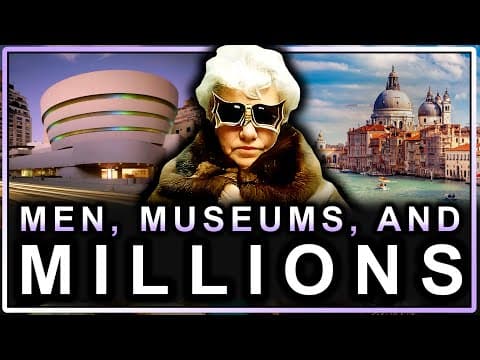
[0:00]Peggy Guggenheim was more than just a wealthy heiress. She was a storm that ripped through the art world, leaving behind whispers of scandal, daring, and heartbreak. Born into the gilded cage of not one but two prominent New York elite families, she defied the social mores of her time, and by the time she was 12, she had already accused her father of keeping a mistress. A man who later perished heroically aboard the Titanic. But tragedy didn't temper Peggy's appetite for life. It merely fueled her pursuit of artistic rebellion and sensual liberation. With a reported over 3,000 lovers, including painters, writers, and revolutionaries, she loved boldly, shamelessly collecting not only art, but the most notorious men of her era. And while her personal life was a wild affair of broken marriages and torrid affairs, Peggy's true romance was with modern art. Indeed, she transformed the staid world of galleries with her daring exhibitions, befriending the likes of Picasso and Jackson Pollock. In today's episode, we share her unapologetic, eccentric, and often scandalous story, how Peggy lived on her own terms, navigating high society and heartbreak, as we describe, Peggy Guggenheim, the girl boss of the Gilded Age. In order to best understand the unparalleled nature of Peggy Guggenheim's unique personality and life story, we must first bring a little context to the fore. You see, as the 19th century gave way to the 20th, New York City was a city where old fortunes held sway and new fortunes dared to redefine society's boundaries, famously or infamously known as the Gilded Age. It was indeed an era was characterized by the likes of the Vanderbilts and Astors, families who, despite their enormous wealth, adhered to the whims of Caroline Astor and her exclusive 400 list, dictating who was in and who was out in high society. And Peggy's family, with their vast resources, mirrored these societal giants, striving to cement their place in the annals of New York's elite through displays of wealth and social gatherings that rivaled the grandeur of their established counterparts. Yet, despite their efforts and the visual splendor of their gatherings, the Guggenheims, much like other new money families, often found themselves at the periphery of this rigid social circle, their acceptance into the old guard not guaranteed. Peggy thus grew up overshadowed by these complex dynamics, observing the relentless pursuit of social elevation that defined her family's narrative and the era itself. This backdrop of relentless ambition and opulent displays therefore shaped her early understanding of wealth, power, and the often capricious nature of social acceptance, imbuing her with a perspective that would later influence her legendary contributions to the world of modern art. Among these emerging Titans were Peggy Guggenheim's parents, Benjamin Guggenheim and Florett Seligman, heirs to immense fortunes and the burdens that accompanied them. And the Guggenheims, not originally of the social elite, had built their empire in the mining and smelting industries, with Peggy's grandfather, Meyer Guggenheim, leading their ascension from Swiss immigrant to industrial magnate. Specifically, the Guggenheim family specialized in copper, silver, and lead, setting the stage for the family's opulent lifestyle and societal aspirations. Conversely, the Seligmans, Peggy's maternal family, were distinguished bankers, who had secured their prominence by financing pivotal deals during the American Civil War. And Joseph Seligman, her grandfather, was known not only for his financial acumen, but also for his unique place in the social fabric of American society, often regarded with the same curiosity afforded to his eclectic contemporaries. Born into this blend of industrial might and financial prowess on the 26th of August, 1898, in New York City, Peggy's entry into the world was nothing short of majestic. In fact, her first breaths were drawn within the plush confines of the Plaza Hotel, New York's beacon of luxury, which had opened its doors just a year before her birth. And this setting was a precursor to a life enshrined in luxury and societal ambitions. Her family later moved to a sprawling mansion on the Upper East Side overlooking Central Park. This residence with its marble staircases, tiger skin rugs, and opulent Louis the 16th furnishings was more than a home. It was a statement of wealth and an attempt to carve out a space among New York's elite. Yet, despite the splendor, Peggy's early years were shadowed by familial discord, and as the middle child among three sisters, she navigated a home life dimmed by her father's notorious infidelities and her mother's emotional distance. The care of Peggy and her sisters fell to a series of strict governesses, under whose watchful eyes they grew, but from an early age, Peggy's sharp intellect shone through. At a dinner, she boldly confronted her father, declaring, Papa, you must have a mistress, as you are never home. Not long after, when she was 12, her father relocated to France under the guise of business, though his pursuits leaned heavily towards romantic escapades. This left Peggy and her sisters pining for his presence, especially the youngest Hazel, who desperately implored him to return for her birthday. He acquiesced, securing a passage on the Titanic. Known for his last heroic acts, he was seen ensuring women and children were safe on the lifeboats, choosing to face his fate in full evening attire, a gesture of dignity in the face of impending doom. His last known words shared with his valet Victor were, we are dressed in our best and are prepared to go down like gentlemen. His body, however, was never found. Tragically, Hazel was unjustly blamed by their mother Florett for their father's death, casting a long shadow over her life. Later, both of Hazel's sons tragically died in an accident at the Sue Hotel. Peggy, meanwhile, never quite recovered from the trauma of her father's demise, admitting, I never recovered from my father's death. My childhood was excessively unhappy. I have no pleasant memories of any kind. Her woes were compounded by her physical insecurities, she loathed her nose, likening it to a fat potato, and underwent a rhinoplasty that unfortunately went awry, adding to her distress about her appearance. Despite these trials, Peggy's life took a transformative turn at 21 when she inherited $450,000, equal to around $14 million today. However, this was just around the time personal income tax was instated. Although it paled in comparison to the fortunes of other Guggenheim members, it marked a pivotal moment. Contrary to what some might have expected, the young Peggy Guggenheim immediately channeled her funds wisely, venturing into a job at an avant-garde bookstore. There her path crossed with cultural icons like F. Scott Fitzgerald and photographer Alfred Stieglitz, who introduced her to modern art and his wife George O'Keefe's work, captivating her completely. Then Peggy, captivated by the Bohemian lifestyle, relocated to France in 1920, plunging into the vibrant Parisian avant-garde scene.
[7:31]She frequented circles populated by celebrated figures like Brancusi, Barnes, and Marcel Duchamp, whose influence indelibly shaped her life and legacy through their art and culture, which had captivated her heart. During her European journeys to uncover the realms of classical and Renaissance art, Peggy stumbled upon startling frescoes from Pompeii that depicted intimate encounters in various positions. In her autobiography, she confessed her curiosity about these ancient practices, expressing a desire to experience each one herself. Soon she would find just such an opportunity, when Lawrence Vale, a distinguished artist and writer, visited her while her mother was away. During their meeting, Vale made his intentions clear, suggesting an intimate rendezvous, and to his surprise, Peggy agreed without hesitation. However, rethinking the risks of her mother's possible early return, he proposed they meet at his hotel instead. With characteristic impulsiveness, Peggy, donning her hat and a look of determination, replied, How about right now? She pursued Vale, who was revered as the king of Bohemia, straight to the altar, though she harbored doubts about his commitment to the extent that she refrained from buying a wedding dress. Nonetheless, he did appear, and they married in 1922. The union resulted in two children, Sinbad and Pagen, but also brought turmoil and suffering. Peggy showered her emotionally distant husband with affection, which he repaid with cruelty, at times physically abusing her by walking on her stomach, submerging her head underwater, or humiliating her by smearing jam in her hair. In his novel Chasm: A Weekend, Vail penned a thinly veiled, unflattering portrayal of Peggy through the character of Annabella, a wealthy American depicted as self-centered, shallow, and manipulative, using her wealth and status to influence others while lacking in genuine affection and support. Despite enduring much, Peggy's breaking point came upon discovering his affair with novelist Kay Boe, and she promptly ended the marriage, gaining custody of Pajan, while Sinbad remained with Lawrence. Peggy's relationship with her children mirrored her own mother's distant parenting style. She famously remarked she would trade her son for a Picasso. After divorcing Vail in 1928, Peggy met British writer and critic John Holmes while visiting friends, and their relationship began with a memorable kiss in a tower, an encounter she attributed in her autobiography as the catalyst for all that followed. However, this relationship too turned sour as Holmes exhibited abusive behavior, including forcing her to stand naked by an open window in winter, throwing whiskey in her eyes, and threatening physical harm. Shockingly, his actions were intended to mar her beauty so that she would be undesirable to others. Despite the chilling treatment from John Holmes, Peggy's captivity to his cruel whims was abruptly ended. Holmes, who required a routine surgery following a horse riding accident, suffered a fatal heart attack on the day meant to bring him relief. Now, liberated from his torment and a previous disastrous marriage, Peggy embraced a life of fleeting romances, her spirit unbound and desire untamed.
[10:44]Believe it or not, it was whispered at one time that Peggy Guggenheim indulged in the company of nearly 3,000 lovers, her wit sharp as ever when quizzed about her marriages. She retorted, Do you mean mine or other people's? And in the shadows of Holmes's death, Peggy found solace and a spark of something new with Douglas Garman, a publishing house director she and Holmes had encountered back in 1933. You see, following Holmes's demise, Garman, moved by some unspoken promise of what could be, penned a heartfelt letter to Peggy. Their bond quickly turned romantic over shared meals and intimate evenings. However, as Garman dove deeper into the political arena, joining the Communist Party of Great Britain and entwining himself with Marxist ideologies, his commitment to Peggy waned, and his life became a series of lectures and travels, leaving Peggy alone and longing. Eventually, Garman's heart wandered to a comrade within the party, with whom he departed, leaving Peggy to grapple with the fragments of yet another failed relationship. At a crossroads, Peggy, having been defined by her roles as wife and lover for 15 years, refused to drown in her sorrows. Encouraged by friends, she seized on the idea of channeling her passion into the arts. So, in 1938, she relocated to London and unveiled her own art gallery. Her inaugural exhibition showcased the stirring pieces of Jean Cocteau, setting the tone for a hub that would soon draw modern art luminaries like Henry Moore and Pablo Picasso. Around the same time, Peggy's path crossed with Samuel Beckett in Paris at a dinner hosted by James Joyce. After walking Peggy home, Beckett, rather boldly, sprawled himself on her sofa and invited her to join him. This spontaneous act sparked a fervent romance. Despite his financial struggles, Beckett took joy in driving Peggy's sports cars, and they once secluded themselves in a hotel for four days, their only contact with the outside world being to order room service. But Peggy's romantic escapades, a heady mix of passion and excess, gradually waned as World War II loomed, closing yet another chapter of her vibrant love life. Despite the changing tides, her commitment to art never faltered, and she vowed to acquire a painting daily, adding masterpieces by Picasso, Dali, and Braque to her collection, earning her the title of the Bohemian Queen of the European art scene. During one memorable visit to Picasso's studio, her artistic ambition was met with derision. Picasso dismissively directed her to a department store's undergarment section. Undaunted, Peggy persisted in her mission until the impending war forced her to confront the peril her prominent Jewish heritage posed. Just a week before France capitulated, she too had to acknowledge defeat and planned her retreat to the United States. Before departing, Peggy sought to safeguard her collection, but the Louvre turned her down, deeming modern art unworthy. Resourceful as ever, she arranged for her treasures to be hidden in a friend's barn in the Vichy countryside, a temporary sanctuary amid chaos. At 45, Peggy returned to the US with a colorful entourage that included her ex-husband, his soon to be ex-wife, her two children, and the painter Max Ernst. Despite the upheaval, her passion for art remained undimmed. Almost immediately upon arriving in New York, she opened a new gallery. Peggy's new post-war venture was a triumph, securing her position as a pivotal figure in the contemporary art scene, and helping shift the art world's center from Paris to New York. And at 42, Peggy married Max Ernst. Reflecting on their nuptials, she humorously remarked about Ernst's gloomy demeanor, questioning whether his distress was due to marrying her or something else entirely. An ex-lover jestingly referred to Ernst's as consort number 3,812.
[14:49]Their union was as unconventional as it was brief, with Ernst sometimes donning Peggy's clothes. Continuing her vigorous support for the arts, Peggy launched 31 Women, the first all-woman art exhibition in America. It was at this event that Ernst met Dorothea Tanning, a fellow surrealist artist, and their connection was instantaneous, leading Ernst to leave Peggy for Tanning. During this period, Peggy discovered Jackson Pollock, who was then working as a carpenter at her uncle's museum. Despite her admiration for his talent, Pollock rebuffed her advances with a blunt remark about her appearance, illustrating the complicated dynamics that often surrounded her. After the war, Peggy was determined to relocate overseas once more. She purchased an 18th-century Palazzo on a Venetian Canal, where she lived in grandeur, surrounded by her prized artworks and a retinue of 10 to 15 beloved dogs. She often rested on a silver bed, crafted by Alexander Calder, a striking symbol of her eclectic taste and undying passion for the arts. This illustrious setting in Venice became a fitting backdrop for the vibrant art-filled life Peggy led, marked by her enduring zeal for collecting and promoting modern art. Three afternoons each week, Peggy threw open the doors of her sumptuous home, allowing the public to meander through rooms draped in masterpieces, paintings that spilled over from the grand salons to the very walls of the bathroom. Meanwhile, Peggy herself would soak in the sunlight on her rooftop terrace, the epitome of Bohemian chic. Peggy's gatherings were legendary, drawing a mosaic of famous faces like Yoko Ono, Tennessee Williams, and Truman Capote. And her companions were as eclectic and vibrant as her art collection, ranging from gondoliers to race car drivers, these thrill seekers and Wanderers, capturing her heart. But tragedy pierced this colorful tapestry in 1967 when Peggy's daughter, Pegine, a talented but tormented artist, battling alcoholism and depression, ended her own life, leaving behind four young sons. The news reached Peggy via Telegram, a blow from which she never fully recovered. Mourning the daughter she described as more of a sister and friend, Peggy confessed, Her death has left me quite bankrupt.
[17:20]In her later years, Peggy, often revered as the Medici of modern art, lived a solitary life, with only her 14 dogs for company. She was frequently seen gliding through the canals in her private gondola, the last of its kind in the city, reflecting on life with a mixture of nostalgia and melancholy. Peggy once remarked, I adore floating. I can't think of anything as nice, since I gave up on sensual relations, or rather they gave up on me. Peggy Guggenheim passed away in 1979 following a stroke, having directed that her ashes rest in a quiet corner of her beloved garden alongside her cherished dogs. This final act ensured that her spirit and her love for art would forever remain intertwined with her cherished Venetian home. In the last chapter of her extraordinary journey, Peggy Guggenheim stood as a beacon of artistic innovation and personal freedom. She navigated her tragedies with indomitable resilience, celebrated love in its myriad forms, and reshaped the art world with her bold vision. Her legacy, stitched together with threads of passion, scandal, and staunch independence, continues to captivate and inspire. As Peggy herself declared with characteristic forthrightness, I have always lived my life exactly as I wanted. I've tried not to compromise. And now we'd love to see you in the comments. What is your opinion on Peggy Guggenheim's life? Was it an example of truly living to the fullest, or was it too hedonistic, trying to hide pain from tragedy? We look forward to hearing from you, and thanks for joining us for another episode of Old Money Alore. Cheers, until next time.


