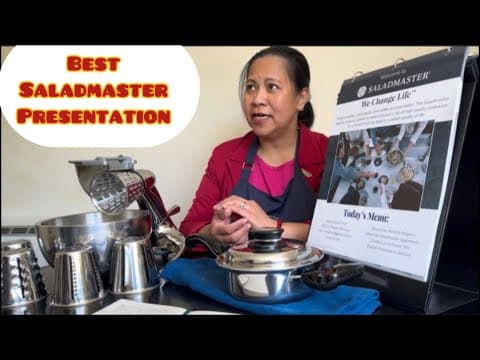
[0:00]Salad Master is a health and nutrition company, which is started way back in 1946. It's a very old company.
[0:07]It's a very old company. It's a 79-year-old company. So, what we do is we do a range of specialist nutritional cooking equipment that are scientifically designed by engineers to allow us to cook our food without using, you know, um, fats, oil or grease. Or in Igbo, they call Manu. How we can cook our vegetables without using water. How we boil egg without water, and we cook in low heat at 86° C. So the benefit of all of that is it preserves an average of 93% nutrition of the food. Therefore, it turns our food back to a natural medicine. So when we cook our food out of salad master and put that in our body, it heals us from the inside out. It's then difficult to explain how we do it, so the best way is to just come and do a demonstration. Exactly, because at the end of the day, you cannot explain taste buds, right? So the format of what we're going to do today is I'm going to start off first with my flip chart and let's talk about the science of food and the science of nutrition. Because, my friends, it's not just about the food that we eat. It's what does that food do in our body. Then we go to the part that you would want to see the magic the practicals and that is me cooking your food in front of you. We'll cook fried chicken without anything, no oil, no nothing, no salt. We'll cook jollof rice without oil. We'll cook yam without direct contact with water. Actually, we're already cooking the yam. We cook it with the back and we will dispatch the yam to make it diabetic-friendly and diet-friendly food. We'll, um, we'll cook cheesy potato, but we're going to defat the cheese and dispatch the potato again to make it diabetic-friendly and diet-friendly food. We'll bake a chocolate cake, but we're not going to use your oven. We'll bake the cake in about 10 minutes only. And of course, we're already got the salad. And obviously, um, we'll be cooking everything in about 30 to 35 minutes only. Once the food finishes off, we'll finish off the evening with something called a pot test. It's a pollution test to show you why we use the highest grade of material we do. So what you're going to see here today is the latest in cooking technology, merged with our unique cooking methods. So our engineers have been able to do things that nobody else has ever done before. So you will see food prepared in front of you with low fat, low cholesterol, heart healthy and guilt-free. Now, everything I have here is available for you to invest in, but having said that, Frank and Love, this is your house and you are the bosses. So you're not definitely getting any sales pressure from me today. The most important thing is if you enjoy my company, if you love the food that we'll be eating today, if you think the information that you will be learning today is worth sharing to people, please do recommend me. However, should you decide to get something today, which will then save us time in the long run, Salad Master will give you a gift. We call this our first call special. I can't tell you yet what really is right now, but I promise you will love it. But the most important thing is I hope I'll be able to change your life for the better today. Now, before I start, in your daily food preparation, what are the things that you mostly consider? Is it taste, nutrition, variety, speed or cost? The nutrition. The taste, number three, and the cost. Okay. What about your Frank? I think that you see the taste, nutrition and the cost. So nutrition is very important for you. Okay. Okay. What about your Frank? I think that just it. Taste, nutrition and cost. Yeah, so nutrition is very important for you. Do you have family history of diabetes, hypertension, cancer? Are you trying to eat healthy, live healthy? Definitely. And how much are you willing to spend, Frank, so you and your family can eat clean and healthy food in, let's say, in a month? Say your grocery bill that includes everything considering eating clean and healthy food. You mean what we spend every month or what we tend to spend? Yeah. You, yourself, what do you spend in a month? I would spend roughly £700 in food, not just food alone for So Okay, for example, if Okay, I think it's roughly we spend around £400 a month for food alone. Food, fruits, and everything, yeah, meat, protein, bread, um, like the everyday here and there going to get it. Yeah. So let's say, for example, in one day, your your budget is just for one day. And a family, let's say three, because your baby is not eating yet, right? So the family of three, three mouths will be eating in one day. How many times do you eat in a day? Is it one, two, three times. Three times. So, let's say you go to a grocery shop and you spend for one day. So the whole family can eat three times a day, clean and healthy food. How much would that budget be for one day? Is it £10, £20? Roughly £20. Highest £20. Highest is £20. That is to divide it in three three eating, so let's say roughly about £7 per meal for three person. Sounds about right, isn't it? Okay. Now, if I'm able to give you, I'm able to show you to save uh 25% of that grocery bill, is that a good thing? Sure. Definitely. Yeah. How about your energy? Your electricity? Do you pay for your energy or is all inclusive in the house? No, we pay for it. If I can show you a way and how you can save 70% of your cooking fuel, is that a good thing? Sure. It is. Yeah. And if you can save 50% of your cooking time, would that be a good thing? Of course, definitely. So if I'm going to show you the benefits of Salad Master today and if you're going to invest in Salad Master, you're not going to pay anything. It's all your savings to pay for your Salad Master. Okay? But again, see the presentation first, and if this is something that would benefit you, I'll be the first person to tell you, go for it. But if you think this will not benefit you and you're just looking into them a shiny pots and pans, I'm going to be the first one to discourage you. Of course, it's fine. Sounds like a deal? Yeah, sure. Fantastic. So, now, Salad Master is an American company. This is our factory in Wisconsin, USA. Still the largest manufacturer of cookware, not just in the USA, but in the entire world. One of the things that our customers like best about Salad Master is its lifetime warranty. Which means if you have Salad Master, that is your cookware for life. You never buy again. When Salad Master first started way back in 1946, this amazing machine is all they used to make. This is a master of salad for both vegetables and fruits. Hence the name, Salad Master. That's right. Then over the years, Frank and love, this has turned a full range of specialist cookware, but then we retain the name. The name just stuck. Now we have literally done tens and thousands of presentations. Okay? Now, one of our customer said, one thing I like best about this machine is it saves so much time. 50 to 70% of the food preparation time is saved, as I will show you today. Yeah. And, um, you know, we used to sell this at £500, but the good news is we don't sell it anymore. Feel the world, this front, it's heavily chrome plated, never to rust, chip in or corrode. It's properly made, isn't it? Yeah. Again, the good news is we don't sell it anymore. If someone wants to get it, how does a person get it then? You can earn it for free. And this is how you earn it for free. Just refer me to your families and friends.
[8:21]After cooking on the fifth recommendation, we'll give this to you as a thank you gift. Okay? Yeah. Again, our products are not sold in the shops. Would you like to know why? Yeah. Now, Frank, and Love, Love. If I may ask you a question. If you went into a shop and in one corner you saw a cookware at £70 and in another at £700, which one would you go for? The £70 cookware, of course. Silly question, isn't it? Yeah. And that is because the Salad Master cookware cannot talk. So it cannot tell us what it can do that the regular cookware can't do. The only thing that this Salad Master has in common with the regular one is they look similar. One of our customers said it's like comparing a real diamond with a false one. Together, they may look the same, but they can never be the same. Exactly. Different things are they? So I'm going to show you today, my friends, is why in the long run this Salad Master £700 one is actually the better buy and the cheaper of the two. Now, just to give you a quick price guideline. Now, if you have every single item that Salad Master makes, you're looking up to over £12,000. And it goes way down to individual items, that starts around £700. Some of our customers, they get started that way, one by one, and then they work their way up. But most of them, they get a set because it works out cheaper by the set. And our most popular set is the professional set, which is worth £4,571. And what most people do is they spread the cost on a family health affordable investment plan of roughly over £4 a day. Now, Love and Frank, if you are to ask me, oh, Janet, come on, really, a set of cookware, worth 4571? Can you please justify the price, isn't it? Now, my friends, if we're just talking about this, you know, shiny pots and pans, I couldn't justify that. But please, today is not about cooking. It's not about cookware. It's about your health and your family's health. Now, in the UK, every three minutes, one person is diagnosed with cancer. You know that working in a geography, one person is diagnosed with diabetes every two minutes, and every five minutes, you know, someone is having a heart attack. Minutes? Yeah. So, as we go through the presentation this afternoon, my friends, all I ask from you is to just keep an open mind. Because I'm not here to try to sell you anything. I'm just here to share with you something I believe will improve the quality of your life and your family's life. So just relax, enjoy the presentation, enjoy the food, and I hope you do more.
[11:09]Is that good? Let's start with nutrition. Again, as I say, I'm not here to sell you anything. I'm just here to share with you something I believe will improve your life. So have you ever heard of the expression, we are what we eat? Sure. Yeah, you've heard of that? So doctors and dietitians tell us that what you eat and how you prepare the food can affect how we look, feel and how long we live for.
[11:51]Now, would you also agree with me, um, Frank, that these are the lifestyle diseases of today. We have heart disease, high cholesterol, digestive problems, obesity, cancer, and maybe high blood pressure. Yeah. And these are in the increase in our society right now. It's really scary because it's targeting now younger and younger generations. Would you agree? Now, these problems have one thing in common. Frank, what do you think they have in common? The diet. That's right. Most of them are related to our diet. Would you agree? That's why doctors tell us that if we are concerned with any of these diseases, we actually need to be concerned with all of them because they all impact to our diet. The biggest culprit is fats, fat and oil. That's why the World Health authorities tell us that the best way to cure these diseases is what do you think? What's the best way to cure these diseases? To reduce your oil intake. Yeah. Oil intake, so meaning prevention? Yeah. Prevention, they say, is better than cure, and would you agree with me that it's way way cheaper than cure? Of course, exactly. Yeah. The reason why we also have these diseases is because of lack of proper nutrition in our diet. That's why they say that in a modern world where we are living right now, we are the so-called most overfed but undernourished generation that has ever lived. Now, Love, why do you eat? Give me one good reason why you eat. Of course, for to to to live. Silly question. You need to stay alive, right? We actually have three main reasons why we eat.
[13:40]Okay. We eat because of taste. To satisfy our taste buds, our cravings when we're hungry. Yeah. But food is not just about taste. It's about the experience. You know, when we're eating, we're creating that experience, isn't it? For example, are you breastfeeding your child? Yeah, sure. You're creating a bond every time. Exactly, isn't it? Is it a he or she? She. Why don't you sit down, Frank? It's okay, now. Yeah. You're creating a bond, right? And perhaps as as husband and wife, most of the time you at least want to eat together as well. Yeah, we need to eat every day, in one place, right? Every day. That's right. So that's number one. That's one reason why we eat is because of taste, to satisfy our taste buds and our tummy. Next is energy. The metabolic processes of our body is being fuelled properly. True. And we get good fuel for food. For example, your car, what's the fuel of your car? Is it diesel or petrol? It's petrol. So what happens if you put diesel? It will spoil the car. That's right. It will spoil the engine.
[14:48]You have to drain it straight away, right? Same thing as with our body. Our body is also an engine. So if we put the wrong fuel in it, over time, it's going to knock it down. That's why we have lifestyle diseases. Are we making sense? Oh, yeah. The third reason why we eat is because of nutrition. So what happens when you eat your food? Is the body will digest the food into its molecular level. And if that food has got nutrition in it, what the body has to do is to extract, exactly, extract the nutrition from it and then put it um, you know, feed it to our blood. Our blood will now act as a postman that goes around the body to deliver all those nutrients, those vitamins, those minerals. So we keep ourselves alive, and our natural immune system will be at its highest level. And that is the science of Salad Master. Therefore, Love, when you cook your food, you're not only crafting a meal, my friend, you are actually creating the healthier version of your family. Same as when you eat your food, Frank. Your body is not only craving for food. It craves for nutrients. Therefore, if we are unconsciously reducing the nutrients of the food, we end up overeating to compensate the lack of proper nutrition in the food. That's why, you know, we are called the most overfed but undernourished generation that has ever lived. We're making sense so far. Exactly. So the next page I'm going to share with you is one of the most important part of our Salad Master presentation. And that's the single most important reason why really Joma recommended you to us. So if ever you're going to listen to one more thing I say, it has to be the next one. So how do we lose out on the nutrition of the food? Now, you've seen our yam, we didn't peel the yam, right? Now, these are the different enemies of nutrition. Nutrition, um, you know, um, seven enemies of nutrition. So we lose the nutrients through this. So, um, nutritional expert says, any vegetable, number one is peeling. Any vegetable grown underneath the ground, like carrots, yam, potatoes, the nutrient is found underneath the skin. Okay. Above ground, like cabbage, it's in the hard core. Okay. What's the first thing we do? We peel it off. And then we take this away. What do we do with it? We throw it away. So what does that suggest to you? So that that simply means we are trying to kill the fat off, and then Exactly. And would you rather keep your nutrients intact in your food? Okay. I'm glad to say that. Now, that's quite scary because that's just the preparation part. We haven't even cooked yet, right? Now we're cooking in water. Frank, water shouldn't be the problem because we need it to survive, am I right? Yeah, sure. So what becomes the problem is when we cook our vegetables with water, because most of the vitamins and minerals found in vegetables are water soluble, and water leeches them out of the food. Yeah. Most of the time, if we boil vegetable, what do we do with the water after? Throw it away. So if the sink has a digestive system, it will be one of the healthier member of the family. Yeah. Next is we have high heat, like boiling. Yeah. 100°. If you want to clean a feeding bottle or nursing bottle, what do we do to clean it? Do we boil? Do we steam? You steam it. Exactly. We even boil it sometimes, right? And the purpose there is to kill the germs.
[19:27]So, Frank, what happens if we boil our vegetables as well, 100°? It will kill the nutrients, active nutrients there. That's right. So we also end up sterilizing the vegetable. So by the time we finish cooking, what's left? What are we eating? It's junk, dead food. But then we want to live longer. Next is we also have steaming. Steaming is better than boiling, but then it occurs at even higher temperature, because if boiling occurs at 100°, steaming does not occur without boiling. It will go to the boiling point first before the steam can come. So approximately 102° C, plus it's a wet drip. Next is we have microwaving and air frying. I see you've got air, um, air fryer there. I'll I'll microwave as well. Why do you use air fryer? What are you trying to avoid? Oil. Exactly. You're trying to avoid oil, cholesterol. We're trying to find alternatives, right? But air fryer releases acroamide, which is a cancer-producing chemical, specifically ovarian cancer in female. Now, let's go to microwave.
[20:33]We cook our food in bulk, and we warm it in microwave because we want to save on time, right? But every time we put our food in microwave, it rearranges the molecular structure of nutrients in the food, leaving it less nutritious, plus the radiation that we don't need. So what do you think are all these enemies of nutrition now doing in our food? Peeling, cooking in water, oxidation, high heat. Now, by the time we finish cooking, what are you eating now? What's left? Nothing really. Nothing. Sham, right? And then where's the boat? We cook with fats and oil. Now, fats and oil, this is the biggest culprit because it makes our food seven to eight times harder to digest. It also adds up to the inches we spend so much time trying to lose. Now, definitely, we need fats in our body, would you agree? Sure. But we can get it from natural food sources. Let's say I want to fry my chicken. I don't have air fryer. I'm going to use oil. One tablespoon of oil is 186 calories. I'm going to mix two and need oil. Now, would you agree with me, we eat with our eyes and digest with our stomach. Our eyes goes, oh, yummy, yummy, yummy. Golden crispy brown chicken, right? Yeah. But our body says, what's in it for me? I'm going to work my hardest to digest the fat and the food. So what will I do with excess? What do you think the body will do? It will remain in our body, right? Thinking it will be used. Exactly. It just keeps on saving it, saving it, saving it. Okay. Never use it.
[22:19]Until it's used. But what do we do? We keep on adding, adding, adding. Yeah. Now, three minutes after ingesting oil, if you didn't use it, it goes to storage. But where is it? It doesn't only store in the adipose tissues. It makes its way to the visceral organs, like our liver, our kidneys, most importantly, our heart. Now, what do you think of this oil if I give it to you to drink? Will you drink it? No. Why not? Because we don't know it as something you consume that way. So you consume it by using it to cook or something. So it's not you who needs oil, it's your cookware forcing it to use oil.
[23:37]Because, Love, how can you fry without oil? Your food will burn. It will stick to the pan, right? Yeah. It will stick to the pan. If I pour this down the oil, the oil down the sink and everyday you keep on pouring, what will what do you think will happen to the sink? Of course, it will block. It will block the sink. If this oil can block the sink with a part of that size, how much more of our arteries of that size?


