[0:00]Today's episode is once again sponsored by the amazing podcast English Learning for Curious Minds. English Learning for Curious Minds introduces fascinating topics about culture, history, and language, while allowing you to practice and improve your English skills at the same time. With unique interactive transcripts, subtitles, and vocabulary resources available as well, English Learning for Curious Minds is a podcast you should all be listening to. Last week's episode on the corruption of FIFA was really interesting. Who knew a sporting group could be so corrupt? And they also released the first episodes of their new fictional podcast series for English learners called Pioneers of the Continuum. I'd recommend listening to episode 4, featuring me. English Learning for Curious Minds is available wherever you listen to podcasts, or click the links in the podcast description.
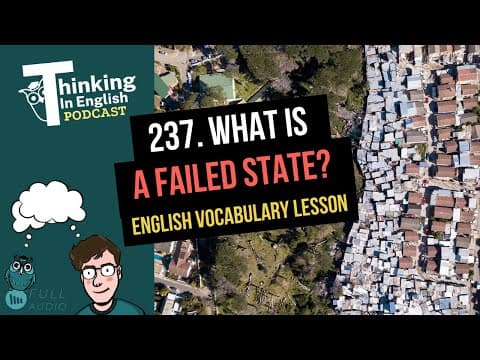
[1:05]Hello, I'm Tom Wilkinson, and welcome to the Thinking in English podcast. A podcast for intermediate to advanced level English learners. What is a failed state? Let's look at some definitions, characteristics and examples of failed states. And then discuss whether South Africa could be considered to be failing. You can find the full transcript of today's episode for free over on the Thinking in English blog. The link is in the description. Leave a five-star rating if you enjoyed today's episode of Thinking in English, and make sure to follow me on Instagram, Twitter, YouTube and all of my other social media. Here is today's vocabulary list. Corruption. Corruption. Illegal, bad or dishonest behavior, especially by people in positions of power. For example, political corruption is widespread throughout the country. Authority. Authority. The moral or legal right or ability to control something. For instance, he has no authority over his students. Good. Good. Items that satisfy human wants and provide utility. For example, air is an example of a free good that is available to all people. Fragile. Fragile. Easily destroyed, ended, or made to fail. As in, the assassination could end with the fragile peace agreement that was signed last month. Instability. Instability. Uncertainty caused by the possibility of a sudden change in the present situation. For example, the instability of the euro continues. To exacerbate. To exacerbate. To make something that is already bad, even worse. As in, this attack will exacerbate the already tense relations between the two communities. Blackout. Blackout. When there is no light or power because of an electricity failure. As in, power lines were blown down and we had a blackout of several hours. Incompetent. Incompetent. Not having the ability to do something as it should be done. For instance, he has described the government as corrupt and incompetent. Last week, most major news publications published articles claiming that South Africa is at risk of becoming a failed state. The African country is currently experiencing an economic crisis and power cuts lasting up to 10 hours a day. There is an incredible amount of corruption in the country and it has one of the highest unemployment rates in the world. But is South Africa really failing? I've been meaning to record an episode on failed states for a few months now, and these reports concerning South Africa becoming a failed state are the perfect excuse to finally record this episode. I'm going to discuss the definition of a failed state, talk about the history and give a few examples, analyze some of the criticisms of the concept before ending with a short discussion about South Africa. So, what is a failed state? The concept of a failed state is controversial. There is no single widespread or accepted definition because failure is a subjective and relative concept. This means that what may seem like failure to you may be a success to another person. It has also been used to justify invasions and political interventions, which has led to many criticisms of the concept of a failed state. However, there are some key features of a failed state that are usually included in definitions. A state, meaning a country basically, but a state can be considered failed when the government is no longer able to fulfill its basic roles and functions. Governments are supposed to be responsible, at least in part, for the armed forces, laws, economy, education, and justice. But if it if it cannot provide or control these things anymore, we can perhaps describe it as failed. Britannica Encyclopedia states that a failed state fails in two key basic functions. First, it no longer can control or use its authority over its people and land. And second, it cannot protect its national borders. A more academic definition comes from Professor Charles T. Call. He says a failed state has three gaps, gaps in capacity, security, and legitimacy. What does this mean? Well, a gap in capacity means a state can no longer provide basic goods, things like energy or food to its people. A gap in security means the country can no longer effectively protect or defend itself. And a gap in legitimacy means that a large number of powerful people in the country no longer respect basic rules and laws. Failed states tend to be characterized by violence and corruption. Unemployment will usually be incredibly high, poverty widespread, and basic services like education and the justice system will no longer be working. Often this will be seen in higher rates of illiteracy and illness. And infrastructure, things like big public buildings and roads will start to fall into a poor condition. Key institutions like the judiciary, which is the legal system, the government, the civil service, and the military will no longer have power or independence. For example, the decisions of the country's courts may no longer have any meaning, because they are not trusted, or there is no functioning police force or prison system to punish criminals. One example of how to measure how close or far a state is to failing is the state fragility index, published by the fund for peace. This index, along with other similar rankings, attempts to quantify the level of state failure. They look at a state's level of development and weaknesses in different categories. For instance, they look at social measurements, such as access to clean water, or the number of refugees. Political measurements, including human rights and the rule of law. Economic calculations about growth, and cohesion measurements including the level of divisions between different groups in a society. As of 2022, Yemen, Somalia, and Syria are ranked as the top three most fragile states. On the other end of the spectrum, Finland is the least fragile state. State failure occurs when a government is unable to effectively govern its people, maintain law and order, and ensure the well-being of its citizens. And there are several reasons why a state may reach this point of failure. Political instability, corruption, weak institutions and autocratic rule can undermine the functioning of a government. For example, according to Transparency International's Corruption Index, countries with high levels of corruption often experience political instability and are more likely to be classified as failed states. Economic mismanagement can lead to economic decline and widespread poverty. Unemployment and unequal distribution of resources further exacerbates social tensions, ultimately destabilizing a country. Social and ethnic divisions also play a significant role in state failure. These can fuel resentment and contribute to social unrest. Lack of social cohesion can also lead to conflicts and even civil war. Historical examples such as the ethnic divisions in Rwanda that culminated in the 1994 genocide illustrate how social divisions can result in state failure. Historical legacies including the drawing of borders during colonialism have created internal divisions and conflicts that persist in some countries to this day. Geopolitical rivalries and interference by external powers can also exacerbate existing tensions and undermine governance. The involvement of external actors in supporting armed groups or destabilizing governments can further hinder a state's ability to maintain stability. Environmental challenges as well, pose yet another threat to states. Poor environmental management, inadequate disaster response mechanisms and over over-exploitation of natural resources can lead to economic downturns and social unrest. The impacts of climate change, such as rising sea levels and extreme weather events, further compound these challenges. For instance, the severe droughts in Somalia in recent years have exacerbated food insecurity and displacement, contributing to the state's instability. So, let's take a deeper look at two examples of a failed state. The Middle Eastern country Yemen is often cited as a failed state due to a combination of political, economic, and social challenges. The ongoing civil war between Houti rebels and the internationally recognized government has resulted in widespread political instability and a breakdown of governance. The conflict has caused immense suffering with a humanitarian crisis characterized by high levels of poverty, food insecurity and displacement. Weak institutions, corruption and a lack of effective governance further contribute to Yemen's failure. Yemen also faces economic mismanagement, exacerbated by the war's impact on infrastructure, trade and basic services. The combination of these factors has led to the classification of Yemen as one of the world's most prominent failed states. Somalia. Somalia is perhaps the most famous example of a failed state. Decades of political instability, clan-based conflicts, and weak institutions have hindered the country's ability to provide basic services and maintain law and order. Additionally, Somalia faces widespread poverty, limited economic opportunities and high levels of corruption, leading to significant social and economic challenges. The presence of extremist groups such as Al-Shabaab further exacerbates security concerns and undermines stability. Despite efforts towards political reconstruction and stabilization, Somalia continues to grapple with a complex web of factors that have contributed to its classification as a failed state. Okay, now we have looked at the concept of a failed state and a few examples. What about South Africa? South Africa usually isn't included with the group of failed states. We tend to think of places like Yemen, Somalia, Syria, Afghanistan, places which have recently or are currently in the middle of civil wars or conflicts. Perhaps South Sudan is another great example right now. But South Africa is not usually part of that group. It's a country that hosted the FIFA World Cup only a decade ago. But despite this, a group of CEOs from major South African companies are concerned that South Africa is on the path to failing. The current main concern is to do with regular blackouts to the South African electricity grid. Already in 2023, South Africa has had more blackouts than the entirety of 2022. In fact, businesses are beginning to prepare for a complete collapse of the national electric supply. CEOs warned that the country may not be able to guarantee essential goods. People with financial resources are moving away from using public services, paying privately for medical care, schools, security, and even installing their own electric generators and solar panels. There is a real concern that South Africa's government may not be able to fulfill its responsibilities. Estimates suggest that in 2022, blackouts reduced the country's GDP by up to 7%. And it will be worse this year. South Africa is now one of the most unreliable power grids in the region. At the same time, South Africa is struggling with massive crime problems. Billions of dollars of cables are regularly stolen from industries and rail companies, stopping these companies from working. Infrastructure projects are interrupted by organized crime demanding bribes. The country has an alarming rate of money laundering. Corruption is everywhere. And the Global Financial Action Task Force has decided to put South Africa's banks under greater scrutiny. South Africa has recently struggled with incompetent leaders. Previous president Zuma was both incompetent and highly corrupt. Current president Ramaphosa may be a little less corrupt, but he may be even more incompetent. None of the politicians or the presidents of South Africa have done any policies that even begin to address the challenges the country is facing. One of the signs that South Africa's government is not fully working is clear when we look at the people working in government departments. If you were to visit South Africa's national prosecution office, you may be surprised to find corporate lawyers from private law firms working there. And if you were to walk over to the Department of Industry, you may notice employees from private banks in that public office. The government is currently so incompetent that private companies, private law firms, private banks, have made the decision to send their own employees to work in government departments. And the companies continue to pay their salaries. If you remember back to the definition of a failed state, one of the characteristics was that the people don't trust the government anymore. In South Africa, while 62% of people trust businesses, only 20% currently trust the government. So, is South Africa a failed state? Not yet. But with a failing electricity grid, crime, corruption, an incompetent government, and more, the country does need to change things to make sure it doesn't fail.
[18:23]So here is today's final thought. While South Africa is currently facing significant challenges, such as an economic crisis, power cuts, corruption, and high unemployment rates, it is not yet considered to be a failed state. Failed states are characterized by a complete breakdown of government functions, widespread violence, and the inability to provide basic services. However, South Africa's issues, particularly the failing electricity grid and governance concerns, highlight the urgent need for change to avoid the risk of further decline. The country must address these pressing issues and work toward effective governance, economic stability, and social cohesion to ensure a brighter future. But what do you think? Is South Africa a failed state? And how about your country? How fragile is your country? Let me know by leaving a comment on Spotify, uh, go over to the Thinking in English blog on the transcript, and leave a comment on the transcript as well. Um, or you can reach out on Instagram and send me a message. Um, or email me as well, right? Send me, contact me in some way. Um, thank you all so much for listening to today's episode. Remember to follow me on Instagram, subscribe to us on YouTube, um, if you want to improve your own English, go over to Patreon. There's currently a seven-day free trial, so if you go to Patreon, seven-day free trial, you'll be able to test out my conversation clubs, listen to bonus episodes, join a uh, question and answer session, um, talk with me, lots of cool things you can do over on Patreon. And if everything goes to plan, there'll be a big announcement at the beginning of June, exclusive to Patreon members, of course. So, thank you all for listening today, and I'll see you all next time. Goodbye.