[0:00]Hanging has been something that I've used for years to make myself feel better. There's two main techniques, the passive hang and the active hang. The passive hang is relaxed, allow the shoulders to rise up towards your ears and let gravity do its thing. This hang works wonders for stretching the shoulder ligaments, creating more space for your rotator cuff to move freely. The passive hang is ideal for people who have strong yet inflexible shoulders, who want more range of motion. If you have healthy shoulders without any injury or pain, the passive hang should be safe when done progressively. The active hang uses muscle tension, engage the shoulders down away from the ears, fighting against the weight of your body and gravity. The value of active hangs is they build straight arm scapula strength. With muscle hangs, you're improving stability by teaching all the surrounding muscles, ligaments and capsule of the shoulder to work in harmony. The active hang is a better choice for people with shoulder pain, instability, dislocations or a history of injury. Otherwise, if you're new to hanging or are weak overhead, play it safe and keep it active.
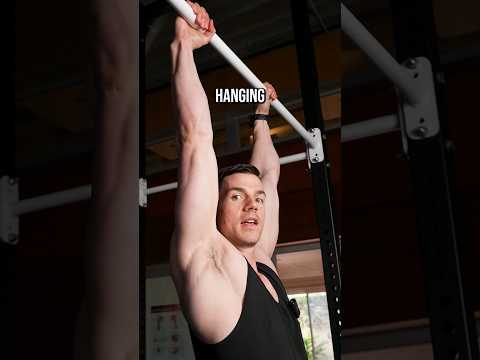
How To Dead Hang Correctly?
FitnessFAQs
1m 1s195 words~1 min read
YouTube auto captions
Transcript source
YouTube auto captions
This transcript was extracted from YouTube's auto-generated caption track. The transcript below is server-rendered so it can be read, searched, cited, and shared without opening the original YouTube player.
Pull quotes
[0:00]The passive hang is relaxed, allow the shoulders to rise up towards your ears and let gravity do its thing.
[0:00]This hang works wonders for stretching the shoulder ligaments, creating more space for your rotator cuff to move freely.
[0:00]The passive hang is ideal for people who have strong yet inflexible shoulders, who want more range of motion.
[0:00]If you have healthy shoulders without any injury or pain, the passive hang should be safe when done progressively.
Use this transcript
Related transcript hubs
Watch on YouTube
Share
MORE TRANSCRIPTS


