[0:00]This video is sponsored by eco. Cities around the world are growing rapidly. As the world population continues to grow, cities will encounter a huge rise in the number of people they have to cater for. The population of some cities will even double by 2050. Now try to imagine twice the amount of people in your city. The majority of this development is not being done sustainably and showing no mercy to our planet's resources. Fortunately, however, there are some cities which show us hope and are pioneering new ways in which development can be made sustainable. So we chose to visit some of these sustainable cities to see how it is possible for urban development to respect our environment. But which one can be titled the world's most sustainable city? Well, stick around to find out.
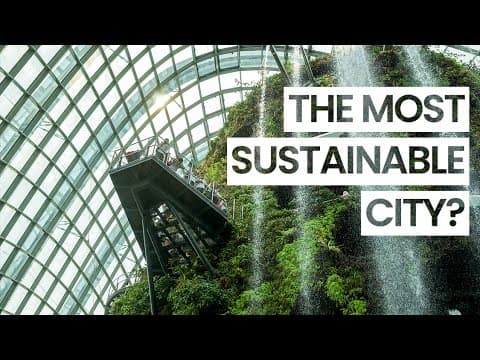
[0:53]Copenhagen aims to be the first carbon neutral capital city by 2025. One of the ways they aim to achieve this goal is through their transportation sector. In the last 10 years, Copenhagen has invested over 300 million dollars into bike infrastructure, and the Danish government have also placed incredibly high taxes on owning motorized vehicles. The residents have no reason to complain, as the public transport is excellent, and the cycle routes cut right across the capital city. They're now five times the number of bikes the cars. They also encourage bike usage by developing residential buildings that can be cycled right to the top, such as the Eight House in the Orestad District. This building designed by Big Architects is incredibly energy efficient. The shape of the building allows for passive solar heating in all of the apartments, while the green roof insulates the building stopping heat from escaping. All new developments in Copenhagen are being designed with the environment in mind. The International School in the North Haven District is wrapped in 12,000 solar panels. The solar panels provide the school with over half of its energy needs, but they also educate the children on the importance of renewable energy. All across Copenhagen, there has been a real effort made in educating the public on sustainability. They are hosting exhibitions which are informing the public on sustainable action for the future. This exhibition also explains how the architecture within the city is environmentally friendly, such as the waste energy power plant, which has a ski slope installed on the roof. Allowing the public to access the energy sector will educate them on where their energy is coming from, and they will therefore feel a greater level of accountability when using the energy. We got to see inside of the power plant, where every year 440,000 tons of waste is being converted into clean energy. Finally, the Danish are leading in their use of wind power and have recently invested over 1 billion dollars into offshore wind turbines. Now over to Singapore, which has been classed as the greenest city in Asia. This city has some remarkable architecture, including the most recognizable building, the Marina Bay Sands. While these mega structures may seem bad for the environment, Singapore has ensured they have interweaved nature into the design. You can see more about the environmental benefits of these designs in my green buildings video. Singapore receives over 19 million tourists each year, which is more than what some of the large European capital cities receive. The major tourist attractions in Singapore have an eco-driven concept. For example, the Cloud Forest in the Gardens by the Bay takes you on a journey through nature, showing you all of its beauty.
[3:44]At the end of the journey, you are exposed to the devastation that humans are causing to the natural world, which makes you want to do your bit to help. Having environmental education like this for tourists means that Singapore is able to have wide-reaching effects with its sustainable efforts. Now away from tourist attractions, Singapore may be classed as one of the most socially sustainable countries in the world due to its remarkable housing schemes. 80% of the population lives in public housing. This public housing helps families avoid homelessness and other kinds of housing instability. This has had great success in stimulating Singapore's economy, and is one of the reasons why they have become one of the most economically successful countries in the world. Having a stable economy allows Singapore to divert their attention towards pressing environmental issues, rather than worrying about financial problems. Given the land constraints and the high population density, they have done exceptionally well to provide adequate green space. In fact, there is over 47% of green coverage in Singapore. This greenery extends up the buildings and also forms new gardens in the sky.
[5:02]Now from our research and visits, Singapore and Copenhagen are the two cities we have found to be leading in sustainability. However, before I argue which of the two cities is more sustainable, I want to give some honorable mentions to some of the other cities, which are taking significant environmental action. In terms of renewable energy, Reykjavik in Iceland would be classed as the world's most sustainable city, as 100% of its energy comes from renewable sources, such as geothermal and hydropower. However, because the city doesn't have the same scale of population to other large cities, it would be unfair to give Reykjavik this title. Berlin deserves a mention due to its focus towards sustainable agriculture. Local food production is being supported across the city, through urban farming and an increasing number of farmers' markets. It is classed as one of the most vegan friendly cities in the world, and organic food consumption is massively on the rise. It is also a city trying to increase its renewable energy usage. The government buildings are now being powered by solar panels and ground source heat pumps.
[6:08]All three of the Scandinavian capitals are great examples of sustainable cities. They have all made promises to dramatically reduce their greenhouse gas emissions. Oslo aims to reduce 95% of its greenhouse gas emissions by the year 2030. There are a number of other cities which are making great progress, but let me know in the comments if you feel I have missed any of the key cities out. Now what makes Copenhagen stand out from the rest? Well, a city's level of sustainability can be based off of the criteria set in the UN Sustainable Development Goals. These two cities are making great progress in almost all of the 17 objectives. However, there must be one winner. Therefore, based off of this criteria, I would deem Copenhagen to be the most sustainable city in the world, as they are progressing much faster in solving their energy sector. However, as you have seen in this video, we can learn from a whole range of cities when we are proposing to create new developments. Therefore, I hope the cities of the future will learn from these examples and implement some of their environmental strategies. Please leave a thumbs up if you found this video to be useful, and I'd love to hear from you in the comments on what you think is the most sustainable city. Also, don't forget to check out the Green Buildings video, and subscribe to How We Save Earth. Thank you for watching, and I will see you next week. This video was kindly sponsored by ECO. They are an all-in-one platform which combine all the tools that you need to start living a carbon neutral lifestyle. I personally use their platform to measure my own carbon footprint, which I am then able to offset by choosing one of their certified green projects. Their website is in the description below, so make sure you go and check them out.


