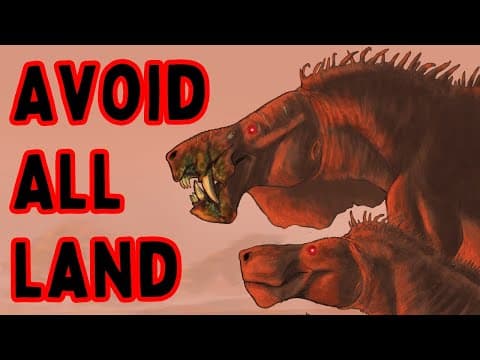
[0:00]There seems to be an unspoken rule in nature, where life in the ocean and seas must always be far scarier than life on land. This is largely seen today, and is also seen throughout history, with even the age of dinosaurs having had aquatic nightmares that would have given you more heebie-jeebies than the likes of the T-Rex or Dramaeosaurus, for example. In fact, it's actually quite hard to find a moment in Earth's history where your best chances were in the water rather than on land. However, there was a short window of time, a very long time ago, as in before the dinosaurs existed, where your chances of survival were actually better in the oceans and seas, Since nearly everything above water, including Mother Nature, seemed to be designed for maximum nopeness. This was the Lopingian. This name most likely means nothing to you, but it represents the last epoch of the Permian period, and played out between 259 and 251.9 million years ago, Which means that it bordered the Triassic period and led to people nicknaming it the Late Permian. This was one of those periods in history where Earth was unrecognizable in nearly every sense, Including when it came to time itself, as during those days, the moon had a closer orbit with Earth, Causing the days to be shorter than they are currently, at around 22 hours. To add onto the confusion, geography was nothing like it is today either, since most of Earth's land mass was tied up into the supercontinent Pangea, Leading to Africa, the Americas, Antarctica, India, Australia, and parts of Europe all being connected. Only to the east could you find decently sized land masses that were free of Pangea's clutches, With the largest quote-unquote island consisting of present day Siberia, Kazakhstan, and North China. While to the south, you would have swam into another island composed of South China and various regions of Southeast Asia. Additionally, Turkey, Iran, and Tibet were also islands at this point, being surrounded by the Tethys Ocean on one side and the Paleo-Tethys on the other. Combined, these two bodies of water were undeniably large, but they were still nothing compared to the super ocean that lay just west of Pangea, Panthalassa. This prehistoric ocean was unlike anything before it or after it, and it occupied well over 60% of the Earth's surface, Outsizing the current Pacific Ocean by two times. Just imagining an ocean that is double the size of the Pacific is nerve-racking, and probably meant that you should have avoided it like the plague. But, despite its grand size, Panthalassa, and the other oceans, for that matter, were all actually fairly tame when it came to what was in them. There were, of course, sharks, who had evolved 200 million years earlier, and if you're something of a Permian enthusiast, then you might be picturing the Helicoprion. An 8-meter or 26-foot long shark that has become something of the poster child for the Permian Marine Megafauna, And possessed one of the strangest and most unsettling mouths of all time, that consisted of a cluster of large teeth on the bottom jaw, which were arranged into whirls. Yet, while this giant shark was indeed from the Permian, it had already died out by the Lopingian, Leaving the oceans rather empty of giant life. That being said, there were still relatives of this shark swimming about, Though none that got that big, as the biggest, Helicampadus, was only 2 meters or 6.5 feet long, similar to the length of a leopard shark. So, definitely not an immense threat, especially since its teeth were designed for soft animals like squid, not bony food. Meanwhile, other sharks, like the Sphenacanthids and Hybodonths, while diverse, were even smaller, Typically growing no more than 1 meter or 3.3 feet. The Eurypterids, or sea scorpions, a group of now extinct arthropods, were also present, but were not doing so well. Because while they used to be highly diverse and giant during the Devonian period, they were now on the brink of extinction, Having never fully recovered from the Devonian extinction event, with only two genera being known from this point. And neither were large nor apex predators. And for the most part, pretty much every marine group wasn't doing well, partly due to the Capitanian mass extinction event that had taken place 2 million years prior. It's a relatively obscure event, but it was actually more deadly than both the KT extinction and the Triassic Jurassic extinction. Its effects have been bad everywhere, yet marine life got the brunt of it, and thus, during the Lopingian, You could see some trilobites, ammonoids, and cephalopods lurking about, but not in any great numbers or size. And things would only get worse for marine life, but we'll get to that later. At this moment, the waters of the late Permian should sound quite boring, but this is a key fact to take solace in. As on land, you would have gotten no breaks. Like in the water, the Capitanian extinction had brought devastation to terrestrial life. However, life on land recovered more swiftly, and was actually made arguably more dangerous than before, since the extinction took out the old rulers of the Earth, the Dinocephalians, And therefore, leaving the door open for new rulers to arise. The Dinocephalians was a group that consisted of large-bodied therapsids, who are extremely diverse and plentiful throughout most of the early and mid-Permian. Yet, despite their success, they failed to make it to the late Permian. This absence allowed multiple groups to get ahead, but there was one group in particular who benefited the most, unfortunately for others. And that was the Gorgonopsids. These prehistoric animals were first discovered by paleontologists all the way back in 1876, And their remains were so horrifying that the researchers decided that the Gorgons from Greek mythology were the perfect monsters to name the master. While diverse, Gorgonopsids still generally shared the same characteristics, which included deep-set teeth, parasagittal gates, long narrow skulls, and razor-sharp elongated incisors and canines, Making them among the first saber-toothed predators to evolve. This presence of saber teeth made them look a bit like saber-toothed cats, such as the Smilodon, and their bodies were superficially similar, too. But these killers were neither cat nor feline, they weren't even mammals, as a matter of fact. Instead, they appeared to have been therapsids, like the Dinocephalians before them, who were more closely related to mammals than reptiles, but still, were not mammals. And like the Dinocephalians, Gorgonopsids had been around during a good chunk of the Permian, first appearing 265 million years ago during the middle stage. In those times, these saber-toothed predators were very small, being no larger than a person's foot, Making them one of the smaller creatures of that time, and forcing them to hunt small therapsids and reptiles. However, as time passed and each new genus evolved, they got bigger and bigger. A trend that exploded during the late Permian after the eradication of the Dinocephalians, which ultimately led to the emergence of the largest Gorgonopsid of all time, Inostrancevia. This predator wasn't just the biggest of its kind, but also the largest terrestrial predator from the late Permian, With exceptional remains suggesting that adults could have been over 11 feet or 3.5 meters long, while weighing over 1,000 pounds or 453 kilos, equivalent to the size of a large bear.
[7:04]Though on average, individuals were more comparable to tigers. In addition to being much larger than most Gorgonopsids, the Inostrancevia was also built different, as it possessed extremely sturdy long limbs, Which made it both durable and surprisingly fast, allowing it to outpace a myriad of medium to large-bodied herbivores, Which, once caught, were in for an absolutely terrible time, as the Inostrancevia possessed elongated postcanines and supersized upper canines that were 15 centimeters or 6 inches long, Making them among the largest teeth seen in non-mammalian therapsids. In addition to being lengthy, the weapons were curved and finely serrated, allowing them to easily slice through flesh, incurring massive blood loss and causing catastrophic damage to vital organs. But despite clearly being lethal, it's not 100% sure how the Inostrancevia hunted, with the two schools of thought being that it either used tactics similar to what is seen in Smilodons, I.E. taking out the necks, Or it would do something similar to a bite and run, letting accumulated blood loss and shock take a toll over time. Regardless, neither are fun ways to go, so you definitely do not want to run into this apex predator, which was also a very hard challenge for animals back then, As Inostrancevia achieved a widespread range that included now parts of Africa, Asia, and European Russia. This saber tooth also appears to have been very adaptive, as it routinely popped up in a multitude of very different biomes, such as warm flood plains in South Africa, or cold arid deserts in Russia, Where relief was only found in the occasional shallow lake and thin forests, which consisted of Peltaspermacean, the dominant flora of the late Permian. It's because it lived in these cold deserts that some paleontologists think that it may have had fur as well, yet this idea is still unconfirmed. Now, having one giant Gorgonopsid prowling both hemispheres of the Earth would have been bad enough. But the late Permian was home to many more than just the Inostrancevia, with dozens of other species of Gorgonopsids being known of. Many of which lived in the European part of Russia as well, including the smaller Pravoslavlevia and the medium-sized Suchogorgon, Resulting in Gorgonopsids having a complete dominance over many ecosystems where herbivores, no matter their size, had a Gorgonopsid as their main predator, And also making Permian Russia one of the last places you'd want to visit. Although, it was actually much worse down in South Africa, where a whole subfamily of giant Gorgonopsids had independently evolved alongside the Inostrancevia, And they were the Rubidgeinae. While the Inostrancevia was the largest single Gorgonopsid of all time, the Rubidgeinae were, on average, the largest family, And were distinguished by robust skulls, the lack of a parasphenoid bone, frequent tooth replacement, and the possession of deeply serrated teeth, That were likely even better for cutting than those of the Inostrancevia. They were fairly stocky, too, with some coming very close in size to the Inostrancevia, as demonstrated by Rubidgea Atrox, A species of Gorgonopsid who resided within what is today South Africa and Tanzania, where it sometimes grew to be 10 feet or 3 meters long. This body size alone made it an apex predator, but what was really impressive and menacing was its skull. As it took up over 15% of an individual's total body length, and not to mention that recovered skulls were also extremely thick and had signs of skull bossing, Which are bony protuberances that indicate that this predator was made to bite and grapple with powerful large prey. Yet, coincidentally, like the Smilodon 250 million years after it, the Rubidgea did not have a very strong bite, With reconstructions indicating a bite force of around 715 Newtons, only 20% more powerful than the bite of a wolf. Which really just shows how well designed its teeth were for piercing effortlessly through flesh and tough hide. Like the Inostrancevia, the Rubidgea would have been able to alter entire ecosystems by its lonesome. Yet, sadly for all, it was almost never alone, as indirect evidence suggests that it routinely coexisted with other members of its subfamily, that consisted of nine genera, all ranging in size from medium to large. And if this wasn't bad enough, it's now thought that it coexisted within Inostrancevia, too, since both had a presence in late Permian South Africa. Given their similar size and fairly similar builds, the two most likely shared the same predatory niche, likely leading to frequent conflict. And that all goes to say that this truly was the planet of the Gorgonopsids, and their dominating presence on land made water a definite safer choice. But just to really prove the point, I should also mention that the late Permian was home to many other predators, too, that were nightmarish within their own right. With the most notable examples being the Therocephalians. In an emerging trend, this clade was once again therapsids, and originated during the middle Permian. Although, unlike the Gorgonopsids, they had not achieved such large sizes in this time. Although, they were equally widespread, and actually more diverse, with species being found across Russia, Antarctica, Africa, and China. A small handful were even herbivores, but the vast majority were predators, who actually could have been confused for Gorgonopsids to the untrained eye. As they, too, had relatively large skulls and similar body plans, but there were key differences. With Therocephalians tending to have broader, deep skulls, smaller, straight teeth, shorter bodies, and more compacted builds. And as mentioned, they were more diverse, resulting in many developing hunting techniques not seen in Gorgonopsids. And there was even a chance that a couple, namely the dog-sized Ichibengops and Euchambersia, were venomous. Which, if accurate, would make them the first tetrapods to have evolved venom. You also had ones that are often interpreted as being semi-aquatic creatures, like the Ictidosuchids, While others were fully terrestrial, hunting large animals using unusual saber teeth, as showcased by the Skylacosaurus. But of all the Therocephalians, the one who stood out the most was the Moschorhinus. A jaguar-sized predator with a lion-sized head that was equipped with numerous very sharp conical teeth. Its disproportionately large head suggested a fairly strong bite, and paleontologists think that it hunted prey by pinning them down with its powerful forelimbs, Before dealing out damage with its razor-sharp teeth and powerful jaws. And to further its legacy, fossil records show that Moschorhinus was among the most abundant therocephalian during the late Permian, And one of the only non-Gorgonopsids to have achieved Apex Predator status, perhaps even replacing Gorgonopsids in certain environments. But interestingly enough, while not as successful as Moschorhinus, there were bigger Therocephalians, Including the Megawhaitsia, a 3-meter or 9-foot long distant relative of the Moschorhinus, who prowled European Russia during the first half of the Lopingian. To date, it is the largest known Therocephalian, and based on coprolites, A.K.A. fossilized feces, We know that it likely fed upon large dicynodonts, which it might have killed by using venom. Specifically, some studies on its skull seems to suggest that in life it had a venom gland and possibly multiple venom ducts, That would have delivered fatal amounts into prey while biting them. However, because remains from its prey tend to be in poor condition, this claim is not fully accepted by the paleontology community. By this point, the late Permian should come across as a hectic place, with Therocephalians and Gorgonopsids running about. But even they were not the entire iceberg, since there were still a bunch of other carnivores, all very distinct and unusual in appearance. For starters, you had the superficially croc-like Proterosuchids, who are slender, but could still be rather large, and were equipped with giant needle-like teeth. Unlike the previously mentioned carnivores, this group were reptiles, and were either terrestrial or semi-aquatic hunters, who were found on every continent besides Antarctica and North America. Then there was the Chroniosuchia, who were again superficially croc-like, but had extensive armor along their backs, as well, perhaps to help protect against attacks from large therapsids. Members of this group could be quite different, and were sometimes fully terrestrial, and other times semi-aquatic. And while they were usually no larger than a monitor lizard, some genera, like the Uralerpton, could get quite sizable. Specifically in European Russia, where specimens grew to be the same size as female American alligators. Amphibians, or rather primitive amphibians, were also present and thriving on Pangea, and were honestly the biggest reason why an animal should be wary around fresh water. As many evolved to be specialized ambush hunters that opportunistically fed on anything they could catch in the water, or anything that ventured too close to the water's edge. Of the numerous families that existed, arguably the most lethal to human-sized prey were the Rhinesuchidae, A family of tetrapods from which living amphibians likely descended from. Each species had four limbs, a fairly long tail, and body shapes akin to that of giant salamanders or crocodilians. The largest member you could find in a body of fresh water was the Uranocentrodon. A 13-foot or 4-meter behemoth that resided in South Africa, along with our friends, the Gorgonopsids and Therocephalians. Talk about a bad place to live. And then in European Russia, that also had its fair share of terrestrial hunters, there were the Archegosauridae to make up for the missing Uranocentrodon. This was yet another tetrapod family, but they were more slender and narrow than the Rhinesuchids, But could still get pretty big, with certain genera, like the Melosaurus, reaching 10 feet or 3 meters from head to tail. With so much going on, it's hard to believe that herbivores even managed to survive, but they sure did. And across large swaths of Pangea, you would have stumbled into an array of Dicynodonts, Cynodonts, Captorhinids, and Parareptiles. Compared to the carnivores, herbivores were actually more diverse and had developed many tools to survive. One of the more famous herbivores was the Lystrosaurus. A badger to pig-sized dicynodont that was one of the most abundant animals around. It had a rather odd build, but it was not to be underestimated. As it sported powerful forelimbs and tusks that it may have used to dig deep burrows that granted much needed protection. And interestingly enough, the art of digging seems to have been relatively common, as totally separate groups, like the Cistecephalids, also learned to burrow, Using their broad skulls to displace large amounts of dirt. Then on the opposite side of the spectrum, you had the Pareiasaurs that took a different route and became armored tanks. Kind of similar to Ankylosaurus, minus the club tails. Specifically, species in this clade often had large bony scutes that were set into their skin and had highly ossified dense heavy bones that provided additional protection. They were also among the largest, if not the largest late Permian animals to have lived. With the most famous member, Scutosaurus, having weighed over 1.2 tons and being similar in length to large Gorgonopsids. At this weight and given its frame, Scutosaurus was a slow-moving animal that relied on its armor to survive. And in its case, its defensive capabilities were further boosted by spikes that adorned its skull, and muscles that were so dense that they were basically impenetrable. This specific genus was only found within European Russia, but as a family, the Pareiasaurs had a global distribution. Additional herbivorous groups worth mentioning include the Kingoriidae, Emydopidae, Bidentalilia, and Dviniidae. As wild as the late Permian was, it did have one silver lining, which was that you didn't really have to worry about looking up. Unlike the Mesozoic, which was home to giant pterosaurs capable of eating literal dinosaurs, the Permian did not really have any dangerous giants patrolling the sky. There were the Griffinflies and Palaeodictyoptera, which could have given you quite the scare, but they were harmless to large animals, and weren't very abundant nor diverse, thanks to the Carboniferous rainforest collapse. Of all the things flying around, the largest animals were probably the Weigeltisauridae. A family of gliding reptiles that grew no larger than a big bat, and while having one in your hair would suck, these guys were only dangerous to insects, And spent most of their days on solid ground, or rather, in the trees, as their morphology was highly developed for arboreal movement. To make up though, for the lackluster skies, the late Permian had one more trick up its sleeve, so to speak, And that was Mother Nature itself. If you've been following along, you may have noticed that life seemed to be mostly concentrated in a handful of places, mainly European Russia and Africa. This was because large chunks of land were borderline uninhabitable, with estimates suggesting an average temperature of 35 Celsius or 95 degrees Fahrenheit, Making it twice as hot as the present. This oppressive heat contributed to severe aridity that plagued the supercontinent, and resulted in absolutely massive deserts near the equator where life was fairly devoid. To make matters worse, to the north, you had the Central Pangean Mountains. An extensive mountain range that spanned across the entire horizontal length of the continent, and creating areas that were prone to severe droughts. To put this into perspective, if such conditions popped up in the present, life would take a serious downturn. And the crazy part is, is that this nightmarish climate was rather tame for the late Permian. Because if you stick around long enough, until approximately 252 million years ago, you would have witnessed the Earth turn into an apocalyptic wasteland, thanks to the late Permian extinction, Otherwise known as The Great Dying, which is a fitting name, considering it was Earth's worst extinction event of all time. It is commonly believed that this doomsday event started from the eruption of the Siberian traps, or rather, it was caused by the eruptions that created the Siberian traps. A large region of volcanic rock in Siberia, that's about the same size as Western Europe. These eruptions are unlike anything ever seen by humanity, and decimated the entire planet, causing lava flows a kilometer or 0.6 miles thick, And spewing out enough carbon dioxide and sulfur to heat up the surface even more. In some places, it's thought that the average temperature year round would have risen to be the same as the average temperature of Death Valley during its hottest month. And if you somehow had supernatural heat resistance, you'd still likely die from choking on the constant spewing of different gases, That led to a drastic drop in oxygen, leading to numerous hypoxic events. And just in case you needed any more evidence that this time was seriously messed up, then also know that some studies report that these volcanic eruptions caused significant damage to the ozone layer, Which made increased ultraviolet radiation by over 5,000% in some parts. Debates linger on how long these effects lasted, but we do know that by the end of them, the Earth was a very different place, with 57% of all biological families, And 83% of genera having gone extinct. For comparison, while more abrupt, the KT extinction, which killed the dinosaurs, only killed off about 17% of biological families. And despite how bad things got on land, life in the water actually suffered even more, due to increased water temperatures and acidification. But if you took a dip, you wouldn't have burnt to a crisp, and you may have actually enjoyed it, Considering the sea temperatures during this event were likely that of a jacuzzi, giving you just one more reason why you'd rather be in the water during this time than on land. Thanks for watching, and until next time, on Extinct Zoo.


