[0:00]Is there anything I could say today that would change your mind? I'm just asking your I'm asking you a question. Probably not because I actually read and study. I I would like to give you my knowledge, my experience and what I've seen in the hospital system. But if you're telling me right now no matter what I say you're not going to change your mind, is there any value to that? I had a debate with 17 vaccine skeptics on Jubilee's surrounded series and it went on for 3 hours. It was an interesting experience for me. I learned a lot as well as gained very valuable experience. But there were about five points that I felt were being repeated that I want to address today. My third child, he got a vaccine that the doctor said was safe that caused him brain issues for the rest of his life and he has arrested hydrocephalus. gave vaccines to the baby and the baby had seizures. And my mother was vaccinated with the flu vaccine and right after three days later, she received half of her face was paralyzed. A through line through many of the conversations was people sharing anecdotes of someone having a negative reaction to a vaccine. I can't and I shouldn't really fact check that. Um I took everyone at their word. I thought everyone was uh discussing all of this in good faith. And at the end of the day, vaccine side effects do happen. They're incredibly rare, especially serious ones, but they do happen. In fact, uh I had to highlight this during the episode that when you compare how pharmaceuticals are treated in research versus vaccines. Vaccines have such a higher level of scrutiny because they're given to healthy patients. As opposed to pharmaceuticals, we allow a chance of higher rate of side effects because we're getting the tradeoff of a major benefit. When someone tells us that they started experiencing a medical condition after getting a vaccine and they attributed to a vaccine. I think you need to be very careful and think, yes, about correlation and causation, whether or not two things happen at the same time or one caused the other thing to happen. A great image representation is this. I'll give you another second, is this. And also, think about the natural incidence. For example, people who are 60 plus years of age have heart attacks. Now, if someone was to get a vaccine and then have a heart attack a week later, was this a natural heart attack or a vaccine caused heart attack? How would we know? We would study those who have gotten vaccinated versus those who haven't and compare that natural incidence versus the incidence of people who have had vaccines. And if that rate goes up, now we start getting worried, we start investigating, we issue warnings. We've actually issued warnings about vaccines in the past because of the careful monitoring we do as a form of post-market surveillance. Risk versus benefit, correct? Maybe you can give your viewpoint whether maybe you're for or against a court ordering the children to be injected with something that there is no harm to. But now we're seeing actual harm with the vaccine. They didn't die from the disease. They're dying from the vaccine. side effects versus benefits. Now, every time we do a medical intervention in health care, whether it's physical therapy, a surgery, a medication, a vaccination, we always want to think about the ratio of benefits to harms and the benefits should always be outweighing the harms. And if we're not thinking about it, we're doing something wrong. So he pointed out how one of his daughters was getting a vaccine against his will because the mother of the child wanted the vaccine. But the reason the court sided with the mother was because they believed it was in the child's best health interest to get the vaccine. He brought in some data and he followed a pretty good and logical approach here. He said, why would I give my child this vaccine when in my area there have been zero pediatric deaths? I didn't fact check that, but even if there were pediatric deaths, they were very low from COVID-19. Why would I give my child a COVID-19 vaccine when looking at the data, the pediatric deaths from COVID in his area were quite low if not zero. When in the VAERS database, it looked like there were thousands of deaths from receiving the COVID-19 vaccine. Now, following that logic, you could say, why in the world would you make a child get vaccinated? Well, you have to understand what the VAERS database actually represents. This is a vaccine adverse events reporting system. It's an open passive reporting system. When we count the deaths from COVID, we count the deaths through the CDC legitimate system that's actually monitoring death certificates, sometimes over counting deaths. But they're actually doing the the work to verify those deaths happened. On the VAERS side, when you're talking about these thousands of reports, they're not verified. There could be duplicates, there could be falsified reports, there could be reports of things happening as coincidences. What VAERS is useful for is if we start seeing a pattern emerge that is actively investigated by the CDC and the FDA. And then we're able to catch vaccine issues happening in the greater public. It's one of the data reporting systems that we use after the launch of a vaccination program. In Japan, they don't start their vaccine schedule, I believe until two years old. Autism is almost non-existent. So they don't cause autism you're saying? Correct. At all? Correct. Well, that's news to me. You can't have a discussion about vaccines without the topic of autism coming up. And uh, there is some truth to the fact that autism rates have gone up. And people have tied that uh to the fact that children get more shots than they did in the past. However, this has been very firmly established as correlation. And again, I'm going to show you this image because correlation does not equal causation. And I'm comfortable in saying this because there's been so much data disproving a causal relationship between vaccines and the rise in autism. There's been a study in Denmark with over 500,000 children. There's been a study in California in the UK. There's been a meta-analysis in 2014 that included 1.2 million children. There's been 20 plus studies on the subject and they all uniformly agree that there is no causal relationship. The only time it's actually been even discussed has been by a fraudulent study done by the person named Andrew Wakefield, who's been discredited, the study has been debunked and he's actually lost his medical license. And that was done on only 12 children. So are you going to trust a research of millions of children across different international lines or one dude who's been discredited based on 12 case reports? When it comes to the science, right? Back in the day, it was labeled misinformation if you were to question the validity of for example, masks. But just that last year, an epidemiologist, uh, Tom Jefferson, uh, came out with a rigorous analysis that stated that they had no effect, uh, benefiting, uh, people in terms of the reduction of getting respiratory illness, including COVID-19. Almost all the participants took issue with the style of messaging that the CDC chose to put forward and the FDA and the WHO to some degree. surrounding the COVID-19 pandemic. I agree with their frustrations. I think that they didn't do a great job. In fact, they were overconfident at times, they were saying things based on weaker data, which is wrong for anyone to do, not just the CDC or FDA. Um, they often times relied on expert opinion without explaining that they were basing their decisions on expert opinion, which is the lowest form of evidence. Instead of explaining why initially we didn't recommend masks, they just said no masks, then they said masks, whatever. So, I I think the messaging wasn't done perfectly. That being said, it's easy to play Monday morning quarterback and point out every mistake they made given what we know now. It's a lot harder to make those decisions in the moment when people lives are on the line, but we could still be critical so that we can learn in the future and do better if a situation like this arises. There was one thing though that the skeptics in the room said that got me pretty frustrated. They started saying that those who were accused of spreading misinformation, like the disinformation dozen, as quoted by one of the major newspaper outlets, were actually the divine dozen. People say the disinformation dozen, I say the divine information dozen because they were kind of prophets when you look at it. If you look back at their old claims, a lot of things that they said came true. If a broken clock says it's 3:15, when in fact, it's 12:15, I'm not going to give that clock credit when it turns 3:15. I want it to tell me the accurate time when I ask it, not for it to end up turning out to be true. And the reason why this is important is because when you ask someone for an answer in the scientific community, they should answer you not based on what might happen in the future, their subjective thoughts on what might happen in the future. They should look at the data that exists now and make a decision based off that data. Those individuals who were accused of spreading misinformation made such a wide variety of claims that some of them ended up turning out to be true. But that doesn't mean we should in fact then begin to trust them. we're not in the labs actually seeing the vaccine process or the clinical trials, so we have to just take uh the expert's word um and trust it, right? Well, when you fly in a plane, you're not in the cockpit. Right, so we put our faith in that. So, you would say that we just have to put our faith in the experts, correct? Correct. Okay. So, with this this would require number one, a good intention, so they have a good intention to help people, to make their lives better, and also they have to be ethical. Is that correct? Those are reasonable things, yeah. Okay. So, if they fall outside of the preview of those two criteria, would you say it is reasonable for us to be skeptical? There was also some awkward moments of people saying if I had faith that the people creating these vaccines were acting in good faith. But to me, that's interesting because when you call an Uber driver or you get a food delivery, you don't spend that much time thinking, are they acting in good faith? And both of those times you're putting your life on the line. So, I think you hope in a society that we live in that everyone's acting in good faith. But it really pushed me to the question of how do I know that vaccines work and that they do what the pharma companies say they do? Well, there's a lot of research that goes into that that's verified by independent review bodies. There's preclinical research, there's animal research, there's human research, there's post-market surveillance. We actually have a vaccine safety datalink that reviews millions of doses of vaccines after they've been given to many more people than the initial research. And guess what? With some very, very rare side effects, you don't see them in the research. But when you give it to exponentially more people, those side effects start popping out and it's important to tell the general public about those side effects and we do that. To make the point even more crystal clear, how do I know they work? Well, where is smallpox? Where is measles? Well, that's changing for obvious reasons. But where's polio? Those diseases have been eradicated and they've been eradicated because of the invention of vaccines. In fact, I find it a bit hypocritical from this community who's in this anti-vax space to be critical of vaccines because they often times blame our health care system for being so reactive and not preventive. When I think about our current health care system, where I think it needs to do better, is it needs to focus more on prevention rather than cures. Agree or disagree? A thousand percent. Yes, sir. Do you know how we can do that? Not through vaccines. But through But vaccines are preventive. We're doing the thing that you would want us to do and yet you're punishing us for it. There was a good followup to this where people said, well, if we can have heard immunity, why don't we get rid of the flu and COVID? Well, it's because there are long incubation viruses and short incubation viruses. Long incubation viruses take a while to start causing symptoms in your body. And as a result, it allows your immune system's memory to kick into high gear and actually prevent you from experiencing any symptoms of that disease. That's why we've been able to eliminate polio, smallpox. These are long incubation illnesses. But it's near impossible to fully eradicate diseases like the common cold, the flu, uh COVID-19. Not only do they mutate, but also once you get a vaccine for them, you build up immunity for the time being that works for a few months. And then it goes into your immune system memory. When that virus reinfects you again because it's a short incubation virus and the symptoms come on so quickly, by the time your immune system's memory kicks into high gear, it only is able to protect you from severe illness, hospitalization, death, but not those mild infection. That's why when you get the flu shot, it doesn't prevent all cases of the flu shot, it prevents severe illness. Same thing with COVID-19. If you haven't watched the entire debate, I think there's a lot of great takeaways. That's linked in the description. And I actually did a really cool animated video talking about the history of the polio vaccine and how it's actually fueled distrust in vaccinations as a whole. Click here, check it out and as always, stay happy and healthy.
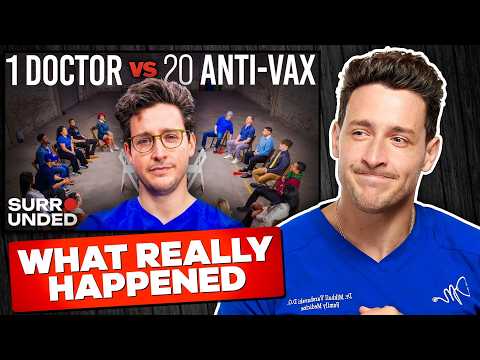
The Truth About My Anti-Vax Debate
Doctor Mike
14m 2s2,442 words~13 min read
YouTube auto captions
Transcript source
YouTube auto captions
This transcript was extracted from YouTube's auto-generated caption track. The transcript below is server-rendered so it can be read, searched, cited, and shared without opening the original YouTube player.
Pull quotes
[0:00]I I would like to give you my knowledge, my experience and what I've seen in the hospital system.
[0:00]But if you're telling me right now no matter what I say you're not going to change your mind, is there any value to that?
[0:00]I had a debate with 17 vaccine skeptics on Jubilee's surrounded series and it went on for 3 hours.
[0:00]But there were about five points that I felt were being repeated that I want to address today.
Use this transcript
Related transcript hubs
Watch on YouTube
Share
MORE TRANSCRIPTS


