[0:13]Where are you heading anyway?
[0:20]I'm not sure anymore. He's in his own movie. You know, metal wares, parts fell. Nothing runs forever.
[0:39]But if nothing ever got broke, then nothing ever got fixed. Try it now.
[1:02]You're good to go. Israeli violations continue here in many areas of the Gaza Strip this morning and into the afternoon. Israeli artillery resumed its concentrated shelling of areas where the occupation forces are deployed near the "Yellow Line" east of the city... There is no power or strength except with God. Is Adam all right?
[1:27]Yeah. He barely slept last night.
[1:35]...two Palestinians were injured and taken to al-Ma'madi hospital east of Gaza City. In addition, here in the southern part of the sector, especially in the city of Nablus...
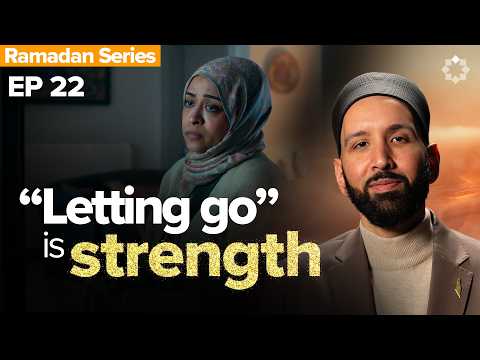
[2:07]You need to be stronger. But maybe not in the way that you think. Strength isn't just about you being okay.
[2:17]It's about being made stable enough to help someone else stand. Because the ummah doesn't just need sincere believers, but strong believers who can uplift others. But first, just like we decouple risk from money, we have to decouple quwwa, strength from mere muscles. Yes, quwwa can mean physical strength, but in our deen, it's also the strength of mind, the strength of heart, the strength of character. And so many other things, financial stability, social leverage, mental toughness, strength under pressure, and the list goes on and on. The scholars summarize strength in Islam as three things: al-isti'dad, which is internal willpower, al-irada, which is the willingness to do things with it, and al-asbab, the means by which you can do it. And since I shouted out the Malaysians, my favorite du'a that I learned from the brothers and sisters in South Africa, May Allah take you from strength to strength. The Prophet (salallahu alayhi wa sallam) said: al-mu'minul qawiy khayrun wa ahabbu ila Allah min al-mu'minu ad-da'eef. Wa fi kullin khayr. The strong believer is better and more beloved to Allah than the weak believer. Though there is good in both, but he qualified strength by saying: laysa ash-shadeedu bis-sur'a, innama ash-shadeedu allathee yamliku nafsahu 'indal ghadhab. That the strong one is not the one who can overcome others physically.
[3:42]The strong one is the one who controls himself in a fit of anger. So true strength is when you're able to spiritually overcome yourself even when your temper is triggered. And the Prophet (salallahu alayhi wa sallam) also said, 'Shall I not teach you a word from beneath the throne, that's a treasure of paradise?' He said, 'Say la hawla wala quwwata illa billah.' There is no power or strength except by Allah. Now, think about that. Above the throne is written: inna rahmati ghalabat ghadabi. My mercy overcomes My anger. Beneath it lies, la hawla wala quwwata illa billah. There is no power and no strength except through Allah. Between the mercy above and the strength beneath, you learn what true power is. You draw strength not by being overpowering, but by yielding to the one who holds the throne itself. And this is the first mention of strength that we come across in the Quran, when Allah says to Bani Isra'il: khudhumaa ataynaakum bi quwwa. Take what We have given you with strength. Meaning, hold on to the covenant, and hold it with seriousness and make sure that you follow through. And the Prophet (salallahu alayhi wa sallam) was introduced to the Quran through a strong embrace that partially was to strengthen him for the revelation to come. And Allah told this Ummah, wa a'iddu lahum ma ista'tum min quwwa. Prepare against them whatever you can of strength. Show your enemies you're unafraid because you have the Lord of the Throne, and that you're ready for whatever they throw at you because you seek refuge in the Lord of the Throne. Ma ista'tum, whatever you can, means that we all need to plug into our Ummah's strength. Some of us need to develop critical skill sets, some of us need to work on tools of defense, some of us need to fortify our intellects. Some need to protect the bodies of our physically vulnerable ones. Others need to protect the hearts of our spiritually vulnerable ones. The strong Muslim is the one who positions his or herself to be of the most benefit, to change yourself and then to change the world around you, only by the power of Allah. Because la hawla wala quwwata illa billah, I can neither change a situation nor garner any strength except through Him. That source is Allah's name al-Qawiyy, the one who possesses all strength. Because anyone trying to draw strength from anything or anyone but Him is just one decree away from collapse. But what does it look like to draw strength and distribute strength through al-Qawiyy? Look at how the Prophet (salallahu alayhi wa sallam) described Umar in a dream. He said, I saw in a dream that the people had gathered and then Abu Bakr stood up and he pulled out one or two buckets full of water from a well. And there was a weakness in his pulling, may Allah forgive him. And then Umar stood up and the bucket turned into a very large one. And I have never seen any strong man among the people doing such a hard job. He pulled out so much water that the people drank to their satisfaction, and even watered their camels to their fill. And then after quenching their thirst, they sat beside the water. You see Umar was so afraid of the mule testifying about him for not paving the road in Baghdad, that Allah gave him the strength due to his sincerity to be able to pave roads all over the world. But even Umar with all of his quwwa, with all of his strength, if you mention to him to fear Allah al-Qawiyy, he would tremble in awe of Allah like a child. So who is al-Qawiyy, the All-Strong? Inna Allah huwa ar-Razzaq dhul Quwwatil Mateen. Indeed, Allah is the Provider, the Possessor of Strength, the Firm. Notice Allah introduces His strength in the same breath as His sustenance. He provides, then He empowers, and then He stabilizes what He gave. Because what good is today's power if tomorrow it crumbles? What good is a strong moment if it can't become a strong movement? And that's where the second name comes in, al-Mateen, the unshakeable, the unbreakable. Every human being has a breaking point, even the most disciplined person can buckle at some point. And when our strength fails, we might feel like we're weak people, but Allah is al-Mateen, unconquerable, undefeatable. Nothing ever spins out of control for Him, even if it feels that way for us. He even describes His plan that way, wa umli lahum inna kaydi mateen. And I grant them time, indeed, My plan is firm. Meaning, it's intact even if they think that they've broken through. Where people see it all falling apart, He sees it all coming together. Al-Mateen is similar to al-barr compared to al-bahr, stable land versus tossing waves. So you plant your feet in His strength, and you speak through His strength, and you become a strong shore for others, without pretending to be their savior. He feeds you, then He fortifies you, then He keeps you from falling apart. And notice how quwwa, strength, is never praiseworthy in and of itself. Allah pairs His own quwwa with benefit, and this is also true for His creation. Allah calls Jibreel (alayhi as-salam) Shadeed ul-Quwwa, severe in strength. So Jibreel descends with the revelation that could crush mountains, and with the tip of a single one of his 600 wings, he could destroy an entire nation, like he did with the people of Lut. But Allah also calls him ar-Ruuh al-Ameen. He's trustworthy, he has integrity. His strength is not just for the sake of it. And for human beings, the same thing holds true as well. What do you pair your strength with? I want you to think of the daughters of Shu'ayb when they introduced Musa (alayhi as-salam) to their father, and they described him as Qawiyy, Ameen, strong and trustworthy. Because what did Musa do with his strength? He fought for the vulnerable that he didn't even know, even though he was most vulnerable at that moment. Allah didn't just give him physical strength. Musa (alayhi as-salam) was strong-minded and trustworthy, while the weakest man in the world, in Fir'awn, was pursuing him in every corner. But then Allah crowns His might with the dignity that only belongs to Him. He's also al-Aziz, the Almighty, whose might is absolute, and whose position is beyond contest. The one through whom all honor is defined and bestowed. wa Huwa al-Azeez ul-Hameed. He is the Almighty, whether you like it or not, and the praiseworthy, whether you praise him or not. And the only izza, the only honor you will ever find in life is through Him. So He tells you to take from His izza, not away from Him, but through Him. man kana yuridul izzata falillahi al-izzatu jami'a. Whoever seeks honor, then know that to Allah belongs all honor. And just like true strength isn't defined by big empty muscles, true izza isn't defined by big crowns or gaudy cars and palaces, or glamorous gowns, or even by titles or trends. So when Umar (radiyallahu anhu) fulfilled the dream of the Prophet (salallahu alayhi wa sallam) by taking that strength to Jerusalem, he entered into Al-Quds with strength and honor. But not in the way that they knew honor before. He was in patchy clothes, and he let his servant ride on his camel. He wasn't interested in the red carpet, and even in that glorious moment, he wasn't deluded by the praise that was being lavished on him or interested in pandering to anyone else's sense of power. He says then, nahnu qaumun a'azzanallaahu bil-Islam. Fa'in ibtaghaynal 'izzata lighairihi adhallana Allah. We are a people whom Allah honored through Islam. And if we seek honor through anything else, then Allah will surely humiliate us. And that izza wasn't just found after they liberated Al-Quds, even under the boots of oppressors, before the Kaaba was liberated. Ibn Mas'ud (radiyallahu anhu) says, ma zilna a'izza mundhu aslama Umar. We have remained dignified since the day that Umar became Muslim. From the moment that they walked out in protest in Mecca to the moment of the opening of Al-Aqsa, they carried a different type of power. Izza rooted in al-Aziz, and the people of Ghazzah are a people of izza, even in the midst of their destruction. They're still the most honorable people on Earth, and they will be honored with the liberation of Falasteen, bi idhnillahi ta'ala. Because their dignity is otherworldly, and ours has to be as well. People seek power for the position, and sometimes they abandon the power of values and integrity for the appearance of strength. They become slaves to position and pompous displays because they're actually insecure and weak. They need the crown on their head or the crowd to clap so that they can feel big. There's no izza in that. Real power isn't in what you own, it's in who owns you. And for us, that's al-Aziz, and we're honored only through Him. And just like we're not slaves to our enemies because of our izza, we're also not slaves to our own egos. And that's when you know it's for Allah. When the same izza that allows you to stand tall, allows you to stand down. The Prophet (salallahu alayhi wa sallam) said, wa ma zad Allahu abdan bi'afwin illa izza. And Allah does not increase a servant in humility or pardon or forgiveness, except that He increases him in honor. Your izza grows when you choose forgiveness over vengeance. Your rank only rises when your head bows only to Him, and you shed your ego for His sake. In the exact same way that your strength expands when you use it for His sake. And if the world has convinced you that you must be loud and make a scene to be strong, flip that script. The Quran preserves izza for the believer, even when materially weak, because honor is in spiritual gravity, not in social status. Wa lillahi al-izzatu wa li Rasoolihi wa lil-mu'mineen. And honor belongs to Allah, and to His Messenger, and to the believers. You don't have to bark like a dog to be seen and heard by people as weak as you. You just have to bear truth to a noble mission, to be seen and heard by the only one who gives true strength and honor. Al-Qawiyy is strong enough to sustain you. Al-Mateen is firm enough to depend on, and al-Azeez is high enough to honor you, with beyond what any human could ever bestow upon you. So honor yourself with the qualities He loves, and He will grant you what you love. So ask Him to make you qawiyy, without being harsh. Mateen, without being rigid. Aziz, without being arrogant. But instead, a refuge that people can lean on, not a boulder they hope not to crash into. Because even the strongest and proudest die, and we all return back to Him.
[15:08]Ya Qawiyy, strengthen me where I am weak, and make me firm where I bend too easily.
[15:18]Lift me so that I can lift others, without ever believing I lifted myself. When the weight of the world feels heavier than my faith, remind me that Your strength is the only way to see through it. Let me draw strength from Your power, but never be weakened by my pride. Ya Mateen, make me steady when everything else shakes. Root me in conviction that does not sway with opinion or fear. Let my faith be anchored deep enough so that no loss can uproot it. Keep my footing secure in moments that test my balance. Ya Aziz, grant me the honor that comes only from You. Let my dignity rest in humility before You. My worth be measured only in worship of You. Protect me from chasing validation from those as fragile as I, and make my highest victory the achievement of Your pleasure. And to Allah belong the Most Beautiful Names; so call on Him by them.


