[0:00]In 1964, a young psychologist appeared before the US Congress with a mission. It was a time when most people thought that the reason poor people stayed poor was a matter of biology and had nothing to do with the environment they grew up in.
[0:13]The psychologist, Uri Bronfenbrenner wanted to change that and convinced the world that to help those less fortunate, we also needed to change their surroundings. But did he succeed?
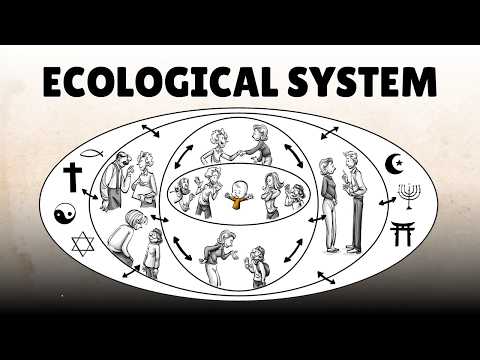
[0:29]Bronfenbrenner's Ecological System Theory conceives that a child is influenced by five ecological forces.
[0:34]First, comes the microsystem of family and friends that affect the child directly. Second are the forces of the connections between the people around the child, parents with teachers and teachers with peers.
[0:46]Then, there are links between social settings that do not directly involve the child, such as the father with his boss, the peers with their parents, and the teacher with the principal.
[0:55]Next is the overarching culture, religion and social norms that influences all others. And lastly, there is time, which changes everything over the course of one's life.
[1:09]Children are born into a microsystem that influences the child's experiences directly. Children from unfortunate backgrounds are more likely to experience problematic family structures, even if it's simply for the fact that parenting is more difficult if you are poor.
[1:23]They also encounter more negative situations at school or bad influences through friends. Consequently, a child that grows up in a negative microsystem will find it hard to succeed.
[1:36]The mesosystem represents the interconnections between the elements that surround the child. For example, the relationship between the father and the school teachers.
[1:45]If the father doesn't get along with the teacher, the child might suffer.
[1:50]The exosystem involves the links between social settings that do not involve the child. For example, a child's experience at home can be influenced by their parents' experiences at work.
[2:01]If the mother loses her job, there might be more arguments with the father resulting in changes in their interaction with the child.
[2:10]The macrosystem describes the overarching culture that influences all other systems such as a child's geographic location and ethnicity. Intelligent people who happen to live in bad places are more likely to move to better ones.
[2:24]But that also means that they are more likely to be strangers in a richer society. So, regardless of the child's biological potential or upbringing, on a macro level, he or she may still be at a disadvantage.
[2:38]The Chronosystem refers to changes in the child and the environment over time. As the child grows up, the parents may stop loving each other and divorce, which can be traumatic for an eight-year-old boy.
[2:49]Five years later, he may have come to terms with how things turned out. But, when the boy turns 16, his mom's new boyfriend moves into their tiny apartment and things get difficult again.
[3:00]Bronfenbrenner, who was influenced by Lev Vygotsky and Kurt Lewin, convinced the US Congress that a child's prospect is not genetically predestined, but is the result of the larger environment they happen to be placed in.
[3:14]Children who grow up in unfortunate social structures, therefore, need a form of support that not only reaches their families, but also elements of their community.
[3:22]Bronfenbrenner's theory helped form the Head Start program in 1965, a government program that has served more than 30 million poor children since.
[3:34]Decades later, Bronfenbrenner and Stephen Ceci proposed an extension of this theory, called the Bioecological Model.
[3:43]This new model recognizes gene environment interactions and acknowledges the role of heritability, but adds that genes themselves are under the influence of the environment.
[3:53]In other words, the process of heritability varies in a magnitude of potentials. How much a child can make of the potential they inherit depends on the ecological environment.
[4:06]Bronfenbrenner made a critical contribution to our realization that parent-child relationships do not exist in a social vacuum, but are embedded in the larger structures such as community, society and culture.
[4:19]In order to develop well, he allegedly said, every child needs at least one adult who is irrationally crazy about him or her.
[4:30]Now, it's your turn. Make five circles, draw yourself in the center, and add a timeline at the bottom.
[4:37]Then, put all the people, institutions, and forces that affect you through the five different systems.
[4:43]On the timeline below, you can add some major events from the past and those you expect in the future. Can you tell how the five forces are shaping your life?
[4:52]To read more about the topic or download the video without background music, visit sprottschools.com.


