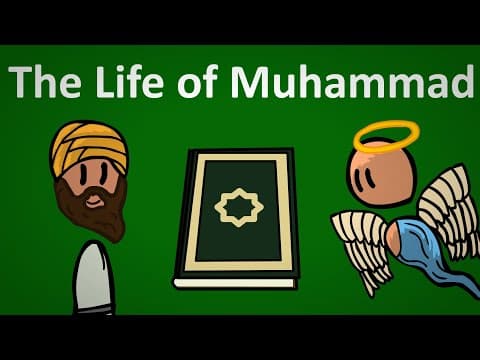
[0:02]Islam is an important religious, ideological, and political force in the world. Yet here in the West, we are taught very little about what Islam is. More people know the story of Buddha better than that of Muhammad. Yet over a fifth of all the people believe in Islam. That's 1.5 billion people. For them, Islam defines their daily life. It is important for us to know more about Islam so we can understand the culture and thinking behind 1.5 billion people. So today, in this series of videos, I'm going to take you from the birth of Muhammad until his death and show the origin of Islam. I will convey the story of Muhammad, including his more miraculous experiences. This series of videos is meant to educate about Islam. These videos are not to convert anyone, not to jump back from controversy and not to push an agenda. Only to educate about the historical figure of Muhammad and the revelations that he supposedly had. The Arabian Peninsula where Muhammad lived was an arid and volcanic region. Communities were dotted with cities and towns located near oasis. People lived in tribal groups that was their identity. Just as today you feel Russian, South African, Brazilian. Back in those days, in that region, it was your tribe who determined with whom you belonged and who protected you. The area was dotted with many nomadic tribes and settlements where many gods and goddesses were worshipped as protectors of individual tribes.
[1:29]The Arabian Peninsula was caught between two large empires, the Byzantine Empire and the Sasanian Empire. Now, I know what you're wondering, am I going to draw Muhammad? Yes, while very few paintings have survived of Muhammad himself, there are very detailed descriptions on how they looked. Let me recite. Muhammad is neither too short nor too tall. His hair neither curly nor straight, but a mixture of the two. He is a man of black hair and large skull, his complexion has a tinge of redness. Muhammad was born in Mecca in the year 570. Unlike the birth of Jesus, however, there are no miraculous events associated with his birth. Muhammad's birth was an ordinary one. He was part of a prominent family in Mecca, but his childhood is laced with tragedy. His father had died six months before he was born, and when he turned six, his mother died as well. Muhammad was then placed in the care of his grandfather, who died two years later, until eventually coming under the care of his uncle Abu Talib. This wasn't a loving care, rather Abu Talib sought to it Muhammad did not die of starvation. But because he was a minor member of the family, it was culturally unacceptable to do more than that in those times. But this wasn't to say the boy was completely rejected either. Abu Talib took the young Muhammad on a caravan trade mission to Syria and he eventually became a merchant, trading between the Indian Ocean and the Mediterranean Sea. By age 20, Muhammad had built a reputation of honesty and trustworthiness. He was so trusted in fact that he was asked to mediate when the central shrine of Mecca, the Kaaba, was damaged in one of the frequent flash floods. It was Muhammad who was asked to mediate a dispute between clan leaders. There was an agreement over who would put back in place in the Kaaba the last stone, the Black Stone, a sacred stone. This was an honor and clan leaders couldn't decide who should receive this honor of putting the Black Stone back. So Muhammad came with a solution, put the Black Stone on a cloth. Then all the men would together place the stone using the cloth. The cloak and this story became important Muslim symbols for later poets and writers. Khadija, a 40-year-old widow merchant in Mecca, heard about Muhammad. After Muhammad came home from an exceptionally successful trade mission, Khadija proposed to Muhammad, and he accepted. There's was a happy marriage. She was not only his wife, but also his friend, his confidant and his moral support. They had six children together, four daughters of which survived until adulthood. As Muhammad entered his 40s, he started to have a personal crisis. He was discontent with his life and the world in which he lived, wondering the purpose of it all. And Muhammad began making regular spiritual retreats to a cave on Mount Hira. According to Muslim tradition, he was meditating as usual and fell asleep. Then suddenly, he woke in terror. His body shaking uncontrollably. As he lay there, completely shattered, he heard a voice saying one word, read. The illiterate Muhammad replied, I can't. I'm not one of those who can read. The voice replied, read. And once again Muhammad replied, I'm not one of those who can read. Then the voice returned a third time, read. And this time Muhammad asked, what shall I read? And the voice replied, proclaim in the name of thy Lord and cherisher, created. Created man out of mere clot of congealed blood. Proclaim, and thy Lord is most bountiful, He who taught the use of the pen, taught man that which he knew not. This sentence would become the first verse of the Quran. Muslim tradition states that Muhammad ran home terrified to his wife. She consoled her husband and reassured him that he did indeed hear the voice of the Abrahamic God. And convinced him that he was his prophet. And so, according to the Muslim faith, this is how Muhammad the merchant became Muhammad the prophet. Muhammad had received a revelation from the Archangel Gabriel and was convinced by his wife that he was the prophet of God. According to Islamic tradition, for the next three years, Muhammad spent his life in deep meditation and praying. For three years, he did not hear the voice of his God. According to some sources, Muhammad was in such despair that his God might have forsaken him that he considered flinging himself off a mountain. But after three years, he heard that voice once more. This second revelation made Muhammad understand that he was truly the prophet of his God and that he had been commanded by God himself to spread his message. These revelations eventually turned into the Quran. Islamic tradition states that the Quran is the literal word of God, passed down to Muhammad. It is, for example, offensive to say to a Muslim that Muhammad is the author of the Quran. Muslims see God as the author and Muhammad more of a publisher, the person to whom the message was first revealed and the first human to write it down. The first converts were Muhammad's family and a friend who bought slaves to set them free. Gaining Muhammad a small yet loyal group of followers. In the year 613, God supposedly told Muhammad to openly spread the word, initiating a phase of public preaching. Muhammad often pointed out that he wasn't preaching anything radically different from Judaism or Christianity. They worshipped the same God as the Jewish and Christian gods. Islam is seen as a continuation of these Abrahamic religions, the final piece of God's message, the literal word of God uncorrupted by the word of mouth. Muhammad made clear that the religion of Islam is simply building atop the Jewish and Christian religions. That is, new religion is actually the old monotheistic religions, except more accurate, that this is the same God people have always heard preachings of. According to Islamic tradition, in the year 620 AD, Muhammad was visited by the Archangel Gabriel once more. This time in the middle of the night in his own home, Gabriel brought with him the winged horse Burak, the heavenly steed of the prophets. Burak carried Muhammad to the Father's Mosque. It is disputed whether this mosque was in Jerusalem or in heaven, but at any case, Muhammad prayed there and was tested by God. He was presented a vessel of wine, a vessel of water and a vessel of milk. Muhammad chose milk, to which the Archangel Gabriel approved and said, you have chosen the natural instinct. Gabriel then supposedly took Muhammad to each of the seven levels of heaven, meaning Adam, the first human created by their God. John the Baptist, Moses, Abraham, and even Jesus. Until eventually Muhammad reached the highest of the seven heavens, where he met God himself. God told Muhammad that he and his followers must pray 50 times a day. With message in hand, Muhammad began descending back down to Earth. Moses came by to Muhammad saying that 50 is too much and he should really ask for less. Muhammad traveled three times between God and Moses, until eventually deciding on five prayers per day that God would reward tenfold. Moses thought five was still too much, but Muhammad felt ashamed to ask for even fewer. And here we see why Muslims pray five times a day. According to their worldview, God himself has commanded everyone to pray five times a day. How could you disobey such a small request from God? The one who gave you everything, the creator of everything that was or will be. This is the worldview of Muslims. This story is important in Islam. You see, the way Muslims see Jesus, for example, is not as the son of God, but as one of God's many prophets. Starting with the first human created by God, Adam, and continuing on to Moses, who parted the Red Sea, Jesus, and now the last of the prophets, Muhammad. What this story symbolizes to Muslims is that Jews, Christians, and other followers of the Abrahamic religion are all following a corrupted version of God's word. To the followers of Islam, these religions are outdated as the last of God's prophets has arrived delivering the last message of God to the people of Earth. A message not corrupted by humans, but written down literally word for word by Muhammad. Those people, if they truly believed in God, should naturally become Muslims. Yet on the other hand, those same people follow God more than any pagan. In Islamic societies, Muslims were often given the most rights. Christian and Jewish communities were given most yet not all rights and had to pay a small tax. And pagans got the worst deal with fewer rights and more taxes. Back on Earth, Muhammad called the local chiefs of Mecca to a mountain where he declared the oneness of God, which boils down to Allah being the only God and the creator of the universe. Later, he also organized dinners where he would convince people of his message. Muhammad preached of serving God and his final judgment. He preached about heaven and hell. He preached of helping those in need and living a pious life free from wealth. This attracted the younger brothers and sons of great merchants who had nothing to inherit, those who had fallen out of favor in their tribe, and the unprotected foreigners. Creating their own clan, not based on blood relations, but on a common belief in the God of Islam being the one and only God. Part of this still hold true today. To be a Muslim, one must proclaim that there is but one God, Allah, and that Muhammad is his prophet. But these ideas didn't sit well with the leaders of Mecca at the time. They were merchants who became rich from people traveling to Mecca on their pilgrimages. If all the other gods were false, why would anyone still travel to Mecca to appease the gods at the Meccan shrines? Who would they have to trade with and get rich? And giving up your own wealth, not going to happen. Although in hindsight, the Meccan pilgrimages did just fine under Islam. Muhammad gained more and more followers every day. He was becoming a problem. The clan leaders tried getting to some arrangement to just make Muhammad stop preaching, even bribe him with lofty positions. But Muhammad refused. Then the people of Mecca harassed Muhammad's followers, torturing some of them, and even an assassination was attempted on Muhammad's life. Living in Mecca had become unbearable. It was time to leave.
[11:04]A delegation arrived from the nearby city of Medina. 12 clans had come to Muhammad to ask him to help in their dispute. This was Muhammad's specialty. As you remember from last episodes, Muhammad was always seen as a reputable man, who excelled at finding common grounds for people as a neutral outsider. The 12 clans of Medina invited Muhammad to serve as their chief arbitrator for their entire community, for Muhammad to leave Mecca and to come live with them instead in Medina. Medina had been suffering from in fighting for 100 years. The city held the concept of a blood feud and eye for an eye. So someone would feel it justified to kill a man of another clan. Then they would fight over whether it was actually justified, resulting in more killing. This would result into more fighting over whether those killings were actually justified. You see where I'm going with this? Even the clans of Medina saw that this type of justice could no longer work. So Muhammad created the Constitution of Medina, establishing a sort of alliance between 12 Median tribes and the new Muslim immigrants from Mecca. It specified the rights and duties of all citizens and how different communities were supposed to treat each other. Establishing new laws in Medina was a huge PR boost. And Muhammad's preachings had become especially effective. Many pagans converted to Islam, and even prominent Median leaders converted. In 624, Medina received another revelation from his God, telling him to face Mecca when praying, rather than Jerusalem. Here we see why Muslims always face Mecca. According to the Muslim worldview, their God, their creator, their highest being, asked them not only to pray five times a day, but to pray five times a day towards Mecca. This is not such a big request, is it? They are already praying. They have to do it in some direction anyway, so does it really matter so much if it's towards Mecca or somewhere else? As long as the one who gave them life, who created the universe for them, was happy. This is why Muslims are so adamant about facing Mecca during their prayers. But back in Mecca, they had not forgotten about Muhammad. The Meccans began seizing the property of Muslims who emigrated to Medina. Muhammad delivered Quranic verses permitting Muslims to pick up arms in self-defense, and small conflicts started breaking out between the Muslims and Meccans. In this fight, Muhammad employed three broad military strategies. The first was to ally himself with all the tribes surrounding Medina who could possibly hurt the Muslim people. Secondly, he dispatched small groups to obtain intelligence and gain allies in and around Mecca. And third, rating Meccan trade routes, the most important source of income for Mecca. The Muslims managed some early victories and disrupted several Meccan caravans. This could no longer do. Mecca sent an army of 1,000 men to defend their next trade convoy. Muhammad marched out of Medina with an army of just over 300. A Meccan scout saw the Muslims arrive in Badr and positioned themselves on a slope around a well. When the scout returned this information, the Meccan army broke camp at midnight and marched into the valley of Badr. It had been raining. The army was tired dragging themselves, their horses, and the camels uphill. Scouts reported that Muhammad's army was small but well positioned, which would lead to high casualties on the Meccan side, further demoralizing the Meccan forces and fracturing their leadership. But they went ahead anyway. Both sides amassed their forces opposite of one another. The battle began with three champions on either side who would fight in a three on three melee. All three Meccan champions were killed, and only one Muslim was wounded. Now, both armies began showering each other with arrows until the arrows ran dry. Then the Muslims charged from that position at the top of the hill, they came thundering down into the demoralized Meccan army. The Meccans, unenthusiastic about fighting in the first place, tired and seeing their champions all died, flee the battle. The battle lasted only a few hours and Muslims and Quranic sources would later speak of thousands of angels descending down from the heaven to terrify the Meccan army. In the end, 14 Muslims were killed, while 70 Meccans lost their lives, and another 70 were captured. This battle would change the course of history. They might not have known at the time, but it's this battle that changed Islam from a group of refugees into a force to be reckoned with, able to defeat the most powerful men of the most powerful city in the region. And Muhammad transformed from a Meccan outcast to a major religious and political leader. On the Meccan side, however, most of the leaders were killed, making a man named Abu Sufyan to become the leader of Mecca by default. The Meccans needed to regain their prestige which they had just lost. Abu sent out 3,000 men to attack Muhammad directly. Muhammad considered staying behind his walls for protection, but younger Muslims convinced him to fight outside the gates, or else Abu Sufyan would burn the crops. Muhammad personally led an army of 700 men, but a lack of discipline led to their defeat. 75 died and Muhammad was wounded, although not critically. The Muslims retreated back to Medina. Muhammad claimed to have received another message from God. This defeat was punishment for disobedience towards God and a test of their steadfastness.
[17:15]Abu Sufyan, however, received a false report that Muhammad was dead, and so concluded that prestige was restored and decided there was no further need for bloodshed. Returning home, however, he heard that Muhammad was still very much alive. He rallied as many tribes as he could, trying to gather an army that would crush the Muslims once and for all. Not long after, a scout came to Muhammad. An army was marching on Medina. 10,000 men. 10,000 soldiers came to kill Muhammad and all Muslims. This would decide the fate whether Islam would die or survive. This will be the largest battles Arabia had seen to date. Abu Sufyan gathered 4,000 foot soldiers, 300 horsemen, and almost 1,500 camel riders. A Jewish tribe who were expelled from Medina by Muhammad two years prior. They began rousing the nomads around Mecca and Medina and paying others to fight alongside them. In total, this confederated army gathered 10,000 soldiers and 600 horsemen. With this giant army, Sufyan marched on Medina. Muhammad gathered the Medians to discuss battle plans. Should they fight out in the open like before, or should they hide behind the protection of their walls? Ultimately, a third option was chosen. The outnumbered Muslims would dig a deep trench on Medina's northern side. The other side was protected by natural barriers such as rocky mountains and trees. No army could pass from those sides anyway. For six days, every abled man helped to dig this trench, including Muhammad himself. This battle coincided with a near famine in Medina and all the food had to be harvested early and brought into the city, leaving the confederate armies without land to live off. Lastly, all men over the age of 14 would help defend the city, except for a Median tribe called the Banu Qurayza, who tried to stay neutral in this whole business. And so Muhammad's army totaled only 3,000 men, against Abu Sufyan's 10,000. They arrived at Medina, cutting the city off from any supplies. For two to three weeks, they sat behind the trench, throwing insults, Quranic phrases and arrows at each other without much effect. Sieges were uncommon in the Arabian Peninsula at the time, and Abu Sufyan was unprepared. The food in the countryside had already been harvested. They started to low run on supplies. The Confederates tried to attack with horsemen in the hope of forcing a passage through the Medians, but the Medians were too well entrenched. The Meccan veterans grew impatient with this deadlock. About 1,000 soldiers attempted to thrust through the trench and managed to cross it, occupying a marshy area on the other side. But not willing to attack the Muslim forces directly after all. It would be 1,000 against 3,000. So they decided on a duel. Each side chose one man to fight on their army's behalf. The Muslims chose a man named Ali, and the Confederates chose Amr. Their blades met, two expert fighters matching blow for blow. A dust cloud started to gather, making it impossible to see what was going on. Finally, the soldiers had screams, hinting at a decisive victory. But unclear who was the victor. Then a man's voice rose out of the dust. God is the greatest. Ali had won. The Confederates holding a small patch of marsh were shocked, and in a state of panic, they withdrew back to their side of the trench. Abu Sufyan was unwilling to attempt a full-on assault on the trench, as he believed the Muslim fighters to be superior in hand-to-hand combat. So he tried a different approach. Get the Banu Qurayza, the only tribe in Medina who hadn't committed their forces to either side, to come fight for the Confederates. At first, the Banu Qurayza refused to even meet the Envoy. But eventually, the Envoy got inside and showed the Banu Qurayza just how many soldiers they had. Until the horizon, the land was filled with men ready for war. The leader of the Banu Qurayza eventually decided to join the Confederates against Muhammad. Thinking Muhammad would lose. News of this quickly got back to Muhammad. He sent out three men to scout their camps, and they came back with the news that the Banu Qurayza were preparing for war. Things were starting to look grim for Muhammad and his Muslims. He hadn't prepared for the Banu Qurayza attacking. And he had not stationed any men between him and their tribe. More bad news came to Muhammad. Food was running out. And the attacks from his enemies became so frequent that they could no longer adhere to praying five times every day. Only at night, when it was cold and wet, when the attacks stopped due to darkness, could they resume their regular worship. Fear ran rampant inside the camp. He sent 100 men and 300 horsemen to protect the city. Cavalry was not needed in the trench anyway. At night, the men prayed loudly, to make it seem that there were more soldiers than there actually were. But they had reached the limits of their endurance. Muhammad then tried negotiating with one of the Confederate leaders, offering a third of Medina's harvest, if he would just take his forces and leave. The leaders of Medina immediately shut this idea down. This proud and ancient city would not need to resort to such low terms. But the Confederate leader was willing to talk to Muhammad, creating a seed of discord between the 10,000 strong army who had gathered from various tribes. Then a man named Ibn Masoud came to pay Muhammad a visit. He was well respected among the Confederate leaders and had secretly converted to Islam. He had a plan. He went to the Banu Qurayza who had just agreed to fight with the Confederates. And he told them, if the siege fails, the Confederates will abandon you. Leaving you at the mercy of Muhammad. So to make sure that didn't happen, they should demand a highborn hostage from the Confederacy. Ibn Masoud then went to Abu Sufyan, telling them that the Banu Qurayza were planning to defect, and were planning on taking hostages to hand over to Muhammad. He went to several other leaders, telling them how Abu Sufyan would abandon them and they should ask for hostages, just in case. Abu Sufyan, now suspicious of anyone betraying him, refused to give out any hostages. But this made the rest even more suspicious. Wouldn't he just hand over a few of his family members, if he was planning on protecting us anyway? The Confederate soldiers were cold, wet, and running out of food. They had to attack now or risk starvation and mutiny. Abu Sufyan ordered the assault. But the soldiers just stood still. During that night, one by one, the armies of the Confederacy withdrew, and by the morning, the siege had ended. Muhammad had lifted the siege, losing only a few men, while the Confederacy had heavy casualties due to starvation, cold, and unsuccessful attacks. Muhammad had lifted the siege. But the Banu Qurayza had betrayed him. This 3,000 strong Muslim army surrounded the Banu Qurayza neighborhoods, putting them to siege. After 25 days, they unconditionally surrendered. An arbitrator was found to pronounce judgment over this Jewish tribe. And in accordance with the Torah, Deuteronomy 20:10 through 20:14, every man was slaughtered, and all the women and children enslaved.
[25:52]Today, Islam is thought of as a highly conservative ideology. However, at the time of its founding in the 7th century, Islam was seen as highly progressive by many people. Before Islam, slaves were property without rights. The owners could do with slaves as they wished. But under Islam, the life of a slave enormously improved. Slaves were seen as human beings, with a certain religious and social status, which allowed them some legal rights. This was far more progressive than some forms of slavery well into the 19th century.
[26:36]Ironically, he improved the lives of women as well. Women were given the right to inherit under Islamic law, to divorce and to life itself. You see, before Islam, baby girls were allowed to be murdered if the father wanted a son instead of a daughter. But all of this was not to say women were equal, however. Sure, the Quran says that men and women are equal, but women were and still are very much controlled by their male protector. And men maintain guardianship over women and can beat the women under his protection if the man feels it justified. Interestingly, however, the practice of women veiling themselves came centuries after Muhammad's death. The veil was impractical for working, so a woman who would be veiled all the time, showed that she didn't need to work, as her husband provided for all her needs.
[27:47]Islam changed marriage as well. Before Islam, a man could marry as many women as he could. Under Islam, however, a man was limited to only three wives. Which brings us to the matter of Muhammad's wives, of which he had 13 to 15, depending on which sources you believe.
[28:15]Muhammad's first wife was the love of his life. But she was around 20 years older than Muhammad, so he became a widower at 49. For as long as he was with her, she was Muhammad's only wife. But upon her death, Muhammad took on over a dozen new wives. Some he took for political reasons, cementing alliances through marriage. Others he took on for humanitarian reasons, such as the wives of Muslims killed in battle and had been left without a protector.
[28:55]And, okay, okay, I guess it's time to finally talk about the elephant in the room. And that's Muhammad's youngest wife, Aisha. According to traditional sources, Aisha was only six years old when she married Muhammad. But they did not consummate the marriage until she reached puberty, at the age of nine. It is important to note that at the time it wasn't that uncommon to marry at such a young age and to consummate such a marriage at the beginning of puberty. But puberty generally started at a later age. And even at the time, this marriage was highly controversial. When people call Muhammad a pedophile, this is what people usually refer to. Lastly, I want to talk about the historicity of Muhammad. Did he actually exist or not? Now, this might seem like a weird topic for the fifth episode in this series. But this series is not fundamentally about that. This series is about teaching what Islamic history looked like according to Islam. When looking at it from this perspective, the historicity of Muhammad is not that important. Muslims pray five times per day because they believe God commanded them to pray five times a day. Whether it is true or not, the practitioners of Islam still pray five times per day because they believe it. When looking at it from this lens, what is more important is the story around which this religion revolves, and how that story affects the world. When examining whether Muhammad is an actual historical person or not, let's look at various historical sources. There is, of course, the Quran itself, but just as the Lord of the Rings doesn't prove the existence of Middle Earth, so too does the Quran not prove the existence of Muhammad. So instead, let's look at non-Islamic sources from that time period. And honestly, there are not that many. While there are certainly mentions of Muslim conquest throughout Arabia, there is no actual mention of Muhammad himself during his lifetime. All sources are either Islamic sources or written decades or even centuries after his death. So did he exist? Well, we simply don't know. It is quite likely a man named Muhammad existed around that time, although not certain. And it appears likely that some of his deeds are exaggerated, and he may have been less important than Islamic sources point him to be. Some speculating that he was raised to prophet after his death. But in conclusion, there simply hasn't been enough research done into the topic, at least that I can find anyway.
[32:09]No peer reviewed scientific study has thus far been conducted concerning the topic.
[32:19]So if you study history or theology, write a research article about the topic. You might very well be the first.


