[0:05]The spinal column or backbone is one of the most important parts of your body. It provides the main support, allowing you to stand upright, bend, and twist. 33 individual bones interlock with each other to form the spinal column. The vertebrae are numbered and divided into regions. C1 through C7 cervical vertebrae form your neck, support your head and neck, and allow you to nod and shake your head. T1 through T12 thoracic, that's the 12 vertebrae that are joined by ribs to form your rib cage. L1 through L5 lumbar, your five sturdy lumbar vertebrae carry most of the weight of your upper body and provide a stable center of gravity when you move. Five vertebrae of the sacrum and four of the coccyx are fused. It makes up the back wall of your pelvis. Between each of the moveable vertebrae is located the intervertebral disc. Intervertebral discs consist of a thick outer layer with a criss-crossing fibrous structure, annulus, that surrounds the soft gel-like center, the nucleus. Discs function like shock absorbing springs. The annulus pulls the vertebral bodies together against the elastic resistance of the gel-filled nucleus. When you bend, the nucleus acts like a ball bearing, allowing the vertebral bodies to roll over the incompressible gel. Each disc works in concert with two facet joints forming a spinal motion segment. The biomechanical function of each pair of facet joints is to guide and limit the movement of the spinal motion segment. The surfaces of the joint are coated with cartilage that helps each joint move smoothly. Directly behind the discs, the ring-like vertebral bodies create a vertical tunnel called the spinal canal or neural canal. The spinal cord and spinal nerves pass through the spinal canal which protects them from injury. The spinal cord is the major column of nerve tissue that is connected to the brain and serves as an information super-highway between the brain and the body. The nerves in your spinal cord branch off to form pairs of nerve roots that travel through the small openings between your vertebrae, intervertebral foramen.
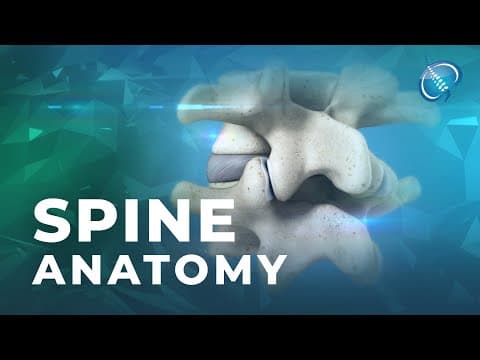
Spine Anatomy | Know Your Spine
Atlantic Spine Center
2m 26s349 words~2 min read
YouTube auto captions
Transcript source
YouTube auto captions
This transcript was extracted from YouTube's auto-generated caption track. The transcript below is server-rendered so it can be read, searched, cited, and shared without opening the original YouTube player.
Pull quotes
[0:05]C1 through C7 cervical vertebrae form your neck, support your head and neck, and allow you to nod and shake your head.
[0:05]T1 through T12 thoracic, that's the 12 vertebrae that are joined by ribs to form your rib cage.
[0:05]L1 through L5 lumbar, your five sturdy lumbar vertebrae carry most of the weight of your upper body and provide a stable center of gravity when you move.
[0:05]Intervertebral discs consist of a thick outer layer with a criss-crossing fibrous structure, annulus, that surrounds the soft gel-like center, the nucleus.
Use this transcript
Related transcript hubs
Watch on YouTube
Share
MORE TRANSCRIPTS


