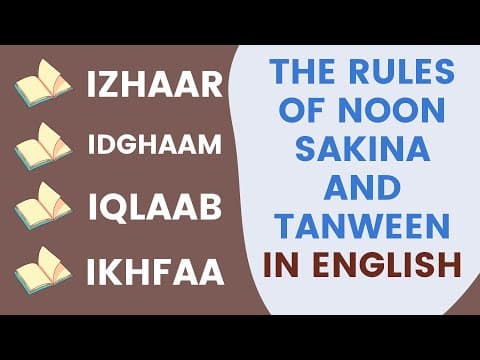
[0:00]Assalamualaikum warahmatullahi wabarakatuh. This is Muhammad Usman from Online Alfurqan Academy. I hope you and your family are doing well. And thank you very much for giving us some time to watch this video. Today we are going to learn the rules of Noon Sakina and Tanween. And these are four rules, Izhaar, Idghaam, Iqlaab, and Ikhfaa. We'll talk about one by one in detail. So let's start. The rules of Noon Sakina or Tanween. First of all, we can define what is Noon Sakina and what is Tanween. The word Noon Sakina means a letter Noon with Sukoon sign. It could be written in this way, like letter Noon with Sukoon sign, it's called Noon Sakina, or sometime it's just written like that, letter Noon, without a Sukoon sign. So both are called Noon Sakina. Now the other thing here we have Tanween, so the word Tanween includes three signs, and these are Fathatain, Kasratain and Dhammatain. As we gave the title, the rules of Noon Sakina or Tanween, it means those rules what we are going to apply on Noon Sakina, the same rules we have to apply on Tanween, I mean these three signs. Now we are going to prove that Noon Sakina and Tanween, they are the same thing. So for example, here we have letter Meem with Fathatain. So we are going to pronounce it Man, right? And also we can write this Man in this way. Man. So we got it that the first Fatha stand for this Ma sound, and second Fatha stand for this Noon Sakina. All the time the sound of Noon is available in Fathatain. And the same thing with Min, and the Min this sound is equal to this one, Min. So the same pronunciation, two writing style and the same pronunciation. And also for example, Mun, so if we are going to open that, so it becomes like that. So there is a letter Noon in Dhammatain. So we got it that the pronunciation is same, or we can write in this way, or in that way. So now we can easily say that the rule what we are going to apply on Noon Sakina, the same rule we have to apply on Tanween. Is that clear? Now, there are four rules we are going to talk about. Here these are the four rules we have for Noon Sakina or Tanween. Number one is Izhaar. Also we can type in Arabic here, Izhaar. And number two is Idghaam. And number three is Iqlaab. And number four is Ikhfaa. These four rules we are going to apply on Noon Sakina, and also we are going to apply on Tanween. Now, let's move further. Now here I'm going to type very main thing, and try to memorize this one. All these rules, they depend on the next letter after Noon Sakina or Tanween. I mean, we are going to recognize these rules by checking the next letter after Noon Sakina or Tanween. And the first one is Izhaar. Now we are going to talk about the meaning. Literally, the word Izhaar means to express. Now the definition of this rule is when there is a throat letter after Noon Sakina or Tanween, that time of we have to pronounce letter Noon clearly. So that is the definition of this rule. Now here in this definition, we have one more thing, that is throat letter. And I think you already know about throat letter. These are six throat letter we have, Ghain, Khaa, Ain, Haa, and Hamza Haa. All these six letters we pronounce from throat. So if anyone from these six letters is coming after Noon Sakina or Tanween, that time we have to pronounce letter Noon clearly.
[4:26]Now let's take few examples. We are going to find out the examples of Izhaar in the Holy Quran. Okay, so we got it few examples according to this rule, and now we can apply this definition on these examples, and we are going to apply this rule. One more time, we can read the definition of Izhaar, that is when there is a throat letter after Noon Sakina or Tanween, that time we have to pronounce letter Noon clearly. Now let's talk about the first example here. Now here you can see that we have a letter Noon, that is a Noon Sakina, and the next letter is a one of throat letter, right? It means we have to pronounce this letter Noon with clear sound. So this examples becomes Minhum. Yes, we are not going to hide the sound of Noon. We are not going to apply anything. Just we have to pronounce it clearly and normally, Minhum. The next example, this one, here you can see that Kaadihun. Letter Haa has Dhammatain, and check the next letter. So the next letter is Hamza here, right? Whenever Hamza is written top of Alif or below the Alif, Alif becomes silent. So basically, we have letter Hamza, and Hamza is also one of throat letter. So throat letter is coming after Tanween. I mean after Dhammatain. So also here we have to pronounce the Noon sound very clearly, like Kaadihun ila. No need to hide it, or no need to apply anything else. I hope you got it, example two. So all the time we have to check the next letter after Tanween or after Noon Sakina. Now, in the third example, look at here, letter Baa has Kasratain, Bin, and also the next letter is Hamza. And Hamza is one of throat letter, so also we are going to pronounce this Bin clearly, Bi'azabin aleem. Is that clear? Now in the fourth example, that is the example of Noon Sakina, that is Man. This is Noon Sakina here we have. And now check the next letter. Next letter is again we have Hamza, and Hamza is one of throat letter. So the sound of Noun becomes very clear. Man, Man Oootiya. And here, that is TabaQan. Qaf has Fathatain. I mean Tanween. Check the next letter. Next letter is letter Ain. And letter Ain is also one of throat letter, right? So now we have to pronounce this Qan sound clearly. So it becomes TabaQan, Ain. We'll talk about such kind of Noon, but right now we are just talking about this example. I mean, this rule that is Izhaar, and the word Izhaar means to express. Okay, so in the last example, here that is Ajrun. The next letter is a one of throat letter, that is Ghain. So because the next letter is throat letter after Tanween, after Dhammatain, so we have to pronounce Run sound clearly. So it becomes Ajrun Ghairu. We are not going to hide the sound of Noon, or not going to prolong it, just normal. Ajrun Ghairu. Second rule of Noon Sakina or Tanween is Idghaam. Literally, the word Idghaam means to merge. When there is a Idghaam letter after Noon Sakina or Tanween. And here in this definition, there is one thing that is Idghaam letter. To understand this rule, first of all, we have to learn the Idghaam letters, right? So Idghaam letters are Yermaloon. Now here we have six letters, Yaa, Raa, Meem, Laam, Waw and Noon. If anyone is coming after Noon Sakina or Tanween, that time we have to apply Idghaam rule. I mean we have to merge the sound of Noon. So also there are further two types in this rule. Number one is Idghaam with Gunnah. Second is Idghaam without Gunnah. As you can see here we have total six letters. So four letters will go here and two letters will be there. So these are Yanmoo, Yaa, Noon, Meem and Waw. When any of them is coming after Noon Sakina or Tanween, that time we have to apply Idghaam with Gunnah. And rest we have two letters, that is Laam and Raa. If Laam is coming after Noon Sakina or Tanween, we are going to apply Idghaam without Gunnah and same in case of Raa. And here we have letter Yaa, Noon, Meem and Waw. To understand this rule clearly, we are going to take few examples, and then it will be very easy for you. So here you can see that we have two examples. And in these examples, here we have Tanween, and next letter Meem is coming. And that is the example of Meem here. So this Sun sound is going to merge with Meem. It becomes Sum, and this sound we have to make it for two second. Nafsummaa. So basically the sound of Noon is going to merge with Meem, and that is the rule of Idghaam. Now here the second one, you can see here we have Noon Sakina, and next letter Meem is coming. And we got it that whenever letter Meem is coming after Noon Sakina or Tanween, to apply Idghaam. I mean we have to merge the sound of Noon into Meem. So this one becomes Mim, and that is also for two seconds. Is that clear? Now here, in this example, letter Jeem has Tanween, and you can check the next letter that is Waw. And this is also one of Idghaam letter. So Jan sound is going to merge with Waw. It becomes Siraajan, and also we have to add the Nezel sound because this is Idghaam with Gunnah. So we have to make Nezel sound. Siraajan. And this is for two seconds. Okay, in example number four, you can check here we have Noon Sakina, and next, you can see that is letter Yaa here we have. So that is the example of Yaa we have. So the Man sound is going to merge with Yaa. It becomes May, we have to make Nezel sound also because this is Idghaam with Gunnah. So, WaMay YaAmal. And this is the example of Tanween, Nun, and next letter is Yaa. So, Nun is going to merge with Yaa, Nay. This sound we have to make. That is the Idghaam we are going to apply here. So Aynai. Here in these two examples, this is Noon Sakina, and now also the next letter Noon is coming. And letter Noon is one of Idghaam letter. So this Noon is going to merge with the second Noon. So also we have to make it for two seconds. Fa'alaan Nazeedakum. Same thing here, Min Nutfatin. Now we can take few examples of Idghaam without Gunnah. Here we have three examples. And in these examples, you can see that we have letter Noon, and that is Noon Sakina, and next letter is Raa. Now in this case, here we have to apply Idghaam but without Gunnah. So it means this Noon is completely gone. Like there is no Noon sound. The Aa sound is directly going to connect with Raa. It becomes Aarrabbihim. Now the letter Noon is completely merge with Raa. Arrabbihim. Even there is no sound of Noon. In second example, here we have Tun. Taa has Dhammatain. Tun. And now it's going to merge the sound of Noon with Raa, completely. It becomes Tur. Because that is Idghaam without Gunnah. Khafizatun Raafiah. Tur Raafiah. There is no Nezel sound. And same thing here that is Mim. Now the next letter Raa is coming. It becomes Mir. So these are three examples of Raa. In example number four, you can see after Noon Sakina next letter Laam is coming. So also we have to merge the sound of Noon into Laam. And there is no sound of Noon. So the Koo is directly going to connect with Laam. It becomes Yakulahu. I hope you got it. So the third rule of Noon Sakina or Tanween is Iqlaab. I can also write down here in Arabic, Iqlaab. And the word Iqlaab means to convert, or to change. Now its definition is when there is a letter Baa after Noon Sakina or Tanween, that time we have to convert the sound of Noon into letter Meem, with Nezel sound. That is the complete definition of this rule. Now we are going to take few examples, and then we are going to apply this definition on those examples. Okay, now here we have three examples, and first of all we can talk about number one, the first example. So here you can see that letter Noon we have, that's letter Noon. After this Noon, you can see here that's letter Baa. Now one more time we can read the definition of this rule, that when there is a letter Baa after Noon Sakina or Tanween. So as you can see here in the first example, there is a letter Baa after Noon Sakina, right? And now we have to apply this thing. That time we have to convert the sound of Noon into Meem. And also the small Meem is written top of that. This Meem is also telling us the same thing that we have to convert the sound of Noon into Meem. And then the last part of the definition is with Nezel sound. Now I'm going to pronounce that. So this is Layumbann. Now one more question that how we can make this sound? This is very easy. Just we have to join our lips softly, because we are going to convert the sound of Noon into Meem. So the lips are touching each other softly, and then sound goes into the nose. And this sound we have to make it for two seconds. One more time, Layumbannaa. Now let's talk about example number two. Here you can see that that is Kafi, and then Raa has just one Kasra. That is the writing style. If we are going to write down the full form of this word, so it would be like that. Kafi, and then Raa has Kasratain, I mean double Kasra. It's like that. Rin. And then there is letter Baa after that, Bihi. So now here you can see that we have a Tanween, and then the next letter is Baa. So it means the sound of Noon, which is available in the Tanween, that sound we have to convert into Meem. But in writing style, to make it more simple, they are not going to write down the Kasratain here. They are just going to write down in this way, one Kasra and Meem. So this Meem is telling us that here we have to convert the sound of Noon into Meem. Okay? So this sound also becomes Kaafirim for two seconds. And then Bihi. Did you get that? Actually, the full form of this thing is like that, Raa has Kasratain, and then there is a Meem. But the font, the writing style what we are learning, in this way they are not going to write down the complete shape. Writing style is just like that, one Kasra and Meem. I hope you got it. Now then third example, this is also very easy. There is a Noon Sakina, and then the next letter is Baa. So because of this Baa, we have to convert the sound of Noon into Meem with Nezel sound, Mim Ba'dihi. The fourth rule of Noon Sakina or Tanween, and that is Ikhfaa. And this is the fourth and final rule of Noon Sakina or Tanween. We can also write in Arabic, Ikhfaa. Literally, the word Ikhfaa means to hide. And we can define this rule, to hide the sound of Noon into Nose, when there is a remaining letter after Noon Sakina or Tanween. That time we are going to hide the sound Noon into Nose. While hiding the sound of Noon, tongue is not going to touch any part of the mouth, and we have to make Nezel sound for two seconds. So now we are going to explain this definition, and we are going to talk about each and everything to understand this rule. So here, the first thing what we have, that is a remaining letter. So first of all, we are going to talk about remaining letters. Now the question is how are we going to find out the remaining letters? To answer this question, here we have total Arabic letters, and then I'm going to minus Izhaar letters from total Arabic letters. And also I'm going to minus the Idghaam letters. I mean Yermaloon letters. And also I'm going to minus Iqlaab letter. And then the answer will be in front of us, and we have all the remaining letters. So let's start. So first of all, I'm going to minus these six letters. I mean Izhaar letters, or we can say throat letters. So let's find out these six letters here in total Arabic letters and we can remove them. So here we have Ain. So like that we can remove all these six letters from here. So I have minused the first group from the total Arabic letters, these six letters.
[18:37]And just one more thing, that Iqlaab letter, that is Baa. And also we can minus this from the total Arabic letters. And the first letter, what you can see here that is Alif. And Alif is just used for stretching. So also we are going to minus that. Now these are the remaining letters what we have. So now we are going to write down here in this column, all these 15 letters. So now here we have all the remaining letters, and we can also say them Ikhfaa letters. And now anyone is coming after Noon Sakina or Tanween, that time we have to apply the rule of Ikhfaa. I mean we have to hide the sound of Noon into Nose. Now memorizing these 15 letters is little hard. So no need to memorize these 15 letters. Instead of memorizing these 15 letters, you can memorize here these groups of letters. And memorizing these groups of letters are very easy because we already talk about these three groups of letters in the previous rules of Noon Sakina or Tanween. We are going to take few examples, and then I'm going to show you it's very easy to find out Ikhfaa letter. So here we have six examples, and now we are going to talk about that, and you are going to learn this rule very easily. So we are going to talk about the first example. Here you can see that letter Raa has Fathatain. That is Run sound. And the next letter is Alif. So this Alif is just because of writing style. Most of the time when a letter has Fathatain, Alif is written after that. So this Alif is silent. So actual next letter here that is letter Zaal. And now we are going to check this letter in these three groups of letter. So what we can do that we can check is letter Zaal is available in Izhaar letter? So the answer is no. And also we are going to check letter Zaal here in Idghaam letter. Also letter Zaal is not available in Yermaloon letter, and obviously, it's not available here because in Iqlaab letter there is just one letter. So it means that is the remaining letter, and now here we have to apply the rule of Ikhfaa. So now, as you know that at the time of hiding the sound of Noon, tongue is not going to touch any part of the mouth, and we have to make Nezel sound for two count. So now the pronunciation of this example becomes Nara, and we have to make this sound for two second. Naranda Zaata. Like that we can talk about the second example. Here we have Noon Sakina, this is Mim. And now we have to check the next letter, and that is letter Sheen. Now the same thing we are going to do, just check this letter, letter Sheen in these three groups of letter. And now Sheen is not available in Izhaar letters, and also it's not here, and also it's not here in Iqlaab letters. So it means that is the remaining letter, one of Ikhfaa letter. So we have to hide the sound of Noon into Nose for two count. So the pronunciation of this one becomes Min Sharri. I hope you got it. Now the same process we have to do on the remaining examples. So here we have Shai In. Now before pronouncing this In, we have to check the next letter, and that is letter Qaf. So as you have memorized these three groups of letters, so just check is the Qaf is available in, in these three groups of letter? So the Qaf is not available here. So it means that is the remaining letter. I mean Ikhfaa letter. So we have to apply the rule of Ikhfaa here. So it becomes Shai In Qadir. Like that. And also in example number four, here we have Noon Sakina. So before pronouncing this, we have to check the next letter, and that is letter Taa. Now just check letter Taa is letter Taa is available in Izhaar letters, or in Idghaam letters, or in Iqlaab letters? So the letter Taa is not available here. So it means that is the remaining letter, and we have to hide the sound of Noon. So it becomes Antum. And also here in example number four, that is Aayatun. Now before pronouncing Tun, you can check the next letter, so that is letter Faa. And also letter Faa is not available in these three groups of letters. So it means we have to hide the sound of Noon.
[23:33]I hope everything is clear and you got it that how we are going to find out Ikhfaa letter.


