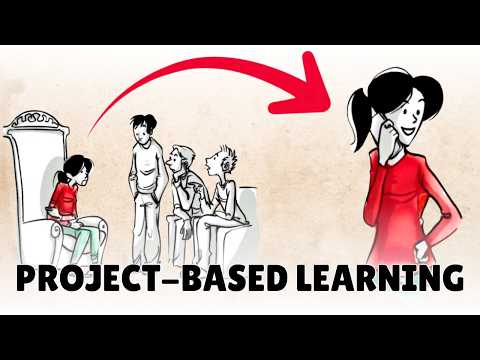
[0:00]Project-based learning, in short PBL, is a powerful way to learn new things and remember them for a long time. It describes a form of learning that happens as a result to solving actual problems. It's arguably so effective because first it gives solving problems meaning, and second, because each task in a project is mentally tied along a storyline, which eventually leads to either failure or success of an entire project. That means what we learn during the process has more meaning, and we can remember it later by mentally revisiting our project story.
[0:36]Business visionary Elon Musk explained it quite well. He said that our brain has evolved to discard information that it thinks has irrelevance. Picking a problem and then using various education tools like math, language, or economics to solve that problem is therefore far more engaging than teaching the tool itself. Say we are going to take apart an engine to see how it works and then put it back together again. In order to take it apart, we need wrenches, screwdrivers, a winch, and other tools. In the course of solving that problem, of taking apart the engine, we learn about the tools, how to apply them, and why they matter. To understand it better, let's look at the story of Jane, a shy 19-year-old student who wanted to move out from home, but miserably failed. Jane just finished her high school degree and still lives with her parents. She is eager to move out and live on her own, but she has a tight budget. Jane begins her project with asking around, where do her friends recommend her to live? How much do they pay? She starts to search online but is soon overwhelmed by all the options. Jane learns that her search is not effective unless she knows precisely how much money she can spend for rent. Her brain takes note that such a big project needs proper planning. The next day Jane spends making some serious calculations about her income, her savings, and her monthly expenses like food, phone bills, going to the movies. Her calculation leads to the conclusion that her budget for rent is very small. She starts thinking about taking on a job tutoring music to kids, this could get her another $200 a month. Although there are additional expenses since she would need to buy a new guitar. Jane's brain goes through the various computations, making a cost-benefit analysis and decides to try moving out without taking on a job. Jane is happy, she made up her mind and realized that math is a good tool that supports making an informed decision. The next day Jane starts searching online again, this time for a shared home. It doesn't take her long and she makes her first call to get an appointment to meet the hosts. This is her first viewing. There are three flatmates, they tell her to sit down and start asking very directly about her habits, preferences and how to describe her personality. Jane starts to feel uncomfortable and stressed, all she wants is to leave. She completely stops focusing. She excuses herself and simply walks out. Outside she feels terrible. Her brain notes an increased heart rate, some confusion about how to describe Jane and a lack of communication skills responding to immediate social pressure. In the evening she lies in bed and can't sleep. She starts to have doubts, should she really move out? Maybe this is not for her. Maybe she is too young to live with such independent people. She decides that she will stay at home for now. Eventually she falls asleep. During her sleep her brain keeps working and revisits the experiences of that day. It puts the experience in perspective and decides what can be forgotten. A few days later Jane meets an old friend who has just moved into a shared house and tells her about his experience. It sounded so exciting. Her friend made his project a reality. Jane remembers her initial motivation, how much she wanted to be independent. She decides to give it another try. Jane spends the entire evening looking at listings, noting down the most promising posts. At midnight she calls her best friend asking him to describe her personality to prepare for her next interview. Her brain, fueled by millions of excited neurotransmitters, now learns with laser sharp focus. The next day she goes to see three new apartments. She learns to answer questions about herself and even ask questions about the others. Do you mind if I play guitar? What do you do for a living? What are your thoughts on keeping it tidy? On her fourth appointment, Jane finds an apartment with two super fun roommates who share lots of her interests. Two days later, she arrives at her new home with her backpack and a big smile on her face. A new life begins. In the evening, her brain notes all the things it learned during the project, her budget calculation, her preferences, her social anxiety, and new developed social skills. Most importantly, the brain realizes that getting better at social skills is similar to improving her guitar skills. We get better with practice. Ten years later, Jane reads a study from 2009 that showed that PBL students perform as well or better than traditional students. Findings indicated that projects were superior when it comes to long-term retention, skill development and satisfaction of both students and teachers. Traditional learning approaches were more effective for short-term retention as measured by standardized board exams. The idea of project-based learning was made popular by the educational reformer John Dewey. In 1916, he claimed that the student learns more if he is interested in the subject and recommended learning by doing, or learning by solving a problem. Dewey further stressed the importance of the connection between life and the objects we are studying. On learning he said, if knowledge comes from the impressions made upon us by natural objects, it is impossible to procure knowledge without the use of objects which impress the mind. learning by doing sprouts SCHOOLS Special thanks this month to Ari Avigal, Cedric Wang, Evi Marie Koblin, and all our other patrons. Millions of students from all around the globe have watched our sprouts videos for better learning. Thousands of teachers play them in their classrooms to start projects. Volunteers on YouTube have translated them to over 25 languages. Our mission is to promote learning by doing in classrooms around the world. If you are a great explainer and a passionate teacher and you want to help us develop outstanding content, contact us. To support our channel with a donation, visit patreon.com/sprouts.
[7:13]SCRIPT JONAS KOBLIN DRAWINGS PASCAL GAGGELLI MADE WITH MINUTEVIDEOS.COM


