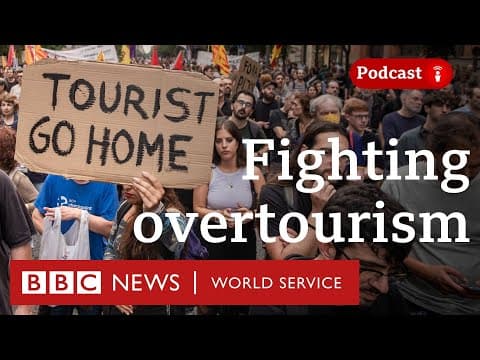
[0:02]Hello, I'm Lucy Hawkins. From the BBC World Service, this is The Global Story. 2024 is expected to be a record-breaking year for tourism, with more travelers going on holiday than ever before. Barcelona, Paris, Hawaii or Bali, they're all beautiful destinations that attract tourists from all over the world. But they are also struggling with overtourism. Too many visitors in one place can have a negative impact on those who live there, and it's also causing lasting environmental damage. So today we're asking how does this relentless rise in global tourism impact the people who actually live in these sought-after locations?
[0:52]And with me today is seasoned BBC TV travelogue presenter Rajan Data. You have been traveling now I think Raj for 20 years or more. Can I call you a lifelong romer? You could try calling me a lifelong romer. I think I'd prefer to say because romer implies that I'm just drifting, whereas I think I'm doing it for well I know I'm doing it for work.
[1:23]So Raj, 2024 is going to be a huge year in tourism. The numbers are expected to be massive. What kind of numbers are we talking about, though? We are talking about uh 11.1 trillion dollars contributed to the global economy by tourism according to the tourism trade body, the World Travel and Tourism Council. We are we're talking about an industry that is the third largest in the world. In total 330 million people are employed in tourism. And ultimately, we're talking about a billion and a half tourists. As maybe our markets that people aren't expecting as well. I mean India, China, they're traveling extensively as well saving up for these holidays of a lifetime. So the big change was in the early part of of this century when when the Chinese started exploring the world. That has now been overtaken by the Indian outbound market, which is incredible. We're talking about a population of 1.5 billion people so that if even 0.5% of them travel or have the money to travel, that is still a huge number of people coming into the market. Adding to, by the way, adding to what is already a huge market. Was there a moment on a particular trip where you thought, I'm becoming really concerned about overtourism? Um before the pandemic, um tourism was reaching an all-time high then, and there were murmurings, actually louder than that, from certain destinations that hang on, we're being crushed here. We're being overwhelmed by the amount of tourists. But I thought the pandemic also meant that people weren't traveling as much. Straight afterwards, they had what they call revenge tourism. People actually, quite a lot of people, certainly in the West, had saved up quite a lot of money during COVID, and they hadn't spent it on travel, they hadn't spent it on anything, and there was this real suppressed feeling of I need to get out. Because for a lot of people, tourism has become travel has become a virtual human right. What are some of the the cities, the destinations that you would say are are being a bit crushed at the moment by too many people? Barcelona is the one that I really had personal of of being there and seeing it change. And I went first before the Olympics. Since then, it's been relentless.
[3:41]Local people, and we did a story um for the travel show that I that I work on, we did a story about locals complaining quite a long time ago, good 10, 12, 15 years ago. We did that story because it was it was brewing. There was a huge amount of resentment that short-term rentals were were rising. In other words, they were more and more available for the holiday maker, which pushed up prices, which marginalize. If you're a young local person living in Barcelona, you can't find a place to rent. You can't basically. And this is the common thread, by the way. It's it's it's the edging out of locals. Pricing out of locals, precisely. I mean, there's been these big protests in the Balearic Islands recently, that has sort of dominated some of the headlines and really brought attention to this issue.
[4:29]What are some of the challenges they're facing there? Because that's an industry where they also need young people to work. They need waiting staff, they need bar tender staff. They need people to work in the hotels. Absolutely. I think there was a story in on the BBC um website not so long ago about, for example, a chef who works in a local hotel or restaurant who was forced to his forced to sleep in his car. I call it feeling like extras in your own movie. You know, it's not a city that you love, or an area that you love has completely taken over. And obviously local customs get get squashed because tourists want their thing. They think what they they want what they're used to, a nice latte. Food-wise, probably, you know, there are some some demanding tastes from from tourists and they if they can afford it, they'll they'll guess what, they'll be a a restaurant for them there. It sort of this notion of international good taste, isn't it? That exists everywhere now, that can kind of muscle out things that are local. What about Austria? You had, I know, an amazing trip to Halstad. It's a little town, 800 residents. It's got a beautiful lake. I mean, it's picture postcard perfect. It's it's just beautiful. 800 residents, and they have it during peak season 10,000 guests a day. Only 20% of people who live there actually work in tourism there. And so therefore, they're not all directly benefiting. There's one particular scenic spot where you can get such a perfect selfie with the with the lake in the background. That the locals, or the mayor in fact, tried to block it for a while. That policy, it's catching. That policy was taken up in on Mount Fuji not so long ago. And where where the the same thing. They stopped people from taking pictures of Mount Fuji from just in front of a convenience store because it was it was. This is Fujikawaguchiko. Very well well said. Yes. Our correspondent Shaima Khalil actually went there. You've probably seen this on your Instagram or TikTok. This is the famous Mount Fuji Lawson, the social media money shot for millions of visitors. But it's not going to be around for long. Residents here in Fujikawaguchiko are fed up with tourists behaving badly. All to get the perfect shot of the convenience store with the snow-capped volcano. As a desperate measure, the local authorities are building a barrier to block the view. You can get a picture of Mount Fuji from many places, but social media has become a big pull for this particular spot. Well, if I didn't have social media, I wouldn't come here. I wouldn't even know that it exists this place. So that's obviously been a big problem in Japan as well, uh for people who live near Mount Fuji. But in Halstat, how much of the money made in Halstat goes back into the community? Not very much money in some of these places stays in those places. The local authorities will say, yes, we're reinvesting money that we get from parking, whatever, into local facilities and resources, but actually a lot of it isn't. That's called leakage, by the way, where a lot of the money that's that is that's made in these tourist centers actually doesn't stay within the economy. Can I ask you about the environmental damage that it's done to some of these places, like somewhere like Bali. Yeah, there's really big issues around water scarcity. In in many destinations, um water is a big issue.
[7:38]I mean, I've I've talked to somebody who's in Kenya, um where quite often you'll get tourists in luxury hotels, pretty well competing with locals for water when there is scarcity. Guess who wins, the luxury hotels. Local farmers uh in Kenya and and in other places are very suspicious of tourism because it actually can get in the way of them doing their job. And in sometimes like in Kenya where you have Safari tourism, it actually means that some farmers were evicted from their own farms, so the land could be used for roaming animals. It's fair to say that there are some places that are doing well. They have come up with some solutions and they're working. There are two sides to this. One is what the local municipality does. The other one is what we can do as individuals, okay?
[8:20]So let's just start with what um places can do. So in Venice, for example, they have introduced this 5 Euro um admission fee. It's not much. 5 Euros. It's not much. 5 Euros. And I did talk to the Deputy Mayor who's in charge of tourism and he said, well, the point isn't actually this at this stage to to charge people and make and make money out of it and dissuade them. It's more for them to to to realize when the peak days are and to when to avoid it. They're collecting data by doing this because you have to actually go online and do this. And Raj, with that data that they're collecting in Venice, is the idea they'll then encourage people to come midweek? Exactly that. And it spreads the burden. Not just midweek, but in what they call the shoulder season. Exactly. So, um spring and autumn for us in the west. And that is another way of of trying to shift the the weight of tourism. There is an issue with that, which I feel that you're about to come to, which is school holidays. And that obviously, unless that changes, unless the most of the West certainly has um stops having school holidays in July and August about the same time, then we're always going to get that crush around that time. What about the move to encourage people to go to similar destinations that are nearby? We went to Slovenia and we went to a place called Bohinj. And there it's quite near Lake Bled, which is near lovely Island, which is come.
[9:39]There at the moment, it's actually building up. I mean, we I went in April and and there were quite heavy crowds there. So he's worried about even if there's spillover from Lake Bled, or even from places other places, that they're going to get crushed as well. So so, yes, you can definitely spread the love, you can have dispersal, but it's not necessarily going to be the answer either. If if the if the next place along also then suffers in the same way. And I guess Raj, that uh climate change is also having an impact on where people are choosing to go. I mean you, Southern Europe at the moment, in the summer particularly, is so hot. In Greece, in uh, Greek Islands as well, uh in Italy, in Rome, and in other um destinations. You had people actually being evicted, not evicted, but being evacuated from um the islands that they were staying in, for example, Roads because of wildfires, because of da actual danger to people. People were were, you know, the heat levels are getting horrendously extreme, which means that people are now looking to do what's called coolcationing. Which means they're going to more to cooler northern climes. Slovenia is one example, uh Northern Europe, uh again, um and that is becoming more attractive. So this and this is not going to go away. This is this is this is climate change. And so this is going to completely shift the the map of of where people will go in the future. Raj, what kind of travelers do these cities want? Is it the sort of high luxury traveler, the high spending traveler, or and they want the backpackers to stay away? How does how does that kind of formula work? Well, the mantra is high value, low volume. That's the big mantra in the tourism industry right now. Now, what does that mean? I think they want it to mean, yes, stays more than two or three nights. Yes, maybe takes public transport to come in. Yes, um eats locally, uh, yes, respect local culture. I mean you're describing quite a few backpackers here. Yeah, well, here's the thing. Interestingly, I talked to a professor of tourism quite recently, and he said, you know what? Uh he did a whole survey in I think it was in in Cyprus. The the budget traveler, the backpacker actually in many ways, makes sure that there is less leakage, the term I used before, that most of the money stays within the country, in the local economy. Because they will stay in cheaper places. They will take public transport. They will they will stay longer. Uh and they will not use up the environment in such a such a way, or they will not destroy the environment in the way that sometimes a a luxury traveler can do. Do quotas work? If you've got a a um an attraction as opposed to an actual destination, then you can impose quotas much more easily. Yes, quotas can work and they will be more and more common, I think. Um I think going back to your thing about solutions, raising prices on things can you on on attractions can probably be one technique. I mean, there's something that that makes me feel a bit bad about that because it means that people, you know, around. It's not accessible for people. So it's out priced. They're talking about 5,000 Euro private tours of the Acropolis now. Um now, great if you're going to afford it, but if you've come all the way from, I don't know, Japan, wherever, and you're not on a huge budget, and suddenly you realize you can't go there because of crowds and you haven't got 5,000 Euros. I'm not sure if that's good. Are we reaching peak tourism? There's no reason why it shouldn't go up. Um the issue is more whether the they start taking measures to to limit the number of people traveling to certainly to certain destinations. I think people anyway, with selfie culture, and we haven't really talked about that, but it's so important selfie culture that with that, people, especially young people, are looking to go to new places. I I was at in Venice recently, and the Rialto Bridge, you had to queue for quite some time. Do you think that the selfie culture there can almost be an adverse reaction to it as well? People are like, like the Rialto Bridge, I've seen that too many times. I think that's definitely the case. I think that's particularly true of of younger travelers. They will want something that's different to what their mates have done. You know, it it we've seen one picture of the Rialto Bridge and the and the view, um and with you on it and so what that's it's like people aren't going to be massively impressed. It slightly reminds me of back in the day when I was a kid and they used to have super 8 movies where they would show, you know, guess what, they went to Austria, they went to the Alps and they went to and people used to crowd down and watch it. But then travel was much, much rarer. Today, if everyone's traveling, you've got to get the unique shot. It's the bragging rights, isn't it? It's the bragging rights, absolutely. I mean, I went to Uzbekistan recently. People, I know, I think that will become a big tourist place soon, because it's uncharted territory. It's somewhere where people haven't been before. And this idea of dispersal that you've talked about, we might be looking at dispersal literally from Western Europe all the way across to the Stands, or to Central Europe and the Caucasuses. I can see that happening, definitely, definitely. Yep. Northern Europe, um Eastern Europe, um yep, the Stands. I mean, these places are got magnificent uh histories, histories, and culture and architecture. Yes, go there, and they've got I think would love you to be there. The problem is, here's the problem. Suppose you've come from a long way away. You've spent ages saving up this money for this trip of a lifetime. You're there for two weeks. You come to Europe, you've got Schengen Visa maybe. Of course you're going to go to the Eiffel Tower. Of course you want to see the Leaning Tower of Pisa. Of course you want to see Venice. And who are we to stop them? And who are we to stop them? That brings me, I think, to our final thought. You and I have both traveled a lot. It would be hypocritical of us to say at any point, you know, you can't travel. It is the most enriching, wonderful, amazing experience. It's managing it going forward that seems to be the big challenge. I'd be hypocrite if I said to younger people who haven't traveled much anywhere in the world or to people in emerging economies who only now can afford to travel, look, don't don't travel because you're you're killing the world. You're you're ruining the Earth. How can how can I say that? I mean, even for me Raj, I'm from the bottom of the world from New Zealand. We are raised to believe that you must go out and see the rest of the world. It's part of growing up. It's part of living your life. It's a cultural expectation. And I'm I'm not going to deny that. It's absolutely true. It is fantastic. Traveling the world is brilliant for all the obvious reasons. You grow as a person. It has so many different beneficial effects on people, on on culture, on relations between different cultures and, you know, I wouldn't knock it. So I suppose what I would say is, please travel. Please travel, but just watch how you travel. Uh the way you travel. Just do be be slightly more conscious of of of the host community. It it's to have respect, much more respect. You are a guest. You're not entitled to this. You're a guest. That do travel. It is life-changing. You just don't meet anyone who who wouldn't say it it changed my life, my perspective, so many things from travel. And I am we both are some of the luckiest people on the planet. Yeah, indeed. Raj, it's been great to have you. Thank you so much. Great to be with you, Lucy. Thank you very much for having me, and good luck on your next journey. I do. I'll have my checklist. Thank you for watching. If you want more episodes of The Global Story, you can find us wherever you get your podcasts. Subscribe to make sure you never miss an episode, and do let us know what you think about today's episode in the comment section below. Goodbye.


