[0:03]What is it that causes some people to achieve a high level of success while others don't? Is it talent? Timing, charisma, or is it something else entirely? What is it that enables people to achieve excellence in their chosen profession and in life? I've spent the past three decades studying high achievers in an effort to determine the answer to these questions. In addition to learning from hundreds of highly successful men and women, I've also interviewed over 80 podcast guests who have achieved excellence in various and diverse areas of life. A New York Times best-selling author, an Olympic athlete, the founder of a luxury hotel chain, a NASA astronaut, and even Miss America. I'd tell you which one, but she made me promise not to tell you the year she won. Through the years, I've uncovered all the traits you might think of when you hear the word excellence, and when you think about what it takes to achieve success at the pinnacle of various professions. Number one, belief. Number two, consistency. Number three, discipline. Four, focus. In number five, good old fashioned hard work. These specific traits were expressed repeatedly in my conversations, and even when they didn't use those exact words, you could hear them clearly in the way they described what it took to succeed at the highest level. What was so interesting to me though, so fascinating, was what they said, wasn't nearly as relevant as what they didn't say. In the hundreds of conversations I've had with highly successful people, not one of them mentioned the one word that captures the essence of what it takes to achieve a high level of success. So what is it that no one tells you about excellence? It's boring. I know, it sounds crazy, doesn't it? It turns out the secret to extraordinary success to excellence is doing boring things really well. It's not what you expected to hear, is it? It surprised me too. You see, we celebrate the big moments, the victories, the medals, the accomplishments. But excellence isn't what happens when you're in the limelight. It's what happens when no one is watching. August 13th, 2008, Beijing, China. Michael Phelps had just won the gold medal again. Less than an hour later, he was back in the water for the 4x200 meter freestyle relay. In that race, the US team broke the seven-minute barrier for the first time in Olympic history, crushing the world record and winning the gold medal. My friend Peter Vander K swamm on that Olympic relay team with Michael Phelps. He stood so proud on the podium as the national anthem played. But that victory, excellence wasn't breaking the world record, or even standing on the podium to receive the gold medal. Instead, excellence was the thousands of hours invested in early morning training, endless laps in the pool, and the relentless focus on perfecting technique during the four years leading up to the Olympic Games. Excellence is boring, and that's exactly why so few people achieve it. It's not about luck, it's not about talent, it's about small steps repeated over time. Excellence is doing what you know you need to do to be successful, consistently, even when it's hard, and it is hard, and even when it's boring. Sociologist Daniel Shambles studied Olympic swimmers and coined the phrase the mundanity of excellence. He called it mundane. He found that what separates champions from everyone else isn't superhuman talent. It's dozens of tiny actions done right, and then done again, and again, and again, and again. Reading Dr. Shamble's research was a huge aha moment for me. As I reflected on my own life, I realized that boring was the perfect word to describe all the actions I had taken throughout my life to achieve success. Whether it was training hours a day as a nationally ranked junior table tennis player, studying late nights and weekends to earn my MBA while working full-time, or waking up at 4:00 every morning to write the manuscript that would one day become a best-selling book. What I realized was the excellence I created throughout my life consisted of doing what I knew I needed to do to be successful. Small, boring steps, repeated over time. Oh, and by the way, my podcast guests all share similar experiences. The New York Times best-selling author I mentioned earlier, Nora Roberts. Nora was a single mom of two preschoolers living in rural Maryland in the late 1970s. During a blizzard in February 1979, with three feet of snow and a dwindling supply of chocolate, Nora took out a notebook and a pencil and started to write down stories. She fell in love with the process and quickly produced six manuscripts. Nora went on to write over 255 novels, 124 of which made it to the New York Times best seller list. What were Nora's small boring steps? Writing. Eight hours a day, every day, even while on vacation and even while raising two boys as a single mom. Now, you might be thinking, you're not an Olympic athlete or a New York Times best-selling author. Maybe you're in healthcare or you're in sales or you're a parent. The good news is excellence is available to all of us. It's the nurse who double checks every chart, every dose, every detail, long after others have gone home. It's the salesperson who makes 80 cold calls per day, five days per week, 50 weeks per year, year in and year out. It's the parent who reads bedtime stories night after night, instilling a love of reading in their child. It's the handwritten thank you note you send because everyone else is going to send a text or an email, or even more likely, nothing at all. It's the small, consistent steps repeated over time. It's doing what most people won't do. Here's the problem, we've lowered our standards. Today, we give everyone a trophy. We celebrate simply showing up, don't we? We now have a dozen valedictorians at graduation. But if we hand out trophies without the effort, what's the point? Excellence isn't elitist, it's earned, and you earn it by doing what you know you need to do to be successful. Even when no one applauds, and even when no one is there to see it. So let me ask you, what's one thing you know you need to do to be successful, but you haven't been doing it consistently? Whatever that is for you, I challenge you to do that one small habit, just one, one action, one step, every day for the next 30 days. Because that's where excellence begins. There's an old joke about a man who travels to New York to see a concert but gets lost. He sees a man walking down the sidewalk carrying a violin case. Uh, excuse me, sir, can you tell me how to get to Carnegie Hall? The musician stops, smiles and responds, practice, practice, practice. Now I know that's just a joke, but don't miss this, that's how you create excellence, too. Not with gold medals, not with standing ovations, but with the small consistent steps that no one sees. Because excellence isn't the moment you cross the finish line to a cheering crowd. It's everything you do in silence when no one's watching, and that's what no one tells you about excellence. Thank you.
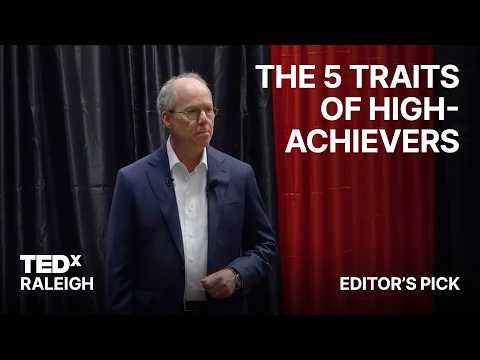
Why being bored is the key to excellence | Brian Bartes | TEDxRaleigh
TEDx Talks
8m 54s1,242 words~7 min read
YouTube auto captions
Transcript source
YouTube auto captions
This transcript was extracted from YouTube's auto-generated caption track. The transcript below is server-rendered so it can be read, searched, cited, and shared without opening the original YouTube player.
Pull quotes
[0:03]What is it that causes some people to achieve a high level of success while others don't?
[0:03]What is it that enables people to achieve excellence in their chosen profession and in life?
[0:03]I've spent the past three decades studying high achievers in an effort to determine the answer to these questions.
[0:03]In addition to learning from hundreds of highly successful men and women, I've also interviewed over 80 podcast guests who have achieved excellence in various and diverse areas of life.
Use this transcript
Related transcript hubs
Watch on YouTube
Share
MORE TRANSCRIPTS


