[0:03]Okay, so, um members, you're welcome on the call and thank you so much for creating time for our evening um discussion.
[0:14]This is part of the African Center for Career Mentorship webinar series. We normally have them every Tuesday's, um, from 7:00 to 8:00 p.m. at such a peak hour.
[0:28]The interest is to prepare, um, prospective, uh, graduate students for their applications, most so for international applications, but also for local application, that's fine.
[0:43]So, um, we will have more of these sessions, the next one is going to be there on on 19th, and we'll have others on 26th and so forth.
[0:53]And very soon I will be inviting more people to join us to also give guest presentations. We have a guest on 20 on 26th of September. We also have a guest on 7th of October as we go along.
[1:07]Okay, so today we are going to chat about a very interesting area, um, that sometimes in applications they ask for it, but sometimes they don't ask for it.
[1:21]So, this favors those where they normally ask for it. I just want to emphasize that in most of the US, uh, US universities and, um, UK universities,
[1:34]most if you're targeting a PhD, they normally ask for it. It may not be very direct that we want, um, a research proposal, a research concept.
[1:45]They can be polite by saying, um, share with us a sample of of any written document by yourself.
[2:09]Yeah, so let's keep ourselves muted such that we can, we can follow the conversation.
[2:15]But I was saying that, um, these concept notes sometimes they ask for them directly, and sometimes they may be, they may hide and they say, just share with us a sample of of any written document by yourself.
[2:31]And so for me, I'm going to share with you some of the things I think would work, but also I'm going to take you through a practical session on how to search for information and then how to put it together.
[2:46]And so, much of it today is going to be practical, I want to say. I will invite you to get your laptop, if you're using your phone, because, um, I will be requesting you to to write something in your on your side.
[3:04]Okay, so, like I've said that, um, concepts, if I'm just to begin, a concept is what you want to work on.
[3:15]And so, the first interesting thing is that you need to, you need to have defined where exactly you want to go or what you want to work on for your PhD or your Master's or post-doctorate.
[3:29]So, in other words, you need to first of all define where you want to go. And in our previous session for last week, we took time to dive into that area.
[3:37]And so, you're welcome to follow and go to our YouTube channel, which is the African Center for Career Mentorship, to go and listen to what we talked about in terms of defining where you want to where you want to go, but also defining what you want to work on.
[3:54]Actually, for me, I, I find that if you can decide and choose what you work, what you want to work on, you are far better and you are in a better position to decide which which supervisor to to support you or to advise you, but also which department to register in.
[4:16]So, in other words, you need to take time to define what you want to work on.
[4:22]Um, this morning I was interacting with, um, a colleague who is aspiring to do his PhD. And, um, when we are talking, he hadn't clearly defined what he wants to work on, but he was struggling to choose a supervisor.
[4:39]So, I, I first took him behind and we first of all agreed on what he wants to work on. That's number one.
[4:50]The second thing that we agreed with him is, um, what exact skills he wants to learn through his PhD and through his, uh, or for this case, a Master's program. What exactly do you want to learn?
[5:03]Do you want to learn drug discovery, for example? Do you want to learn, uh, computer, computer science, and maybe computer engineering? What exactly do you want to learn?
[5:14]If you're very clear on what you want to learn, it is easier to know which supervisor is good in that field.
[5:22]And once you know which supervisor is good in that field, you are now able to know, um, which supervisor can take you on. So, let's just dive into this conversation for today.
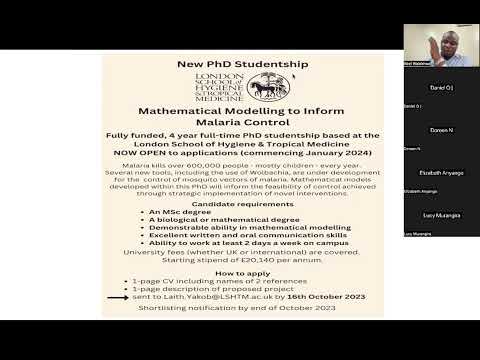
[5:34]So, just to begin with, um, I just picked up this current, um, call, which is flying everywhere. I think I have found it in around, um, in around over 30 platforms, and so it's flying almost everywhere.
[5:47]And I said, okay, I'm going to use it for my illustration. Now, this is a PhD, um, a PhD, uh, scholarship, if I want to use the word scholarship.
[6:02]And, um, it is for four years. Now, they have made it very clear on one page, the person they are looking for, and they've put in bold what they are looking for.
[6:16]But interestingly, what kept my what what captured my attention was how to apply. Number one is one page CV.
[6:26]Now, one page CV most people struggle with it. But my mentor, Dr. Dan Msinguzi, who is on the call, if you can just check on the list of participants, who his user is Dan Msinguzi, he can help you and design a one page CV.
[6:39]And so that shouldn't be a very big problem, including two names of two referees. That's not a big issue.
[6:45]So, number one, okay, number two is one page description of your proposed project. And for me, that's what I want to that's what I want us to talk about today.
[6:55]The entire one hour we shall be discussing that one page description of your proposed work. So, that's the requirement number two, on how to apply, is why we are here this evening.
[7:11]Now, even when they are asking for one page, the way you see it. And of course, like I've said, um, it may not be straightforward, but it may be straightforward like here. Here it is very straightforward.
[7:25]But in other words, they can say, any sample or any idea you want to work on. Now, the approach to this one page description of your proposed project, the first thing to do is to get this email address here.
[7:42]And you put it in Google in Google such that you get to understand, um, this person better. But even if you don't put the whole email address, and you just copy the word Wraith and Jacob, you are able to know this supervisor, this person here, who is going to be your supervisor.
[8:00]This person has areas he or she is working on. Now, before you begin writing the one page concept, the first thing to do is to read about this person.
[8:15]Which area is he or she working in? Because, um, that is how you try to now see whether your interests align with his interests.
[27:39]Try to look at the strength of this work. Try to look at the areas that they were not able to do. Good enough, in most published papers on the in the discussion section, they normally give the strength of their work and the limitations for their work.
[27:56]Those limitations are an opportunity for you to design work to address those limitations. They also sometimes point out areas for future research.
[28:12]So, in other words, you can take on those areas for future research as an area for you to focus on. And I'm going to show you how we can interact, um, more in that work.
[28:25]But in this review, they say provide a summary of previous related research on the research problem. A very, very quick, in other words, don't not be so detailed because you don't have the time. Okay, you don't have the space anyway.
[28:53]So, but you need to show the supervisor that you've reviewed some three or four papers in this particular topic or this particular area that you are going for.
[29:24]Now, this is how you can review it. And I was guided by one of the lecturers at Makerere University called Professor, uh, Spire Sentongo.
[29:34]So, he guides that literature review is a conversation and therefore as you are reading other people's work, you should be able to begin interacting with it and conversing with it.
[29:50]And so he guides, like, what you do when you're reading particular paper on that particular area, so you get a notebook. And as you're going through this content or this paper, you try to ask yourself questions about what they have written.
[30:05]For example, their sample size, their conclusions, how did they measure, uh, how did they measure this? Uh, how big was their study area?
[30:20]How did they select the study participants? Should we trust their analysis? Couldn't they go deeper into analyzing their work than where they ended?
[30:34]They collected data, maybe using paper. Couldn't they have used online tools like maybe Kobo Collect, um, maybe Mankey Survey?
[30:43]So, you ask those questions as you're reading this paper. And when you ask those questions, I keep writing them down.
[30:54]So, when you are writing or when you're analyzing the the literature review, you interact further and you say, okay, a study by so and so found out this.
[31:01]This is what they recommended, but in my opinion, they didn't talk about this. They didn't talk about this. Or they measured using this, but I think if they had measured using this, we would have got better results.
[31:18]So, you are interacting with these published papers, and by the way, supervisors are looking out for that kind of interaction.
[31:27]Again, this is very much important for PhD applicants because they these supervisors are looking for somebody who can be able to critique available evidence.
[31:39]Try to look at the strength of this work. Try to look at the areas that they were not able to do. Good enough in most published papers on the in the discussion section, they normally give the strength of their work and the limitations for their work.
[31:56]Those limitations are an opportunity for you to design work to address those limitations. They also sometimes point out areas for future research.
[32:12]So, in other words, you can take on those areas for future research as an area for you to focus on. And I'm going to show you how we can interact, uh, more in that work.
[32:25]But in this literature review, they say provide a summary of previous related research on the research problem. A very, very quick, in other words, don't not be so detailed because you don't have the time. Okay, you don't have the space anyway.


