[0:00]ma'am for well known for their expertise in the field of neonatology. And they had been a guiding staff for many students in their academic journey. Here comes a presentation on Patent Ductus Arteriosus presented by Dr. Bharathi. I request Dr. Duraiarasan Sir and Dr. Hemachitra ma'am to moderate this session. Over to you Bharathi ma'am. Good evening to all. First of all, I would like to thank my professor Dr. Duraiarasan sir and Hemichitra ma'am and our register sir to for giving me this opportunity.
[0:33]So this is her case. A 6-month-old female child, Jayshree Durga, second born of non-consanguineous marriage, brought by mother, whose reliability is good, with chief complaints of fast breathing noticed by mother since for the past 3 months of age. History of present illness. History of fast breathing noticed by mother since 3 months of age, which was more while feeding, and history of increased precordial activity for the past 3 months. History of suck rest suck cycle for the past 3 months, history of forehead sweating for past 3 months, and history of not gaining adequate weight and history of feeding difficulty. There is no history of bluish discoloration of skin, mucous membrane, and fingers. No history of abdominal distension, no history of pedal edema or sacral edema. No history of facial puffiness, no history of reduced urine output, no history of fever, and no history of rash. Past history. Child was apparently normal since 3 months of age, then mother started noticing increased precordial activity while feeding, and there is a feeding difficulties.
[1:37]At around 5 months of age, child developed cough, cold, followed by breathlessness, and child was taken to Puliyangudi GH and referred immediately to Thenkasi GH for further management. At Thenkasi GH, child was treated with O2 support with mask, nebulization, IV drugs for about 3 days, and child showed some improvement, and during the course of stay child was incidentally found to have some abdominal mass and abnormal heart sound and referred to Tirunelveli Medical College for detailed evaluation. At Tirunelveli Medical College, child was evaluated and heart disease was confirmed by echo, and child was started on anti-failure drugs and referred to ICH for further management for surgery.
[2:22]Can you summarize so far? A 6-month-old female child presented with features suggestive of congestive cardiac failure, like, a sacral cycle, forehead sweating, and fast breathing for the past 3 months. Okay. So, but there were no other any other signs of congestive cardiac failure? No, sir. Okay. What else do we ask for? Increased respiratory recurrent respiratory tract infection, not gaining adequate weight. not gaining adequate weight. Okay, failure to thrive. Okay, was that present in this child? One episode of pneumonia was there during the hospital stay. That was the first episode of infection which brought the child to the medical attention and at that time the congenital heart disease was diagnosed. So that was the only one incidence and what about the failure to thrive? Child birth weight was 2.1 kg and she doesn't get adequate weight as compared to others. Mother hasn't complained that the baby was not gaining weight also properly. Okay, fine. Antenatal history is a second pregnancy, conceived after 2 years of first pregnancy. Age of conception 32 years, confirmed pregnancy by UPT test after 1 month of missing period. Registered and immunised at Thenkasi GH, had 5 antenatal visits. No history of hyperemesis gravidarum, no history of fever with rash, no history of lymphadenopathy, no history of any drug intake or radiation exposure. The quickening felt after 5 months, started on iron and folic acid tablets from 2nd trimester. What drugs do you want to ask for specifically any drugs?
[4:15]Drugs anti-convulsants, anti-histamines. Okay, anti-convulsant and then So you wanted to ask for any intra-uterine infections, fever with rash. Okay. So rash, lymphadenopathy, and drug intake. is it? Okay.
[4:46]So you should be able to say some few drugs, yeah? What are all the common things which can cause? Sodium valproate, phenytoin. Okay. Warfarin. Okay, fine. Okay. So No history of gestational diabetes, no history of pregnancy-induced hypertension, no history of hypothyroidism, no history of chronic drug intake, no history of leaking PV or bleeding PV. Okay, diabetes mellitus, we know gestational diabetes. Why are you only specific about gestational diabetes?
[5:35]Does gestational diabetes lead on to cardiac congenital heart problem? Yes, sir. Okay. When does your cardiovascular system development complete? in 8 weeks. When will your cardiovascular system complete its development? By 12 weeks it is complete. So mostly it is an I insulin-dependent diabetes or a known diabetes going in for pregnancy will get an congenital heart. Your GDM is known to cause only an hypertrophic cardiomyopathy. Okay. So that is not going to be, so you should ask for in diabetes in the mother and not in gestational diabetes. Okay. What is that for your gestational hypertension? How is it going to cause your heart problem? Preterm labor. Okay. Okay. Natal and postnatal history. It's a full-term LSCS. Birth weight was 2.1 kg. Cried soon after birth, breastfed after 1 hour. No history of respiratory distress or bluish discoloration of skin, no history of feeding difficulty, no history of jaundice and seizures in the newborn period. Mother and child both discharged on ninth day, and there is no history of suck rest suck cycle, forehead sweating, noticed by mother till 3 months of age. Okay. So what I'm interested here in your natal and natal history? Birth weight, no birth weight, is it? So can we elaborate something about it, antenatal weight gain? Was the mother informed about anything? Antenatal the mother was 58 kg before conception and 64 kg 68 kg during delivery. 10 kg weight gain. And mother had no history of any co-morbidities. Was the inter-pregnancy interval good? What was the first child's age? 6 years, sir. 6 years. So inter-pregnancy interval was good, and the pregnancy weight gain was also good enough. Was she alerted about any low birth weight or intra-uterine growth retardation antenatal? Yes, sir. Actually four, four ultrasound have been taken throughout the pregnancy, and last pregnancy at 9 months of gestation, mother was told that the baby weight is less. Okay. Okay. So any significance of it, when it regards to your case?
[8:06]Sir, term child, but birth weight is 2.1 kg, so IUGR child. IUGR child. So possibly what do you what can we think of? Genetic factors. Okay, some intra-uterine infections causing a low birth weight and then congenital heart should be the first thought. Yes, there could be some other genetic anomaly also. Okay. Developmental history. Gross motor, neck control at 5th month of age, rolling over at 5th month of age. Sit with support not yet attained. Fine motor by dextrous reach present.
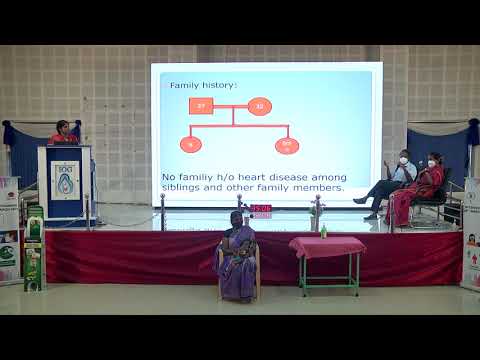
[8:51]Social and adaptive, social smile at 2 months, recognises mother by 3 months, stranger anxiety present. Language, cooing present, mono-syllable not yet attained. Vision follow bright objects, hearing turns head towards sounds. Okay. So all these are normal, normal for its age. Okay. Immunisation history, immunised up to age. Last vaccine was at 3 1/2 months. No optional vaccines taken, BCG scar present. Dietary history. Child now on exclusive breastfeed till now. No complimentary feeds given. Socio-economic history. Modified Kuppuswamy classification 2020. Class III lower middle class family, lives in kutcha house, water from public tap, uses boiled water for drinking. There is no separate toilet facility. Okay, fine. Family history is the second born of non-consanguineous marriage. There is no family history of heart disease among siblings and any other family members. Okay. What if if the mother has some congenital heart disease? What if if the sibling has a congenital heart disease? What significance?
[9:54]Syndromic child. Okay, possibility of some anomaly. Okay. Then what is the normal incidence of congenital heart disease in a general public? What is the incidence of congenital heart disease if the mother is having an congenital heart disease? What is the incidence of congenital heart disease in the baby if a sibling is having an congenital heart disease?
[10:19]8 per 1000. Okay. It is less than 1% maybe 8 to 10 per 1000 should be okay. If the mother is having a congenital heart disease, offspring having it is somewhere around 10%. Suppose if the sibling, another sibling is having a congenital heart disease, the child having a congenital heart disease is around 5%. This is roughly for congenital heart disease, but for individual lesions, you have separate percentages. Okay.
[10:54]Examination. Okay, wait. Now summarising your history. A 6-month-old female child presented with features suggestive of congestive cardiac failure, probably the differential could be VSD and PDA. I would like to examine further to confirm the diagnosis. Okay. So a 6-month-old baby taken for medical attention, mainly for worsening respiratory distress. The mother had given history that previously she has noticed some signs of failure in the form of forehead sweating. cycle for which she hasn't attached much of significance, but the child has been taken for medical attention because of a respiratory tract infection. Okay. And there is a failure to thrive, which is again a sign of failure. Okay. And there is a low birth weight. We don't know what is the significance. In spite of good pregnancy weight gain and good inter-pregnancy interval. Is it? Okay. And then some other thing you said in the history, found to have some abdominal mass by ultrasound, which was again an incidental finding. So put together what are we going to think of? So a low birth weight, onset of failure at 3 months of age. Possibly the child became symptomatic after 3 months, is it? So possibly 4th month, 5th month, now the child is running 6th month. So for the past 2 months, the child is symptomatic and it is also having some other abdominal mass. Mass. So which is possibly an other congenital abnormality. Is it? So there is an congenital heart, there is an congenital problem in the form of a mass, and then low birth weight. So what are we going to think of? Yes, definitely and you said, what did you say for your? Okay, it is an cyanotic, possibly an left to right shunt. So with the failure. That that for is known. Why are you saying it as an VSD? Because the most common disease. Most common disease. VSD being the most common, you wanted to show that possibility. And when will your VSD normally present? After 6 weeks. Why? Because of pulmonary vascular resistance fall after 4 to 6 weeks. Okay. So possibly this child is following the pattern and after 3 months, the child has become symptomatic, possibly after the pulmonary pressures has come down. Okay, fine. That is in favour.
[13:47]Common lesion is VSD, PDA, sir. The other differential diagnosis is PDA. Does PDA present with failure so early? Yes, sir. Okay. What type of PDA? Large PDA. Moderate to large PDA can present earlier. Okay.
[14:14]Why are you not including ASD or other left to right shunts? What are all the other left to right shunts you know of? Atrioventricular canal defect. Atrial septal defect, VSD presentation will be little later, sir. And that's not present with failure. Okay. Presentation will be a little adolescence or adulthood.
[14:34]Okay. Can it be an AV canal defect again? Could be, sir. Okay. General examination. Child awake, alert, lying on mother's lap, tachypnea present, no cyanosis, no clubbing, no pallor, no icterus, no lymphadenopathy and no edema. Head to foot examination. Head and skull appears small, eyes, hypertelorism present, depressed nasal bridge, low set ears, open mouth, protruded tongue. Neck, chest, abdomen, limbs, normal, sandal gap present, skin normal. No petechiae and rash. Child showing open mouth and protruded tongue, sandal gap and low set ears. Okay. Go back to your general examination. If you want to show the baby, you can ask him to focus the baby and then show for them. Okay. You have just enumerated the positive finding, is it? Hypertelorism, depressed nasal bridge, low set ears, open mouth, protruded tongue. All these points towards your Down syndrome. Possibly of Down syndrome. Okay. But there is no other abnormality and also your sandal gap. Yes, sir. Points towards your Down syndrome. Okay. What are all the features you are missing here for your Downs? What else do you want? Flat occiput. Flat occiput. Excessive skin at nape of neck. Okay. Clinodactyly. Clinodactyly. Simian crease. Okay. Can it decrease? Okay. So all those things are not there. Yes, sir. Okay, good. Anything to add? You said like suppose in a VSD, the systolic murmur will be in the little lower down. Okay. Can you have a VSD murmur a little higher up as in this case? And in that case, how will you differentiate it from your first diagnosis of a PDA?
[16:59]In which which type of VSD you get a murmur little higher up? VSD with aortic insufficiency. No, no, no. It's a subpulmonic VSD. Subpulmonic VSD you don't expect the VSD murmur to be in the left lower sternal border, it can be little higher up. As in this case, it could be still a subpulmonic VSD. But what is the differentiating point between that and your PDA, which you have kept as the first diagnosis? It is the pulse and the blood pressure. Okay. VSD it still can be a bounding pulse, but it's a small volume, because during the the systolic, that is the cardiac output is less because of the shunting of the blood from the left to the right side. So it will be still a bounding pulse, it will be a small volume bounding pulse. You don't get a large volume bounding pulse as in this case of a PDA. You said the systolic BP is somewhere around 90. Okay. So that one differentiates this between a probably subpulmonic VSD or a PDA. So you can still have that as a second differential diagnosis for this case. Okay. Okay, your final diagnosis. Okay. Clinically on discussion, we have ruled out pulmonary hypertension. I think we can take that out out.


