[0:00]People always want to talk about the serve, the forehand, the volleys. And yes, all of that was real, but that's not what got to me first. What got to me first was the way he walked onto the court. Pete and I, we could not have been more different. I came out there with everything on the surface. The hair, the clothes, the emotion. I wanted people to feel something when they watched me. I needed that energy, I fed off it. Pete, he didn't need any of it. He walked out like the match was already over. Not arrogant, that's the wrong word, it was something quieter than arrogance. It was certainty. Like he had already seen how the afternoon was gonna end and he was simply there to confirm it. I remember standing across the net from him early in our rivalry and I thought this man is not performing. He is not trying to intimidate me, he just genuinely does not need what I need. I once said I envied his dullness. That I wished I could emulate his spectacular lack of inspiration, and I meant every word. Because what looked like dullness from the outside was actually the most complete form of focus I have ever witnessed in another athlete. That, before anything else, is what made Pete terrifying. I had a good serve, people know this. Um, for a long time I believed my serve was the most dangerous weapon on a tennis court. Then I played Pete. The first thing you notice is the ball feels different when it comes back at you. Not faster than you expect, heavier. Like it has more inside it than a tennis ball should. You get your racket on it and somehow it still beats you. I could not explain it then. I still find it difficult to explain now. He was not the fastest serve on tour. That is the part nobody understands. But the combination of pace and spin he generated nobody else was producing that. His second serve came at you like a first serve from most players. I, I, I remember saying after one match that sometimes I thought he had forgotten the difference between his first and second serve. I meant it as a compliment. The highest one I know how to give. I worked my entire career to own Wimbledon. Three titles. I believed that place belonged to me in a way it belonged to very few people. Then Pete arrived, and within a few years it was simply his. Not because he took it, because he earned it, over and over, in a way I could not answer. That is the honest truth. Look, I played Borg, I played Connors, I played Lendl at his absolute peak. Um, I know what it feels like to stand across the net from someone who is genuinely trying to end your career. I have been in those matches, I know what that pressure feels like. But Pete was different and I say this as someone who beat all those other guys at least once. I never beat Pete, not once. Three matches, three losses, and I want to be clear, these were not close calls where I felt like I was right there. It felt like I just had the racket taken out of my hands. It did not matter what I did. He served so big and hit the ball so hard that I simply could not do what I do. He took me completely out of my game. Now, was I at the end of my career when we played? Yes. Does that explain some of it? Sure, I will give you that. But I have also seen Pete dismantle players in their prime and the story is exactly the same. The serve, the forehand, the net game, and then that face completely blank, completely calm, like none of it cost him anything. I called his serve the greatest of all time. I meant it. It is a serve I dream about having myself. You have to understand something about my generation. We built our careers on patience, on rallies, on making the other person crack first. That was the logic of the game we played. You construct the point, you extend it, you wait for the moment. Pete made that logic completely useless. Before you even had a chance to construct anything, the point was over. Serve, volley, done. And if somehow you got the ball back, the forehand was waiting. There was no grinding him down because he never gave you enough time to start grinding. I remember watching him and thinking this is a different sport. What he was doing and what the rest of us were doing, it looked similar from the outside. Same court, same racket, same ball. But the game he was playing had completely different rules. And here is the thing that people miss. It was not just the serve and volley, when Pete needed to stay back and trade grand strokes, he could do that too. You could not push him into uncomfortable situations because he did not have uncomfortable situations. Every part of his game was already at a level where you simply had no plan. I will say this, it is probably fortunate for me that by the time Pete was truly dominating everything, I was already nearly finished. I am not sure I would have enjoyed that period very much. I beat Pete in a grand slam final, people sometimes bring this up as if it is evidence of something. I am not sure it is. When we played that final in New York, Pete was already very good and dangerous. But looking back, I think he was still becoming the player he was going to be. There were small openings. Not many, but they existed. A few years later, those openings were simply gone. What changed was not his serve or his forehand, those were always there. What changed was the completeness, every part of his game reached a level where you could not find a direction to play. You could not exploit his backhand because his movement covered it. You could not out volley him because his first strike was too good. You could not out serve him because, well, nobody could out serve Pete. I think about the matches we played after that final and the feeling was, was genuinely different. The problem was not that he was doing something new. The problem was that everything he had always done was now perfect. And when everything is perfect, you run out of ideas very quickly. He was the most complete opponent I faced. I do not say that to be generous. I say it because it is simply accurate. That is really all there is to say about it. I had reached the final at the US Open eight consecutive times. Eight, that does not happen by accident. That happens because you have built something that is very difficult to break. Pete broke it, he was 19 years old. Before we played that quarter final, uh, I will be honest, uh, I was not particularly worried. I had seen young players before, talented ones, they tend to find a way to lose when it matters. I was skeptical about whether Pete had what was needed when the moment became serious. Then he went up two sets. Fine. I have been in that situation. I came back. I won the next two sets. And I watched him very carefully during that period, waiting for what usually happens, the doubt, the tightening, the small signs that tell you a young player is starting to feel the weight of the moment. There were none. He was 19 years old. I was coming back in a major quarter final and his face told me absolutely nothing. No panic, no fear. He just kept playing his game as if my comeback was mildly interesting, but ultimately not his concern. Uh, he won the fifth set. He won the tournament. I, I went home and thought about that for a while. A player with no reaction to pressure is a very specific kind of problem. Uh, I had not encountered that before, not at 19. 1995, the US Open final. I was world number one. I genuinely believed that day was mine. Pete had other ideas. What I remember most is not any single shot. It is the feeling of standing on that baseline, waiting to return serve and having absolutely nowhere to go. Not just that his serve was fast. I had returned fast serves before. It was that there was no pattern I could find, no, no tendency I could exploit. Every time I thought I had identified something, the next serve went somewhere completely different and just as unreachable. And he hit 24 aces that day. Uh, but the number is almost beside the point. The real damage was psychological. Every time I stepped up to return, I was already slightly beaten before the ball left his racket. I fell apart after that loss. Not immediately, but over time I dropped to nearly the bottom of the rankings and I have thought about that period a great deal since then. How much of it was Pete and how much of it was already inside me? Probably both. But I will tell you this, when I came back, when I rebuilt everything and became the player I eventually became, Pete was a large part of why. You cannot face that level of excellence repeatedly without it either destroying you or making you something better. He made me something better. That is the honest answer. 1995, Wimbledon final. I had beaten Andre in the semi-final, which felt significant at the time. I was playing well. I genuinely believed I had a real chance. I won the first set. And for maybe 20 minutes, I thought, yes, this is possible. This is happening. Then Pete decided it was over. That is the only way I can describe it. He did not panic after losing that set. He did not change anything dramatically. He simply lifted. And once Pete lifted, there was nothing left to discuss. I have, I have lost matches in my career where I felt the other player took something from me. Where I was beaten by a tactic or a hot streak or a moment of brilliance that I could not have predicted. This was not that. Pete was just better than me. Better than me at serving, better at volleying, better at moving. He was better at being a tennis player, and on that particular afternoon, on that particular court, there was no version of Boris Becker that was going to change that outcome. Afterwards, I said that the center court used to belong to me. But now it belongs to Pete. I meant it completely. That place was his. Seven finals, seven titles. He never lost a single Wimbledon final, not one. That is not dominance. That is something beyond dominance. I, I, I am not sure the word exists yet. I want to talk about January 1995, because I was courtside for that match, and I have never forgotten it. Pete was playing a quarterfinal at the Australian Open. His coach, Tim, who was one of the genuinely good people in this sport had collapsed during the tournament and been flown home. Pete knew. He knew what it probably meant and he, and he went out and played anyway. He won the first two sets, then his opponent came back and took the next two, and then at the start of the fifth set, he just broke down. Standing there on the court, in front of everyone, crying, completely exposed in a way that Pete Sampras essentially never allowed himself to be. And then he served an ace. I am telling you, I have commentated hundreds of matches at the highest level. I have seen extraordinary things on a tennis court, but I have never seen anything like that. Crying between points and producing championship tennis within the same 60 seconds, that is not normal. That is not something you can teach somebody. What it told me is that Pete's mental game was not just about staying calm when things got hard. It was something deeper than that. Some part of him that simply refused to stop functioning, no matter what was happening around him. That to me is the most frightening thing about Pete Sampras. There is something I think gets overlooked when people talk about why Pete was so difficult to play against. Everyone focuses on what he did to you. The serve, the volley, the forehand. All of that is true and correct. But what I noticed watching him over many years was what he did after he won a set. Most players when they win a set convincingly there is a moment, a small release. The shoulders drop slightly, the breathing changes, the intensity dips just a fraction before they reset. It is completely human. It happens to everyone. Pete did not do that. He won a set and walked to his chair looking exactly the same as when he walked onto the court. No satisfaction, no relief, no celebration. He sat down. He got up and he went back to doing exactly what he had been doing before. That for an opponent is a deeply unpleasant thing to experience. Because you realize there is no moment coming where you can steal something back. There is no brief window where his focus softens. He was simply going to keep doing this until the match was finished. My generation knew how to wait for those windows. We were very good at it. Against Pete, the window never opened. I find that remarkable even now. Genuinely remarkable. The man simply did not allow himself to be human between sets. Only between points and even then barely. People called me cold on a tennis court, reserved. I never thought that was unfair. I believed then and I still believe that composure is a form of respect for the game. You do not need to perform your emotions to compete at the highest level. But Pete was something different from composure. What he had went further than that. When I was calm on court, I was managing something. There was still something underneath that needed managing. Nerves, pressure, the weight of the moment. I controlled those things, but they were present. I think if you ask most players honestly, they would say the same. With Pete, I genuinely could not tell if if there was anything underneath. Um, he walked onto center court for a Wimbledon final, looking the same as he looked walking onto a practice court on a Tuesday morning. The same pace, the same expression, the same economy of movement. Nothing extra, nothing wasted. Uh, as an opponent that is very difficult to, to deal with because somewhere in a match you are looking for information, you want to know if the other person is feeling the pressure. You want to see something that tells you the door is open, even slightly. Pete never gave you that information. Not once. He was the most disciplined competitor I encountered, completely. And I played in an era of exceptional competitors, that is not a small thing to say. I am going to say something that might surprise you. The most frightening thing about Pete was not the serve, it was not the forehand, it was not even the mental strength, though that was exceptional. Uh, it was the absence of weakness. Every player I faced in my career had something, uh a surface they preferred less, a shot that broke down under pressure. A pattern you could find if you were patient enough and disciplined enough. Uh, I built my entire career on finding those things and and uh exploiting them systematically. With Pete, I looked, believe me. I looked carefully. Early in his career, the backhand was the answer. Everyone said so, so I played to the backhand, and then the backhand got better. Not just uh adequate, genuinely good. He simply removed the option. That is not normal. Most players protect a weakness their entire career. Pete eliminated his. I will give you one more thing to consider. Pete once said he never wanted to be the the great guy or the colorful guy. He wanted to be the guy who won titles. That is exactly right. And that is precisely what made him so difficult to prepare for. He had no interest in being liked, no interest in being entertaining. He was only interested in winning. When you face someone with that kind of singular focus and no weakness left to find. Well, good luck to you.
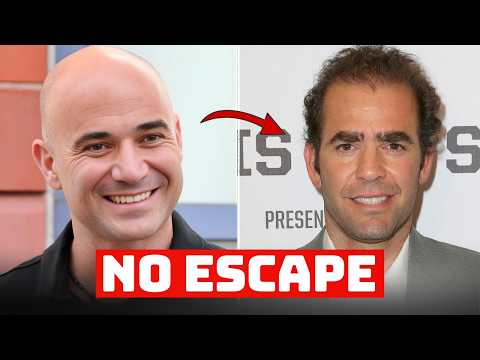
Tennis Legends Explain How TERRIFYING Pete Sampras Was
Tennis Time Machine
17m 59s2,834 words~15 min read
YouTube auto captions
Transcript source
YouTube auto captions
This transcript was extracted from YouTube's auto-generated caption track. The transcript below is server-rendered so it can be read, searched, cited, and shared without opening the original YouTube player.
Pull quotes
[0:00]Like he had already seen how the afternoon was gonna end and he was simply there to confirm it.
[0:00]I remember standing across the net from him early in our rivalry and I thought this man is not performing.
[0:00]That I wished I could emulate his spectacular lack of inspiration, and I meant every word.
[0:00]Because what looked like dullness from the outside was actually the most complete form of focus I have ever witnessed in another athlete.
Use this transcript
Related transcript hubs
Watch on YouTube
Share
MORE TRANSCRIPTS


