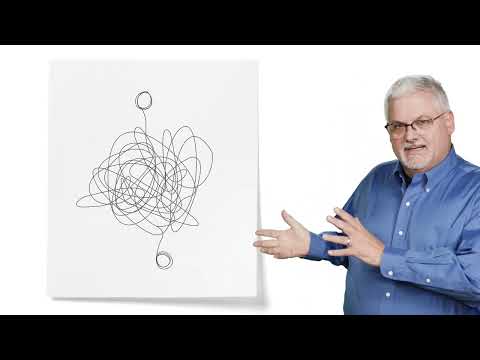
[0:06]Once upon a time, all across America, we'd spend three hours every Saturday morning listening to Casey Kasem's American Top 40. Hello and welcome to American Top 40. I'm Casey Kasem in Hollywood with our countdown of the 40 most popular songs in America this week. Well, we've got We listened because that's how you found out what all the biggest hits in the land were. We were living in a linear world, a time when media could deliver mass because media controlled the pipe that delivered what we knew. All that changed in a moment, this moment. And we are calling it iPhone. Sure, the internet existed before iPhone, but this gave us anytime access to the world's collective knowledge ushering in a non-linear on-demand, give it to me now era. While humans remain fundamentally the same, our non-linear world has remapped the journey from trigger to purchase. We seldom travel neatly down this old linear funnel from awareness and consideration to preference and purchase and advocacy. Instead, according to research by behavioral architects commissioned by Google, today's modern funnel looks more like this. Welcome to the Messy Middle, drawn from several hundred hours of observing shopping tasks covering 310 journeys across 31 categories. Sitting between the twin poles of trigger and purchase, this is a more typical non-linear customer journey. Today, I'll show you how this research can help you untangle the messy middle, or as Casey might put it, We're going to start counting down from the trigger, and we won't stop till we reach the number one outcome. They say this is our new reality, what Google calls the Circle of Exposure. The sum total of a customer's awareness of brands and products in a category, what's seen in ads, heard by word of mouth, read in the news. It's a manifestation of your brand's penetration, an always on, constantly changing backdrop that's passively assimilated prior to a purchase trigger. And we're off. When a trigger takes customers from a passive state to an active one, they set out to explore options, expanding their knowledge. Then, in either a sequential or simultaneous process, they evaluate options, narrowing choices. For some purchases, this process is brief, but for more complex ones, customers will cycle back and forth in an infinite loop, a dance between System 1 and System 2 thinking. In Thinking Fast and Slow, Daniel Kahan breaks thinking into two camps, System One thinking that's automatic, intuitive, using simple associations, and System Two thinking that's more conscious, requires effort, evidence and is guided by logic. Exploration is additive, intuitively system one, where distinctiveness is your friend. Evaluation, on the other hand, is reductive, guided by System Two logic. Here, differentiation will further your cause, almost like relational and transactional modes. But beware, this study showed that sending the wrong signal at the wrong moment could be highly disruptive to the customer journey. Put simply, say the wrong thing, the wrong way, at the wrong moment, and click, you're out. We've traveled back in time to this prehistoric cave to make a point about customer journeys. How we shop really hasn't changed. Back in these days, when foraging for food, predators learn to evaluate the effort of the hunt versus the energy gained from eating it. Let's apply this principle to modern-day information foraging by your customers. Your information must be an easy hunt, satisfying enough to entice them through the messy middle to purchase. And so it goes in the here and now, customers flip-flopping between these states, weighing effort versus reward until they're comfortable making a purchase. Behavioral architects identified six biases in the explore and evaluate cycles that can help you tip the scales in persuading customers. First, category heuristics. These are shortcuts or rules of thumb for making quick decisions, like camera megapixels, miles per gallon, or carrots in a diamond. Authority bias, where we tend to follow people we see as credible. Social proof is on display when we emulate the behavior of others. Power of new proves that we want things now. Scarcity bias comes in three flavors: time limited, quantity limited, and access limited. And finally, the power of free. There's something special about the price of free. Each of these biases addresses a cognitive need. Applying them helps you help customers simplify their decision-making, but first, you must show up. Being present to these flip-flop deliberations is where you harvest the benefit of what Byron Sharp refers to as mental availability. When a trigger fires, who do you think of first and feel best about? Not so fast. Remember, customers are promiscuous, they shop around. Showing up at trigger moments means first decoding the customer's category entry points.
[5:36]Let's say this is your piano. One day you hit a sour note. Needs tuning. Trigger. Our category entry point, find a piano tuner.
[5:48]Exploration begins. Piano tuning. Let's see. Okay, I have three quick results right here. Uh, C.Miles Piano, I got a five, yeah, let's check them out here real quick here. They're right there. Oh. Okay, this is what I mean about showing up, okay, his website isn't even hooked up right. I don't want to let him play with my piano. Okay, let's see what else we had on here. Uh, Master, oh, I love my piano, but I don't want to tune it myself. Let's go back up here. Wait a second. Hammond Piano. This looks good. Look, he's got five stars, 10 plus years in business. And he closes today. I can browse, see if you can get out here today. Look, and here's a review. They did a great job tuning my old piano. Perfect. Let's go check him out. Okay, great. They they service acoustic pianos. I land here. They're giving me the they're telling me that they can do what I want them to do. I click book now, and look at that. How easy that is. I'm going to put my address in here. I'm going to tell them how many pianos I have. They're going to come out. They're going to fix it. Bam, there we go. While every customer journey is unique, this should give you a taste of a voyage through the messy middle, an idea of what signals are needed to influence customers as they explore and evaluate. In exploration, consider your category entry points. Do you have a landing page for each one? Does it give a distinct reason that draws the customer closer? And is the page optimized to be found easily by information forgers? Coming on hard here is the wrong voice. Think broadly, you're just showing up and opening the door to examination. When customers flip to evaluation, release your inner Ross Reeves. What's your unique selling proposition? Lay out your case, features, advantages, benefits, and build confidence with examples, videos, testimonials, reviews. Show up, distinguish for exploration, differentiate for evaluation, convert. That's how you navigate the messy middle and connect the dots from trigger to purchase. But you're not done. Right here. See this? Purchase begets experience. What do you know? Turns out this isn't a funnel, it's a cycle where purchase experience adds to what the customer knows about your brand and your category. The key takeaway is this: delivering positive customer experiences earns added future exploration because every experience expands your exposure. There you have it. We've counted down from trigger to exploration and evaluation all the way to purchase and experience, our new number one. That means there's just one thing left to say. Casey. Keep your feet on the ground and keep reaching for exposure.


