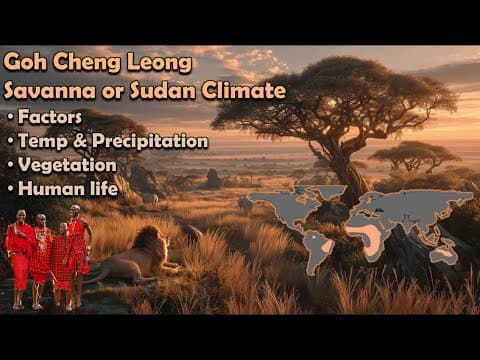
[0:11]Hello friends, welcome to another video of Zxiss and today we are going to discuss about the Savanna or Sudan climate as discussed in GC Leon book. So these are all the climatic systems discussed in GC Leon book and we will be discussing each of them one by one. And today we are going to discuss the Savanna or Sudan climate system. Now, GC Leon has not specifically mentioned the criterias used for classifying the regions into different climatic systems. Therefore we will be comparing it with Kopen climate classification system which is the most accepted climate classification system in the world and we can see that there are slight variations. By comparing both of these images side by side we can see that there are certain differences in the region. If we see this book map then we can clearly see these are the regions of Savanna over here then in South America we have this region as well as this second region is there. Similarly when we come to Australia we can see that there are another Savanna region. But if we come to the similar location in uh South America here then we can see that the extent is slightly different. Similarly here also we see that this is a Savanna according to Kopen climatic system but it is different than what GC Leon discusses. Even in Africa, when we see the extent or the region of Savanna is slightly different than what GC Leon discusses. Therefore, this should be kept in mind that there are two classification or in fact more than two classification systems and each classification system maps different regions into Savanna region. The most accepted Kopen climate classification system maps the Savanna region into this way and the GC Leon maps it in this way. Now with this we will see the Savanna or Sudan climate system in GC Leon book. Now this Savanna climate is between Tropic of cancer or Tropic of Capricorn. This line that you see over here is the Tropic of Cancer which passes through Gujarat in India and then here we have Tropic of Capricorn which is here. So we can see that this Sudan region which is indicated by this color as we can see over here, so it is indicated by this color. It is exactly between these two Tropic of cancers and Tropic of Capricorn. Even here in Australia we see it only very slight portion of Savanna system is below the Tropic of Capricorn. It is located between equatorial climate and trade wind hot deserts. So this is a transitional type of climate which is located between the equatorial climate which we can see over here and the deserts. So it is in between them. Here we will see that there are marine or monsoon climatic systems in the north and then we have this desert systems in the south of this Savanna climate. Here also there is this Savanna climate in the middle on the west side we have equatorial climate and on the east side we have tropical marine climate. But generally it is considered a transition region between equatorial and hot desert. It is best developed in Sudan. Sudan is located right over here in this region. And here we find that it is most distinguishedly expressed. That is the characteristics of Savanna climate can be seen very clearly over here and that is why this climate is also called Sudan climate system. Now what are the distribution or what are the regions around the world where we see the Savanna or Sudan climate? So first is in Africa, West Africa, Sudan, East Africa, South Africa. So it covers a very big portion of our Africa starting from West Africa, here we have already discussed that there is Sudan and then we have East Africa and then South Africa. Within South America we have two distinct regions, Campos and Llanos. Here we have Brazil Highlands which blocks the trade winds and therefore we have Savanna climate over here. Then we have Llanos which is surrounded by the Highlands here. Here we have North Australia and Central Australia where we see this Savanna type of climate which extends from this border and goes till Central Australia. Now let's see the characteristics of rainfall in Savanna climate. It has distinct season of rainfall and dry seasons. So we can clearly see that these bars indicate the amount of precipitation in that month, we can see that there are months where there is no rainfall. And then there are months where there is this precipitation. So there is very good distinction between dry and rainy season. Generally from May to September it is hot and rainy season. So we see from May to September there is rainy season and the climate is hot. Then from October to April we have cold dry season. So we see that right from October the cold dry season starts. Rainfall is concentrated in summer and most of it is in 4 months. So we can see that most of the rainfall occurs in these four months and this is the summer. Precipitation decreases from equatorial to desert side. So as we have seen that uh the Sudan type of climate system it covers a vast area. So as you move from the equatorial region towards the desert region the amount of rainfall will decrease significantly. Annual precipitation is much less than tropical monsoon climate. So if we see or if you have remembered the chart of monsoon climate then it is quite similar. There also the rainfall was concentrated in four to five months but the bars were very high. That is rainfall in each month was very high compared to Savanna climate system. So here the rainfall is very less. Generally Savanna type has annual rainfall of 100 cm while tropical monsoon has greater than 150 to 200 cm. Length of wet and dry period varies based on location. So within the Savanna there is very lengthy dry season. But the exact length will vary on the place where it is located. Now let's see the temperature characteristics of Savanna or Sudan climate. So the monthly average temperature is 21 degree Celsius to 32 degree Celsius for low altitude region. Remember this is the average monthly temperature. The annual temperature range is 20 degree Celsius. What it means is the maximum monthly temperature in an year and minimum monthly average temperature in an year. So it indicates the gap between these two readings. Here if we see then the maximum temperature will occur over here. While if we come over here then minimum temperature is in this region. So the value over here is around 30 degree Celsius and here it is 20 degree Celsius. So the difference between these two is 10 degree Celsius. However, a temperature range of 20 degree Celsius is not abnormal. In fact, as you move away from the equatorial region towards the deserts, you will see that this range will increase. Moreover, if you are away from oceans further, you can see that this temperature range increases. So this indicates that summer is very hot and winter is very cold. Therefore the range is very high. Now highest temperature does not coincide with period of highest sun that is summer solstice in June. So we know that in June the sun is over the Tropic of Cancer. So in this period, the northern Savanna region, it will receive maximum sunlight. So the temperature should be highest in this time period because if we see then we can clearly drag it down and we can see that this is July and this is June. So in this June, the temperature should be highest which is directly over here. But the temperature is highest in this region. So there is this gap between the maximum temperature time and the solstices or the time when the earth receives maximum amount of radiation. This occurs because the start of the monsoon it reduces the temperature and therefore we see that the maximum temperature occurs just before start of monsoon. Highest temp just before start of rainy season, start of rain and cloudiness reduces temperature. So when there is cloudiness in the sky, the solar radiation cannot directly reach the earth. Therefore the temperature is also reduced by cloudiness as well as the rainfall decreases the temperature of the atmosphere. We already know that. Now let's see the temperature characteristics for diurnal range. That is for daily range, that is within a day. So days are hot. Noon temp often greater than 37 degree Celsius because there is clear sky. Remember in Savanna there are distinct dry periods when there is no rainfall, no cloudiness so the sunrays will directly reach the earth. Therefore there is intense heating during the day. Night temp often less than 10 degree Celsius. It is also because there is clear sky, so the radiation is quickly lost to the atmosphere or to the space and therefore we have very cold nights. And therefore frosts can also occur in the night time in the Savanna system. Extreme diurnal temperature range is a distinct feature of Savanna climate. So extreme difference in the day temperature or afternoon temperature and night temperature is a characteristics of Savanna climate. Here you can see the temperature of Savanna region for a particular place in a day where it starts from midnight and ends till midnight. And here you can see that the temperature is minimum over here and then during the day around 1:00. You can see that the maximum temperature is over here. So this difference is actually very high. Therefore the diurnal range is very high in Savanna climate system. Now let's try to understand why Savanna has this kind of climate system. So if we see the winds here, you can see that these regions which are in slightly white color these are the Savanna region. And if we see the wind then this wind are offshore. They are coming from very far oceans and while they reach this Savanna region they will lose all of their moisture while they reach over here. And then they blow offshore. So it is because of this reason these winds when they reach in this Savanna system they will not have any moisture to give rainfall. We can see the movement of these winds. Here also we can see that because the winds are moving from the eastern side, these are the trade winds, we see that these winds they come from a very far off sea. There is lot of land in in the middle where they give the rainfall and when they reach this region there is no moisture to give rainfall. Here also the same concept is there. The thing is that one more factor which adds over here is it is having mountains around it. Here also we have Brazilian Highlands, here we have Guyana Highlands. So because of these Highlands in this region the wind is blocked so the wind is not allowed to reach these regions even though they are within the direction of winds they may gave rainfall. So it is because of those mountains which are blocking the wind flow. That is why we have Savanna type of climate here as well as here. So here we see the prevailing winds. Trade winds blow over here strongest in summer dry by the time they reach continental interiors or west coast of land. So these trade winds are strongest in the summer but they become dry when they reach the western coast. See these are the continents western coast even here, even here you see this is the western coast. So these winds when they reach these regions they are dry, they lose all their moisture. Therefore they cannot give any rainfall. Another prevailing wind is that in West Africa Harmattan winds blow. It is a trade wind blowing from Sahara towards Gulf of Guinea. So these trade winds they blow from here towards here and they are called Harmattan winds. Now here we can see Harmattan winds. These are specialized winds or local winds which blow in this particular region. They blow from Sahara towards the Gulf of Guinea which is located over here. This is the ITCZ. And we know that this region has equatorial climate but just north and south of this equatorial climate we have Savanna climate system in this particular region. Now here ITCZ on the equator the sun is also on the equator but as the sun moves in the southern hemisphere. We will see that these winds are reaching towards north. Now further when the sun is in the northern hemisphere, we will see that the extent of these southerly trade winds has reached and they are reaching till south of Sahara or mid of Sahara. Now these Harmattan winds which are blowing from the Sahara towards the Gulf of Guinea, they are very dry because there is no moisture source in this region. Therefore these dry winds they are coming to this Savanna region. Now in the Savanna region there is dampness, there is moisture because it is close to ITCZ and we know that in the ITCZ the air is not moving and the moisture from both hemispheres collect because the winds they bring moisture along with them. So here the moisture brought by this southern trade winds, it will be over this region creating very dampness, a very damp atmosphere. So when this dry winds they come to this region they will cause evaporation of this moisture or they will reduce the relative humidity in the air. Thus removing the dampness and that is why Harmattan which means doctor winds, so these are called doctor winds because they remove the dampness from the atmosphere. Now the Harmattan winds they are northeasterly trade winds blowing from Sahara to Gulf of Guinea. They occur from November to March. So we have seen that as the ITCZ moves in the southern hemisphere, we will see that these winds they will start to reach the Savanna region. Dry and dusty, these winds are very dusty as we can see in the image below. It picks up fine dust and sand particles from Sahara Desert. As it is blowing from the Sahara Desert where there is abundant amount of dust, it brings a lot of dust along with it. It is formed because of high pressure subtropical ridge is over the Sahara while ITCZ is over Gulf of Guinea. So we know that ITCZ is low pressure region and on the Mediterranean we have high pressure subtropical zone. So because of this pressure difference we see that Harmattan winds they blow and they are called doctor winds because dry winds gets relief from humidity of tropical climate. So let's see effects of Harmattan winds. It lowers the humidity, dissipates cloud cover, prevents rainfall, creates big clouds of dust which can result in dust storms or sandstorms. So it does give relief from humidity but it brings lots of dust with it. This can be harmful both for uh communication that is uh transportation on the roads. There could be visibility issues as well as it damages crops. It also leads to some issues in the health. It increases fire risk and cause severe crop damage because dryness in atmosphere increases. So because now the atmosphere is very dry and the wind is blowing at a very high speed. So because of this, there is some friction between dry uh stems or dry twigs, it could lead to fire. It causes Harmattan haze. So this haze you can see in the background because of the dust in Harmattan is called Harmattan haze. Heavy dust in winds blocks sun for days. Humidity can drop to very low levels. So we have already seen that Harmattan winds have very less humidity. Therefore when they reach they will reduce the humidity of the region. So here is the summary. In West Africa Harmattan winds blow it is a trade wind blowing from Sahara towards Gulf of Guinea it is dry and dust-laden. Harmattan means the doctor. It has very less relative humidity less than 30%. Clears the damp moist air of Guinea lands by increasing evaporation it provides cooling effect. This dry dusty wind forms dusty haze, impedes navigation and ruins crops. So we have already discussed all of these points in detail. Now let's see the Savanna soil. The Savanna soil is mainly lateritic soil caused by heavy leaching. What this mean that all the important minerals which are dissolvable in water they are removed. So because this regions have torrential rainfall, they have less rainfall but when the rainfall occurs it occurs at a very high intensity. So because of this torrential downpour and lack of vegetation important minerals like nitrates, phosphates, potash dissolve in water and wash away. So when these minerals they get dissolved in the water, they will be taken away with the water as a as the water moves away from this region. Here also we can see that in a special case the what the minerals from the surface they can move in the deeper parts in the streams and then they can move away. So because of this the top layer is devoid of these minerals. Even in dry season we see intense heating from the sun which causes evaporation and dries the soil. So all the moisture is also removed from the soil. So because of this the Savanna soil is not good for agriculture because there is no moisture as well as the minerals are removed because of torrential rainfall. Now the natural vegetation. So the Savanna landscape is tall grasses and short trees. You can see there are these short trees and there are these tall grasses in this landscape so this kind of landscape is called Savanna landscape. It is often called grasslands but trees are found intermittently. So there are trees in this region, a pure grassland or two grasslands should not have any tree. But here we have trees which are located at quite distance. So they can also be called as Parkland or Bushveld. Tree grows towards equator or equatorial region and river banks. So because trees require moisture or water, therefore they will grow in the regions where there is abundant rainfall or at least sufficient rainfall or there is river. As you move away from the equator, the density of tree will decrease and the height of tree also decreases. So as you move towards the desert, remember on the north and on the south of this Savanna, we see there is desert region. So as you move away from the equatorial region, you are actually moving towards the desert region and therefore the density of tree will also decrease and the height of tree will also decrease because there is scarcity of water. Now let's see the characteristics of trees in the Savanna landscape. So here the trees are mostly deciduous trees that is they shed their leaves in dry season that is to conserve the moisture. Because if the leaves are not there the transpiration decreases. Then the trees are umbrella shaped. Here we can see that these trees are umbrella shaped. This reduces the cross section of the trees to the winds. In this Savanna lands which are having a very less trees, the wind blows at very high velocity. If they offer a lot of friction to the wind then they could get uprooted. This kind of adaption where they have this umbrella shape which reduces the cross section to the wind, it helps them in prolonging their life. Palm trees, they cannot survive in dry season they require sufficient amount of water. So they are confined to wet regions around the river lands or there is other source of water. Some trees have broad trunks. Here we can see these trees have broad trunk which is used to store water. These are the examples of such trees. Then trees are mostly hard, gnarly and thorny. So because all of these adaptations, it helps them to reduce transpiration. They also emit gum and during the rainy season we see abundant vegetation. But in the dry all of them will either die out or they will lie in the dormant condition. Now let's see the grass of the Savanna region. They are grass is tall and coarse. The height could be as high as 6 to 12 feet. There is something called elephant grass which can grow till 15 feet. So even the elephants they can hide in this grass. The grass dry and die in dry season. So when there is drought when there is no water available, no moisture available, these grasses they will either die or they will become dormant. And the grass lies dormant in long dry period and springs up in rainy season. So whenever there is this source of moisture in the soil, it will again become alive. So we can see this is the dormant grass which in the process of dying out and it will wait for moisture to come. Now the grass grows in tuft which is cluster or group of roots. So here we can see an example of this. So these are the cluster of roots in which these grasses grow. It has long roots. Here we can see that the roots are very long, it helps it to find moisture or water in the soil. As rainfall diminishes towards the desert, Savanna merges into thorny scrub. So we can see in this particular image that the trees are now very small or they are not available and mostly it is thorny scrub. Now let's see the animals. So Savanna particularly Africa is rich in wild life. And it is called big game country it was used for hunting animals. There are herbivorous animals which are generally agile and quick runner. They move from place to place for green grasses. So they keep moving, they are not confined to one place, they cover large distances in search of fodder. The examples are zebra, antelope, giraffe, deer, gazelle, elephant, okapi etc. There are also carnivorous animals and if we see their skin color then it is adapted to match yellow grass. We can see this tiger and its patterns they match the grass color. So they can hide within this background. Reptiles and mammals are also found. Some national parks are also established in this region now for preservation of these animals.
[24:49]Now let's see the human life in the Savanna type of climate. It is mainly inhabited by tribes Maasai tribes of East African Plateau they are cattle pastoralists and then we have Hausa tribes of Nigeria, they are settled cultivators. So these are the two major tribes which are discussed in GC Leon so we will be focusing on them. So let's start with Maasai tribe. So they are nomadic cattle pastoralists. They are found in East Africa in Kenya, Tanzania. So here we can see the region where they are found. This is Tanzania, this is Kenya and on the border this is the region where they are mainly found. In mid 19th century they were at the height of their power and they covered a large area in the East African region. In fact they had control over these Nile valley. But when the British came they first evicted them and they did a treaty in 1904 and 1911 which established plantation. So land were taken from them and plantation were established. When Tanzania became independent in 1940 it was forced to give up land. So these Maasai tribe, they were forced to give up their grazing lands for farmers of Tanzania. National parks were also formed, so their lands were again taken, they were not allowed to enter or graze in the national park. So again their lands were squeezed. Now Maasai is confined to only 15,000 square kilometer in Kenya and Tanzania. We can see this region over here. They occupy less fertile areas of Savanna because most of the fertile areas has been taken for farming. They live lower slopes of East African Plateau and move uphill with cattle to escape droughts. So they generally live in the plain area but when there is drought or when there is severe heat, so they will move to the higher altitudes to escape from the drought. Now let's see the cattle rearing of Maasai tribe. So Maasai house is circular. We can see this is the house of a Maasai tribe. It is made of mud and it is a temporary structure because they are nomadic, they keep moving so this is a temporary structure. They have separate enclosures for cattle's. Cattles protected from wild animals by fencing. So there is a separate enclosure for cattles in which there are proper fencing is done to protect the cattles from wild animals. The cattles are respected and kept by every family. So all families have cattle and it is the prime wealth for them. Zebu is the most common cattle. So here is a Zebu and it has very large hump. So this is the most important cattle for the Maasai tribe. They also keep sheep and goat but Zebu is the most important cattle for them. They consider cattle as wealth. The person having more cattle is most respectable. Even cattle is paid in dowry or for other purposes. Cattle is never slaughtered for meat. Cattle meat is consumed only after natural death. So they do not use cattle for meat by killing them but if it dies by natural cause then they can consume it. Cattle are also not beast of burden so they are not used for carrying loads. Like we see in most of the other places, they are actually only for milk or for blood. So the Maasai tribes they drink raw blood of these Zebu cattle. The milk held is very low. The yield is very low for these kind of Zebu cows which are over here. The blood is obtained by tying leather cord on the neck. So they tie a leather cord around their neck and when the veins they will swell it is punctured by an arrow and then they get the blood and they consume it. Now let's see Hausa tribe which are cultivators. So remember the Maasai tribes they were nomadic pastoralists that is they used herding but here we have cultivators and they have been cultivators for hundreds of years. They inhabit Bachi plateau in northern Nigeria. There are around 6 million in population and have an advanced and well developed civilization. They live in towns and cities. So these are tribes which have well developed over the years. They have cities, they have towns in the area, they have a very well developed agriculture system. They do not perform shifting agriculture as we see lot of tribes do but they do food grain cultivation like guinea corn, groundnuts, bananas, maize, millet etc. They also grow cash crops like cotton and tobacco. They leave the land fallow for some time. So when they have used a land for several generation of crops then the yield of that land will decrease. So they will leave it for a couple of years to increase the fertility of the land and then they will reuse. So they are not doing shifting agriculture but they do leave the land fallow for some time. They use crop rotation and they are mainly rain dependent agriculture.
[31:38]Again if you see the Hausa tribe, they also use domesticated animals like cattle, goat and others. It is kept for both meat and milk. So earlier we see the Maasai tribe, they do not used to derive meat directly but here they also derive meat and milk. Manure is used in fields. Poultry is raised for egg and chicken. So they also raise poultry.
[32:10]Now let's see the problems and prospects of the Savanna or Sudan climate. So the Savanna can provide land for future needs. We are seeing that there is increasing population around the globe. There is demand for land. Now the deserts like the Sahara Desert or the Thar Desert they are not usable for living. Similarly the freezing Tundra in the north is also not suitable for living, it is very difficult to live there. But Savanna lands have rainfall and they are devoid of severe cold. So all the problems over here they are not there. The heat is significantly less. Already settlements have been done in several places. Central Africa, North Australia, East Brazil, we have already seen that some efforts have been made to settle in the Savanna lands. The Savanna lands also have agriculture potential for cotton, cane sugar, coffee, oil, groundnuts, tropical fruits. So all these agricultural crops have been grown in these regions in the Savanna land. In the countries of Kenya, Uganda, Tanzania and Malawi large scale production of cotton and sisal has been done from Savanna regions. Even in West Africa we see groundnuts, oil palm and cocoa have been grown. So efforts have been made to convert the Savanna land into proper agricultural regions. New drought resistant varieties can be developed which will help in using these lands for future use. Now let's see some of the challenges to agriculture in the Savanna land. The main challenge is long drought season that is dry season is very long, water is not available for very long. Even the rainy season has very less amount of rainfall. Therefore we need adequate irrigation facilities. In some of the regions canals have been made from Nile river or other rivers. The crop varieties should also be improved. Because we require that crops they give higher yield but require less water. Now most of the Savanna region has lateritic soil. Therefore we require proper manuring, proper fertilizers, proper soil management. Only then proper crops can be grown in this region. Now let's see what are the opportunities and challenges in cattle rearing in the Savanna region. Savanna is natural cattle country. There are native people which are herders for centuries. So they know how to uh bring up cattles in this region. Cattles are kept in large numbers and they are fed tall grasses. We have seen that this is a type of region where there are abundant grasses grown. The cattles are kept for milk, meat and blood. However the challenges if we see that the Zebu breed which is found over here are bony and they have low yield. They do not give sufficient amount of milk as well as meat. They fall victim of tropical diseases. Sleeping sickness carried by Tsetse fly is one of the most significant diseases in this region. So we need to have proper vaccination, proper medicines and proper doctors available. There is insignificant export of milk or meat from this region. Now it is both because of lack of proper yielding animals in this region as well as proper facilities like cold storage and transportation. What are the majors? Better quality fodder be made available. So the food or the grass which is given to the cattles they could be improved. Higher breeds of cattle be introduced from other regions. Cross breeding could be done. Diseased control by better vaccination and communication. So by communication it means that if in one region a disease is spreading then proper communication should be done to other regions so they can be ready or prepared.
[37:34]With this we will conclude our video on the Savanna or Sudan climate. I hope it clarified all your doubts on this topic. If you have liked the video then do subscribe to the channel and share it with your friends. We are going to cover all the climatic regions one by one so do watch all the videos. And if you have liked what we are doing then you can support us using the Paytm ID given over here. Thanks for watching the video.


