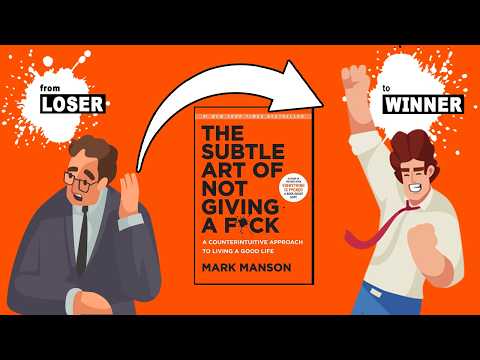
[0:00]You know it, and that's why you're here. Now, I'm not the one saying it, but Mark Manson is. His book, The Subtle Art of Not Giving a F, is the slap in the face you didn't know you needed. It cuts through the fluff and gets real about what actually matters in life. In this video, we're diving into key concepts from the book, like how chasing more steals your energy, how your problems are actually the solutions to living your best life, and why you need to stop trusting your brain to truly evolve. But here's the thing. Reading is passive, watching this video is passive. That's why I've linked an actionable blueprint in the description below. So you can actively apply these ideas and make real daily progress. Use it to take action every day. So sit back, relax and grab that blueprint. There's a lot to cover, so let's get started. Chapter 1. Don't Try The desire for more positive experience is itself a negative experience. And, paradoxically, the acceptance of one's negative experience is itself a positive experience. We live in a society that's obsessed with telling us we're not enough. Every day we're bombarded with messages. Be more popular, be more attractive, be more productive, be more successful. As we chase more, we fall into the trap of thinking that these endless pursuits will somehow make us fulfilled. But this chase often brings the opposite result. Anxiety, dissatisfaction, and burnout. Mark Manson calls this the paradox of positivity, which relies on three key ideas. First, the more we chase after better, the more we fixate on our own shortcomings. This obsession with constant positivity doesn't push us forward. It keeps us trapped in an endless cycle of stress and self-blame. On the flip side, accepting negative experiences often leads to something positive. Second, Alan Watts's Law of Inverse Effort says the harder we try to feel better, the worse we feel. Sometimes, caring less about success actually leads to better outcomes. Third, in life any attempt to escape the negative, to avoid it or silence it, only backfires. The avoidance of suffering is a form of suffering. The avoidance of struggle is a struggle. The denial of failure is a failure. Hiding what is shameful is itself a form of shame. And this is what's so dangerous about a society that coddles itself more and more from the inevitable discomforts of life. We lose the benefits of experiencing healthy doses of pain, a loss that disconnects us from the reality of the world around us. So what's the answer? Stop the endless chase of more. Manson advises to just stop caring about all that. Lower your expectations. Manson's message is clear. Real happiness comes from focusing on what actually matters in your life, right now. Family, close friends, and the few passions that make life enjoyable. By accepting who you already are and what you already have, you free yourself from the exhausting pressure of always wanting more. The danger of staying trapped in the cycle of constantly chasing more, is that it drains your energy, leaving you with less for the things that truly matter. Think of your energy and attention as a form of currency. Like a limited number of coins you get each day. Each coin represents the things you spend your time and mental effort on. Every time you worry about being more popular, successful or attractive, you're spending a coin. But here's the catch. Your coins are limited, and once they're spent, they're gone. Most of us waste our precious coins on things that don't matter. And when we do that, we run out of coins to spend on the things that really do matter. So, ask yourself, what are you spending your coins on today? Are those things really worth it? Real happiness doesn't come from more. It comes from less. Less worry, less comparison, less unnecessary stress. Ironically, it's only when we stop caring about trying to be perfect that we find real fulfillment. Chapter 2. Happiness is a Problem. Happiness comes from solving problems. The keyword here is 'solving.' If you're avoiding your problems or feel like you don't have any problems, then you're going to make yourself miserable. Life is essentially an endless series of problems. The solution to one problem is merely the creation of the next one. This is a reality we must accept. As happiness is a work in progress. Something we achieve through the ongoing process of solving problems. However, in today's society, we are pushed toward constant positivity, which often leads to denying or suppressing problems because they are tied to negative emotions. Some people deny that their problems exist. They avoid facing reality, distracting themselves in the short term to feel good. But ultimately, they live in insecurity and emotional repression. Some choose to believe that there is nothing they can do to solve their problems. Victims seek to blame others for their problems or blame outside circumstances. They may feel justified in their frustration, but this leads to a life of anger, helplessness, and despair. Adopting those behaviors prevents us from confronting the very problems that need solving. Without facing these issues, happiness remains out of reach. It's important to remember that emotions aren't the whole picture. Just because something feels good doesn't mean it's good for us, and the reverse is also true. Sometimes, positive emotions can lead to behaviors that ultimately cause suffering, like indulging in good food or traveling. Suffering, however, is unavoidable and even necessary. It's a driving force for change. A survival mechanism. We're wired to feel dissatisfaction, and that discomfort pushes us to strive for more. Pain and misery aren't flaws in our design. They signal that change is needed. Growth happens when we turn suffering into productive struggle. An active effort to solve problems and move forward. Though challenging, this struggle leads to personal development and ultimately, to genuine happiness. These problems become more complex. The person you marry is the person you'll argue with. The house you buy is the house you'll need to maintain. The dream job you land will still bring stress. Deciding to fix your health by joining a gym means waking up early, enduring tough workouts, and rushing to avoid stinking up the office. And the artists who embrace the uncertainty and challenges of their craft are the ones who succeed. It's not about willpower, it's about loving the struggle. Our struggles pave the way for success. Solving one problem simply gives you a better one. If you think you can stop climbing, you're missing the point. The joy is in the climb itself. True happiness comes from finding the problems you enjoy solving. Instead of asking, what do I want in life? Ask, what pain am I willing to endure? What struggles am I ready to face? This mindset, more than anything, shapes how your life turns out. Don't hope for a life without problems, because such a life doesn't exist. Instead, hope for a life full of good problems. Chapter 3. You Are Not Special. The more extraordinary you perceive yourself to be, the more you crave validation and praise, the more you become dependent on these superficial markers, and the harder you fall when they fail to appear. Mark Manson introduces Jimmy, a guy who's all talk and no action, convinced he deserves wealth and success without lifting a finger. Jimmy thinks he's exceptional, but in reality, he's just a lazy, entitled guy. Manson argues that self-help methods telling people they're special without earning it, don't create the next Mark Zuckerberg or Elon Musk. They create Jimmy's. It has become an accepted part of our culture today to believe that we are all destined to do something truly extraordinary. But here's the thing. You're not as special as you think. Most of us are average in most areas of life. Even if we excel in one, chances are we're below average in others. But society amplified by technology makes us feel ashamed of simply being average. We're flooded daily with the most extraordinary events. The top 0.001% of accomplishments, the greatest physical feats or the funniest jokes. This flood of extreme information has conditioned us to believe that exceptionalism is the new normal. And being average has become the new standard of failure. Mark Manson argues that this idea is not just exhausting, but harmful. This constant exposure creates a toxic mindset, where we begin to believe that unless we're part of that elite, we're falling short. To cope, many people fall into addiction, believing that's the only way to stand out. The worst thing you can be is in the middle of the bell curve. When a culture's standard of success is to be extraordinary, it then becomes better to be at the extreme low end of the bell curve than to be in the middle. Because at least there, you're still special and deserve attention. Many people choose this strategy to prove to everyone that they are the most miserable, or the most oppressed, or the most victimized. Being okay with being average means freeing ourselves from that constant stress and anxiety. And in that space, we find freedom. Freedom to focus on what really matters, the simple everyday joys of life. When we accept our non-exceptional existence, we can appreciate the basic experiences.
[9:56]Sounds boring, doesn't it? That's because these things are ordinary. But maybe they're ordinary for a reason. Because they are what actually matters. Then accept this truth. The vast majority of your life will be boring and not noteworthy, and that's okay. Chapter 4. The Value of Suffering. Our values determine the nature of our problems, and the nature of our problems determines the quality of our lives. After World War II, Hiroo Onoda, a Japanese lieutenant, continued fighting in the jungles of Lubang, Philippines, for over 30 years. Believing the war was still ongoing, despite numerous attempts by both U.S. and Japanese authorities to convince him it was over, he refused to surrender, thinking it was a trap. It wasn't until a young adventurer named Suzuki found him that Onoda's reality shifted. When asked why he continued to fight, Onoda explained that he was simply following orders to never surrender. Ironically, he felt more depressed after leaving the jungle than during his years of struggle. Where his life had purpose. Onoda had sacrificed decades of his life for a lost empire. Yet his suffering had meaning, tied to a cause greater than himself, which helped him endure and even find enjoyment in it. His sense of loyalty to his country, and to the values of honor, duty, and perseverance, made abandoning his mission unthinkable. This story illustrates the powerful role personal values play in driving us, sometimes to extreme lengths. Mark Manson encourages us to examine the values behind our suffering. Instead of asking, how can I stop suffering? We should ask, why am I suffering? What purpose does it serve? To find your values, Mark Manson introduces the concept of the onion and self-awareness. Like an onion, self-awareness has layers, and each layer we peel back brings us closer to deeper truths about who we are, what we value, and why we behave the way we do. The first layer is simply recognizing our emotions. The second layer involves questioning why we feel those emotions. The deepest layer, and most critical, is our personal values. These values shape the problems we face and ultimately determine the quality of our lives. Everything we think about a situation ties back to the value we place on it. Mark Manson points out that much of personal development only scratches the surface, focusing on short-term feel-good solutions, rather than digging deeper into our true values. Unfortunately, it leads us to develop false values. Mark Manson calls false values, our beliefs that only lead to unresolvable problems. While pleasure is the easiest form of satisfaction to obtain, it's also the most superficial and fleeting. It's a byproduct, not a source of happiness. Research shows that once basic needs are met, there's little correlation between happiness and material wealth. Those who cling to being right miss out on learning from their mistakes. This mindset blocks personal growth and valuable experiences. It's okay to express negative emotions. Sometimes life just sucks, and acknowledging that is healthier than forced optimism. Ultimately, Manson argues that enduring challenges, like completing a marathon or raising children, brings more lasting joy than fleeting pleasures, or the constant need to be right. These demanding experiences may be tough in the moment, but they often become cherished memories we look back on with fondness. As Freud said, "One day, in retrospect, the years of struggle will strike you as the most beautiful." That's why, according to Manson, false values are pathetic ideals. They don't lead to meaningful or lasting fulfillment. In his book, Mark Manson categorizes values into two groups. Cool values and bad values. Cool values are grounded in reality, socially constructive, immediate, and controllable. They focus on what truly matters in life, such as honesty, vulnerability, curiosity, creativity, and standing up for yourself and others. These values improve both personal well-being and contribute positively to society. Bad values, on the other hand, are based on superstition or external approval. Often beyond our control and lead to chasing superficial goals. Examples include dominance through manipulation or violence, casual hookups, the constant need for attention and approval, pursuing wealth for its own sake also falls into this category. Embracing cool values leads to a more meaningful life with better problems. While bad values trap us in a cycle of dissatisfaction. However, Mark Manson goes even deeper. For him, those values, while positive, aren't fully useful for leading a meaningful life. Instead, Manson argues that embracing certain "negative" values, which might seem unpleasant or counterintuitive, can lead to personal growth, fulfillment, and happiness. Here are the five negative values promoted by Mark Manson. First, take full responsibility for everything that happens in your life, without blaming others. This empowers you to control your own narrative. Second, acknowledge your ignorance and maintain a healthy skepticism about your own beliefs. This openness fosters growth and learning. Third, be willing to recognize your flaws and mistakes. Accepting failure is crucial for personal development and improvement. Fourth, learn to say no and set clear boundaries for what you will and won't accept in your life. This clarity enhances your decision-making. Fifth, seriously consider your own death. Facing the reality of death helps prioritize what truly matters and deepens your appreciation for life. As mentioned in our previous video on Robert Green's The Laws of Human Nature. By adopting these values, you not only challenge societal norms, but also set the foundation for a more meaningful and fulfilling life. Chapter 5. You Are Always Choosing. We don't always control what happens to us, but we always control how we interpret what happens to us, as well as how we respond. Mark Manson reminds us that the difference between feeling overwhelmed and feeling strong often comes down to one thing. Choice. He uses the example of running a marathon to illustrate this. If you choose to participate and prepare, the experience becomes unforgettable. But if you're forced to run, it becomes an exhausting ordeal. The message is simple. When you choose your problems, you gain a sense of autonomy and control over your life. This sense of choice is key to feeling empowered. Conversely, when problems are imposed on you, you're more likely to see yourself as a victim. The difference isn't just in the challenges you face, but in how you approach and embrace them. Mark highlights the lesson from William James, an American psychologist and philosopher, who suffered with feelings of depression and failure. James conducted an experiment. For one year, he would take full responsibility for everything in his life. No exceptions. This shift in mindset transformed his life. A rebirth, as he described it. The lesson is clear. While we can't always control what happens to us, we can control how we interpret and respond to those events. Even inaction is a form of choice. This story brings us to the distinction between fault and responsibility. In today's world, it's easy to feel wronged or victimized. And Manson warns about the dangers of the victim mentality. Focusing solely on fault keeps us stuck in the past, trapped in a cycle of blame, making us feel powerless to change our circumstances. On the other hand, taking responsibility shifts our mindset toward finding solutions in the present and future. By distinguishing between fault and responsibility, Manson offers a path out of victimhood. In fact, just because something isn't your fault doesn't mean you have no responsibility to handle it. Responsibility is about what we do now. It's about how we react to the situation we're in, regardless of who or what caused it. This is not easy. It requires us to challenge our old beliefs and accept that discomfort is part of growth. It can make us feel uncertain or insecure, and it forces us to confront the fact that we are in control, even when it's hard. But this discomfort is part of the process. Accepting responsibility is not just the first step out of victimhood. It's the key to personal empowerment, giving us the ability to actively shape our lives, no matter the circumstances. Chapter 6. You're Wrong About Everything (But So Am I). The more something threatens your identity, the more you will avoid it. That means the more something threatens to change how you view yourself, the more you will avoid ever getting around to doing it. Mark Manson shares the shocking story of Meredith, a feminist journalist who, during therapy in the late 1990s, uncovered what she believed to be a repressed memory of being abused by her father. At the age of 37, she confronted her family, which led to deep divisions and tore them apart. However, a decade later, Meredith came to a devastating realization. The memory was false, constructed in her mind during therapy. By then, her father had passed away, and the damage to her family was irreversible. She later documented her experience in the book, My Lie: A True Story of False Memory. Manson uses this story to highlight a critical point. Our memories are far less reliable than we think. Just like the game of telephone where a message becomes distorted as it's passed along, our brains reshape memories based on our current beliefs, emotions, and circumstances. This story serves as a powerful reminder of the dangers of trusting our memories and more broadly, of being too certain about anything. The constant pursuit of certainty can have the opposite effect of what we desire, leading to insecurity and inflexibility. The Law of Reverse Effort applies here. The more we strive for certainty, the more insecure we become. We cling to rigid beliefs, thinking they'll provide security, but this rigidity only increases our anxiety when things don't align with our worldview. On the other hand, accepting uncertainty fosters growth. When we admit we don't have all the answers, we open ourselves to learning, evolving, and discovering new possibilities. This mindset also prevents us from making snap judgments and assumptions about others and about ourselves. Manson argues that absolute certainty is an illusion. The harder we try to be certain, the more uncertain we feel. However, when we accept uncertainty, we become more comfortable with ambiguity, allowing ourselves to explore new ideas and experiences without fear of being wrong. Another reason we cling to our certainty is because it is closely tied to our sense of identity. There's comfort in knowing where we fit in the world. But anything that threatens that comfort, whether it's success, failure, or change, can be terrifying. For example, becoming wealthy can be just as threatening to your identity as losing all your money. Achieving fame can be as disruptive as losing your job. People are often afraid of success for the same reason they fear failure. It forces them to question who they are. Pursuing a long-held dream like writing a novel might challenge your identity as a "practical" person. Similarly, engaging in difficult conversations in a relationship might force you to reconsider your image as a good or moral partner. These are moments of potential growth. Yet they're often avoided because they challenge how we see ourselves. But, as Mark Manson argues, embracing these identity shifts, rather than fearing them, allows us to grow beyond the limitations we've set for ourselves. Manson's central message is that certainty is the enemy of growth. By clinging to certainty, we limit our potential for change and prevent ourselves from evolving. Whether it's in our memories, our beliefs, or our identities. Clinging to absolute certainty leads to rigidity, insecurity, and missed opportunities. Embracing uncertainty, on the other hand, opens the door to growth, discovery, and self-improvement. This mindset is crucial for achieving long-term success, personal development, and resilience in the face of life's inevitable challenges. By accepting that we don't have all the answers and being open to the unknown, we unlock the potential for growth, learning, and transformation. Chapter 7. Failure is the Way Forward. If someone is better than you at something, then it's likely because they've failed at it more than you have. If someone is worse than you, it's likely because they haven't been through all of the painful learning experiences you have. Mark Manson presents a crucial truth. Success is built on a foundation of countless small failures. Progress isn't a straight line, but rather a process of trial and error. Refusing to fail is essentially refusing to grow. However, society conditions us to fear failure. Manson identifies two primary contributors to this mindset. First, the school system. From an early age, we are taught to prioritize performance and avoid mistakes. Taking unconventional paths is often discouraged, which leads to a fear of stepping outside the norm. Second, mass media. We're constantly bombarded with stories of spectacular success, but rarely shown the struggles and failures behind them. The long hours, setbacks and sacrifices are glossed over, creating a distorted perception of how success is achieved. In the 1950s, psychologist Kazimierz Dabrowski studied survivors of World War II. To his surprise, many of them reported that their trauma made them more mature and even happier in the long run. The unimaginable horrors they endured strengthened their emotional resilience. Manson echoes this finding. Pain is essential for growth. Instead of being something to avoid, pain should be embraced as a catalyst for transformation. Trying to mask or avoid pain through positivity or distractions, robs us of the chance to grow. Dabrowski believed that emotions like fear, anxiety, and sadness are not inherently bad. Just as physical challenges strengthen the body, emotional pain fuels personal development. Pain forces us to confront our beliefs, question our values, and make necessary changes. Manson argues that our worst moments are existential crises, often lead to our greatest transformations. It's during these painful periods that we're most open to reevaluating our choices and shifting our values. Mark Manson challenges the conventional belief that motivation leads to action. Instead, he explains that action can actually lead to motivation. When you're stuck on a problem, the key isn't to wait for inspiration. It's to start doing something, anything. Even if you're unsure of the right direction, taking the first step can lead to progress and generate the motivation you need. By taking action first, you create emotional responses and new ideas, which in turn fuel more motivation, keeping you moving forward. When you focus on action rather than waiting for the perfect conditions, failure becomes less intimidating. Every small effort moves you closer to your goals, and the act of progress feels like success. The fear of failure fades because taking action, no matter the outcome, is already a victory. Chapter 8. The Importance of Saying No. The point is this. We all must give a fuck about something in order to value something. And to value something, we must reject what is not that something. Clear boundaries are essential for maintaining healthy relationships. In unhealthy relationships, partners often blur the lines between their own issues and their partners', creating a cycle of codependency. One partner might feel the need to fix the other's problems to feel validated, while the other becomes reliant on their partner for happiness. This dynamic erodes personal growth and fosters weak personal values. The core principle is simple. You cannot solve someone else's problems, and no one else can solve yours. In healthy relationships, both partners take responsibility for their own emotions and actions, support each other's growth without trying to fix or control each other. Accept that conflict and rejection are normal and necessary for personal growth, rather than fearing it. Toxic relationships, on the other hand, often fall into one of two unhealthy patterns. One partner assumes responsibility for the other's feelings or problems, creating a rescuer-victim dynamic. One partner blames the other for their own issues, sparking drama to feel validated. This cycle traps both partners in roles that limit their personal development. Whereas, healthy boundaries encourage self-reliance, open communication, and mutual respect. Rejection, disagreements, and even conflict, when managed healthily, help to reinforce those boundaries and foster true intimacy. Mark Manson emphasizes that rejection is a crucial part of life. In a culture that promotes saying yes to everything, we often lose sight of our values and sense of direction. When we try to embrace everything, nothing holds meaning, and this can lead to shallow or unhealthy relationships. Avoiding rejection might provide short-term comfort, but it leads to long-term emptiness. True fulfillment comes from dedicating yourself to a singular relationship, career or craft, something that takes years or even decades to build. This level of commitment is only possible when you learn to reject alternatives along the way. Rejection is essential for defining your values. To deeply value something, you must reject what it is not. Your identity is shaped by the things you say no to. Without rejection, there's no clear sense of self, and you risk falling into entitlement. The belief that you deserve happiness without the effort of making tough decisions. In today's culture, we are constantly pushed to want more. More options, more experiences, more success. But more isn't always better. The paradox of choice tells us that having more options often leads to dissatisfaction, because we're always wondering if there's something better we missed. Commitment brings clarity. While commitment might feel limiting at first, it's actually a source of freedom. When you commit to something, a relationship, a career, or a project, you eliminate the distractions and anxiety that come from constantly seeking alternatives. This allows you to focus your energy on what truly matters, increasing your chances of success and fulfillment. Chapter 9. And Then You Die. You too are going to die, and that's because you too were fortunate enough to have lived. You may not feel this privilege at the moment, but it is the greatest gift any living creature can receive. Manson introduces the ideas of anthropologist Ernest Becker, whose book, The Denial of Death, transformed how we understand psychology and mortality. Becker's central idea is that humans, unlike other animals, are uniquely aware of their own mortality. This awareness creates what he calls, the Terror of Death, an existential fear that influences much of our behavior. To cope with the inevitability of death, we create immortality projects. Like leaving a legacy, mastering a skill, accumulating wealth, or passing on our family name. Becker's message is clear. We all fear death, but accepting this fact gives life meaning. Without death, nothing would matter. Manson challenges us to consider how death forces us to confront life's deeper questions. What will you leave behind? How will the world be different because you were in it? We often spend our lives chasing superficial goals. More money, more fame, more validation. But death, with its certainty, pushes us to think about what truly matters. Death scares us, but in a paradoxal way, death is what gives life its meaning. Without death, everything would seem arbitrary. Every experience would feel inconsequential. The looming presence of death is what gives weight to our decisions and our values. Accepting the brevity of life is not about despair, but about finding meaning in the limited time we have. As Manson suggests, "To truly live is to embrace the inevitability of death, and, in doing so, stop giving a fuck about the things that don't matter." Thanks for watching! Don't forget to grab the blueprint linked below.