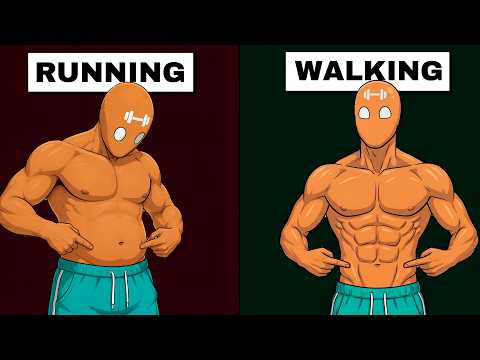
[0:00]This cookie contains 600 calories. To burn this off, you would have to run at full speed for 55 minutes. Think about that. 55 minutes of misery, sweating, and gasping for air just to neutralize one single snack. You cannot outrun your diet. The math simply doesn't work. But you can outsmart your metabolism. Most people think fitness is a suffering contest. They think, if I'm not dying, I'm not losing weight. So they sprint, they do hit, they suffer, and they look exactly the same six months later. I've developed a walking protocol called Bro Unlock. It doesn't rely on burning calories. It relies on manipulating your insulin levels after you eat. It is a biological glitch in the human metabolism that bypasses your body's defense mechanisms and melts belly fat without you ever breaking a sweat. If you give me 12 minutes, I will save you 10 years of wasted cardio. To defeat the belly, we first have to understand why it's such a jerk. Why is it that you can diet for weeks, and your face looks gaunt, your arms get smaller, but that tire around your waist refuses to budge. It's not because you're lazy, it's actually a biological defense mechanism. Back in 1997, a researcher named Dr. Bouchard discovered that fat cells aren't just bags of energy. They have receptors. Think of them like light switches that tell the fat whether to stay or go. There are two main types you need to know about. First, you have the beta receptors. These are the green lights. When adrenaline hits a beta receptor, it unlocks the fat cell and releases the energy to be burned. You have tons of these in your face, your arms, and your chest. That is why those areas get lean first. But then, there are the alpha receptors. These are the red lights. When hormones hit these, they tell the cell to lock the doors, shut down the release of energy, and hold on to the fat for dear life. And here is the bad news. The subcutaneous fat covering your abs has a significantly higher ratio of these red light alpha receptors compared to the rest of your body. Evolution put them there to protect your vital organs from starvation. Your body wants to keep that belly fat. And here is the trap that catches almost everyone. When you do high-intensity cardio, sprinting, crossfit, or grueling interval training, your body enters a fight or flight state. You release massive amounts of stress hormones, specifically adrenaline and cortisol. In your arms, that adrenaline hits the green light. You lose arm fat. But in your belly, that adrenaline hits the red light, and cortisol is even worse. Chronically high cortisol levels have been directly linked to increased abdominal fat storage. So, by killing yourself in the gym and stressing your body out, you are chemically signaling your belly fat to stay exactly where it is. You are literally working harder to stay fatter. So, how do we fix this? How do we turn the light from red to green? We need to move the body without stressing the body. We need to enter a specific physiological state known as the lipid oxidation zone. To understand this, imagine your body has two fuel tanks. Tank A is a small tank filled with high octane rocket fuel. This is glycogen, or stored sugar. Your body uses this when you sprint or lift heavy weights because it burns fast and hot. Tank B is a massive oil tanker. This is your body fat. Your body prefers to use this for slow, low-intensity tasks that last a long time. A major meta-analysis in 2021 titled Slow and Steady or Hard and Fast analyzed 54 studies to settle the debate. The result, high-intensity cardio burns mostly sugar. Low-intensity cardio burns mostly fat. Your body doesn't care about your feelings, it cares about fuel efficiency. When you run, you burn the sandwich you ate for lunch. When you walk, you burn the fat stored on your hips. This is the zone two hack. When you walk, you keep your heart rate in a specific range where you can still hold a conversation. In this zone, cortisol stays low, meaning those alpha receptors on your belly don't get triggered to lock down. Meanwhile, fat oxidation hits 100%. The answer, as you've probably guessed, is walking. But wait, before you click off thinking, I already walked to the fridge and back, listen closely. Simply walking around a bit isn't going to get you a six-pack. If it was that easy, the mailman would be the most ripped guy in your neighborhood. To make this work for rapid fat loss, you need a protocol. But first, we need to destroy a myth that is holding you back.
[4:26]I can hear the comments already. But bro pump, running burns twice as many calories as walking. It's basic physics. Sure, on paper, running wins. A 30-minute run burns about 350 calories. A 30-minute walk burns about 150. But humans aren't spreadsheets. We are biological machines driven by hormones. Specifically, a hunger hormone called ghrelin. This leads us to the compensatory effect. When you do high-intensity exercise, your body senses a massive energy deficit. It panics. It spikes your hunger hormones through the roof. So, you go for a run. You burn 350 calories. You feel great. But then, an hour later, you are starving. You eat a bagel, or maybe an extra scoop of rice at dinner. That bagel is 400 calories. Congratulations. You suffered for 30 minutes just to put yourself in a 50 calorie surplus. Even worse, high-intensity cardio makes you tired. After the run, you sit on the couch. You fidget less. You take the elevator instead of the stairs. Your subconscious body tries to save energy to make up for the run. Walking does the opposite. Walking is auto-regulated. It doesn't spike ghrelin. It doesn't cause massive fatigue. You can walk for an hour, burn 300 calories of pure fat, and your appetite stays completely stable. You don't feel the need to reward yourself with food. If you walk for one hour a day, that's 300 calories. Do that seven days a week, that's 2,100 calories. That is nearly two-thirds of a pound of pure fat, gone, every single week. Over the course of a year, that is 31 pounds of fat. The runner usually quits after three weeks because their knees hurt or they burn out. The walker wins the race because they never stop. Okay, so walking wins. But how do we structure it to get the fastest results possible? Most people screw this up. They try to hit 10,000 steps by going for one gigantic, boring, two-hour walk at the end of the day. Do not do that. That is the hard way. We are going to use a method called insulin stacking. You see, fat loss is impossible when insulin is high. Insulin is a storage hormone. When you eat, insulin spikes to store that energy. We want to switch your body back to burn mode as fast as possible after a meal. Step one is the post-prandial trigger. A study in the journal Diabetes Care found that walking for just 10 minutes immediately after a meal creates a massive improvement in blood sugar control compared to walking at other times of the day. So, here is your rule. You will take three 10-minute walks per day. One immediately after breakfast, one immediately after lunch, one immediately after dinner. That's it. That is 30 minutes of cardio. That's roughly 3,000 steps. You didn't even have to change into gym clothes. By doing this, you are blunt the insulin response of your meals and forcing your body to use that food for movement instead of storing it as belly fat. Step two is the neat cheat code. NEAT stands for non-exercise activity thermogenesis. It's the calories you burn just living, fidgeting, standing, pacing. Research shows that the difference between a naturally skinny person and an overweight person often isn't the gym, it's their neat levels. The variance can be up to 2,000 calories a day. We need to turn you into a neat freak. Here are three lazy hacks to get 2,000 free steps without trying. Hack number one, the parking lot rule. Stop circling for the closest spot. Park at the very back of the lot. It saves time and adds 400 steps round trip. Hack number two, the Pacer. Never sit down while you are on the phone. If you get a call, stand up. Pace around the room like a movie villain plotting a scheme. You can easily clock 1,000 steps on a 10-minute call. Hack number three, kill the elevator. Unless you are going up to the 50th floor, take the stairs. Stair climbing burns calories three times faster than walking on flat ground. If you apply the post-prandial trigger and these neat hacks, you will hit 8,000 to 10,000 steps a day almost by accident. Now, I know some of you are impatient. You want that six-pack in 12 weeks, not 12 months. If you are willing to do a little bit of actual work, you need to meet the king of fat loss, the incline. Walking on a flat surface is great. Walking on an incline is nuclear. Biomechanical, walking at a steep incline doubles the metabolic demand without the impact of running. It forces your glutes and hamstrings to work overdrive to fight gravity. There is a trend on TikTok called 12330. You set the treadmill to 12 incline, three speed for 30 minutes. It went viral for a reason. It works. It burns nearly the same calories as a jog, but keeps you in that cortisol safe, fat oxidation zone. However, I have to give you a warning. I see people doing this wrong every single day. Do not hold on to the handrails. The moment you grab the rails and lean back, you are cheating. You are offloading the weight from your legs to your arms. You are turning a 12 incline into a two incline. Let your arms swing. If you can't do 12 incline without holding on, drop it to eight. Form is everything. If you add just two or three of these incline sessions per week on top of your daily steps, your fat loss will go vertical. We need to have a serious conversation now. The fun part is over. You can walk to the moon and back. You can do the incline until your legs fall off. You can hit 25,000 steps a day, but if you eat like a raccoon in a dumpster, none of this matters. Remember the cookie from the beginning, it takes you 60 minutes to walk off 300 calories. It takes you roughly 45 seconds to eat 300 calories of peanut butter. A modest frappuccino from Starbucks can have 500 calories. That is an hour and a half of walking, gone in five minutes. You cannot outwalk the fork. They use the walking as an excuse to eat more. They think, oh, I walk 10,000 steps today. I deserve this pizza. No, you don't. You need to look at it this way. Use your diet to create the weight loss, use the walking to amplify it and keep your metabolism healthy. Think of your diet as the engine of the car, and walking as the turbocharger. The turbo makes the car go faster, but if there is no gas in the engine, you aren't going anywhere. You need to be in a slight caloric deficit. I recommend eating about 300 to 500 calories below your maintenance level. Combine that with bro unlock and the fat will literally have nowhere to hide. So, let's put this all together into a plan you can actually use. Here is your 12-week roadmap. I want you to visualize this. Weeks 1-4, the warm up. Do not try to hit 10,000 steps yet. Just find your baseline. Open your phone, see what your average is. Add 2,000 steps to that number. Focus purely on the post-meal walks. Just get in the habit of moving after you eat. Weeks 5-8, the stack. Now we turn up the heat. Aim for a strict minimum of 8,000 steps every single day. No excuses. Rain or shine. This is where you start using the neat hacks, parking far away, taking the stairs. Weeks 9-12, the shred. This is god mode. You are hitting 10,000 to 12,000 steps a day. You are adding in two incline walking sessions per week at the gym. At this point, your friends will start asking you what secret pill you're taking. As you know, we live in a world that tells you that results only come from suffering. That if you aren't dying in a pool of sweat, you aren't working hard enough. That is a lie. The most effective path is often the most sustainable one. Walking is the oldest human movement pattern. It is what we were designed to do. It clears your mind, lowers your stress, heals your joints, and yes, it shreds belly fat better than almost anything else. So here is my challenge to you. Don't worry about a year from now. Just commit to the next seven days. Track your steps. Add those three 10-minute walks after your meals. That's it. Come back to this video in a week and comment your results below. You will be shocked at how different you feel. Your energy will be up. Your bloating will be down, and your pants will feel looser. As I've mentioned, walking is only half the battle. You also need the right nutrition to match your efforts. I am currently preparing a detailed video on exactly what to eat to accelerate fat loss alongside this walking routine. Make sure to subscribe so you don't miss it. Now, let's get moving.