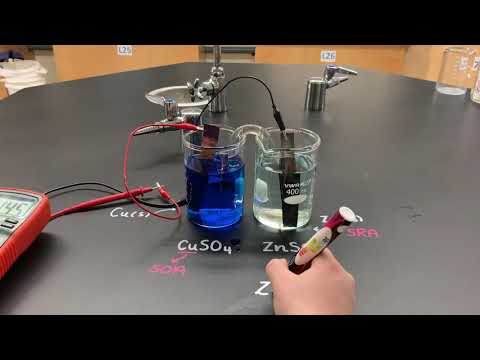
[0:00]Okay, so what we see here is a voltaic cell. Um this is a standard copper zinc voltaic cell and I'm just going to walk through each part of this cell so that we can understand what's happening.
[0:12]So, in the left beaker here, we have a solution of copper two sulfate.
[0:18]Um that's what the blue color is, it's from the copper 2+ ions. Uh inside of that solution immersed in it, we have a copper electrode.
[0:27]So that's just a piece of solid copper, um and it's just alligator clipped to a wire.
[0:32]Uh between the two beakers we have something called a salt bridge, so this is filled with sodium sulfate and the little cotton plugs on the end there are just to keep the solution in.
[0:42]So this provides us ion flow between the two beakers.
[0:47]On the right here we have a beaker containing a zinc sulfate solution uh with a solid zinc electrode.
[0:54]And you can see that there's actually a reaction taking place on that zinc, that's what that darker color is where it was in the solution.
[1:01]Uh and so we're going to walk through what's happening in this reaction um in terms of electron flow, ion flow, oxidation, etc.
[1:09]So, uh in a voltaic cell, we have a spontaneous reaction.
[1:13]That means that this reaction does not require any external energy.
[1:17]In fact, it's producing electrical energy. So this is a voltmeter and it tells me that I'm getting about 1.1 volts out of this reaction.
[1:27]And so what is happening is I have my strongest reducing agent, which is zinc.
[1:37]And my strongest oxidizing agent, which is copper 2+.
[1:44]So my strongest reducing agent, zinc, is going to undergo oxidation at the anode.
[1:50]So at my anode, I'm going to have solid zinc oxidized to zinc 2+.
[2:04]Um and at my cathode, which is the solid copper electrode, I'm going to have copper 2+ ions reduced to solid copper.
[2:21]So what we're going to see over time as this cell operates is we're going to see this zinc get become oxidized.
[2:27]And that's what we're seeing with that black color on the electrode.
[2:31]So the oxidation is actually going to decrease the mass of our zinc electrode and it's going to eventually dissolve away.
[2:40]The electrons that are produced during this oxidation reaction, are going to move through the wire to the cathode.
[3:00]So my electrons leave my zinc solid and I produce zinc 2+ in the solution.
[3:07]The electrons travel through these wires, through my voltmeter and then into my cathode.
[3:14]Once they're in the cathode, they're able to meet up with copper 2+ ions in the solution and then form solid copper.
[3:20]So what we should see over time here is the color of this solution should get lighter and the mass of my copper electrode should increase.
[3:32]Now, that's going to be a little bit hard to see um on an already copper electrode.
[3:39]But we can make a small adjustment to this reaction uh and maintain a working cell. So if we look at our two half reactions, we'll see that the solid copper is actually not a reactant, it's a product.
[3:47]And so this electrode is merely here to deliver electrons, it's not actually involved in the reaction.
[3:53]So I can take this solid piece of carbon, carbon is actually quite uh conductive in its solid form.
[4:00]I can take this solid piece of carbon and I can uh replace the copper electrode with it.
[4:06]So I'm going to pull out this copper electrode.
[4:09]I'm going to squeeze this carbon electrode into my solution, and we see that we still have voltage moving through this cell because we haven't actually changed the reaction that's taking place.
[4:23]We still have copper ions being reduced at the cathode, uh and zinc zinc metal being oxidized at the anode.
[4:32]The only difference is that over time as this reaction occurs, I should see some plating of copper onto this carbon electrode.
[4:41]So over time that should develop kind of a copper-colored sheen as copper solid or solid copper um is plated onto it.


