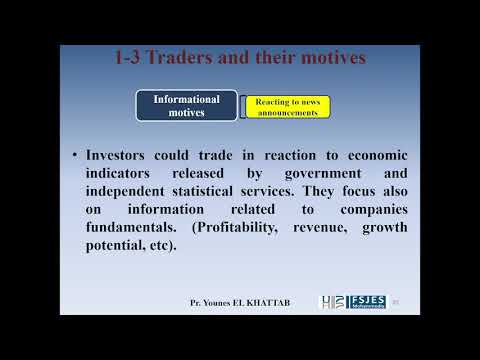
[0:10]Hello, we'll be trying to cover an important section of this third chapter. Traders and their motive. What are the main reasons that explain traders moves in the market? Why do we buy? Why do we sell? Why do we engage in transaction in financial market? Trade arises from differences in investment goals, risk exposures and beliefs about stocks values. That means simply that your position in the market, short position, long position, your direction, the direction of your orders, buy or sell, is determined by three variables or three factors. Your investment goals, whether you are speculator, long-term investor, short-term investor. Risk exposure, how important that your exposition to risk, and finally, your assessment of the value of the stock or securities generally speaking. If you are identical in these three aspects, if you are identical in these three aspects, you will simply trade in the same direction, buy or sell. And choose the same position, long or short position, and so on. Simply, as a recap, we can say that your position in the market, your choices, your behavior in the market is determined by your investment objectives, risk exposures, and finally, the beliefs about stocks values. Technically speaking, we have two major group of factors that explain our behavior in the market. We can trade for informational purposes, and also we can trade for non-informational purposes. When I say informational motives or informational reasons or purposes, it means simply that my behavior is a simple reaction to the news that I analyze. Reacting to news, trading for as a reaction for news, as a response to news, as a reaction to news is simply trading for informational motives.
[2:46]If I try to give you more details about that, first of all, you should you should keep in your mind that informational motives are closely linked to the principle of efficiency theory. Because in efficiency theory, the price should respect simply all the information available about the value of the stock. Now, practically speaking, we have a set of macroeconomic and microeconomic data, macroeconomic data or macroeconomic information released by the various institution. Officials, institutions, independent institutions. Here we have the government data, the government statement, the government report, as well as also the report and the data of the central bank and other identical independent statistical services. What kind of data I am talking about? So simple. If central bank, uh, determined and justify the level of its policy rate, if there is a move change in policy rate. This is an important factor, macroeconomic variable that investor take into account simply because the policy rate, the central bank policy rate has an inf an an impact, direct impact and also indirect impact on interest rates. Higher policy rate means that it is so difficult to access funding, whether you are uh, households or physical person or legal person enterprises. When it is so hard to access funding, to access the necessary fund to cover your consumption and investment needs, simply it will have a direct impact on aggregate demand, and of course, in this case, the the prospect for growth will be negative. Investors are not really motivated to invest in such conditions, in such macroeconomic conditions. Other variable, unemployment rates, also unemployment rates, especially the figures released by United States about the American economy. Unemployment rate is a sort of proxy variable for the growth prospect because higher or low unemployment rates means that we have a positive growth prospect and vice versa. Also, there is a variety of other macroeconomic variables, the fiscal measures of the government, the fiscal balance, the fiscal deficit, the current account deficit and the currency change, the value of our currency, changes in the value of our currency, and so on. All those variables should be taken into account and will determine how investors behave in the market, whether they will enter and engage in investment or simply leave the market and try to find to find other assets in order to to invest in. Other variables are simply the microeconomic variables. Microeconomic information that is closely linked to the enterprises about their revenues, profitability, growth prospect, growth potential, investment project is also an important factor, an important component of your analysis. So, simply, when I use information the data, available data, I simply use a sort of combination between macroeconomic analysis and microeconomic analysis in order to make the right decision at the right moment. And if all investors are rational investors and take into account those information this information, that data, simply we will say that the market is efficient. The non-informational motives of trading. Yeah, we can trade, but our moves in the market is not explained by informational aspects. So here we have three component of non-informational motives: hedging, liquidity and speculating. Hedging. Hedging aims at risk reduction, reducing your overall risk. It's about diversification. If your portfolio is concentrated in few number of stocks, your exposure to risk is important. You need to reduce the overall risk of your portfolio, the overall risk exposure. How can we do that? How can you do that? So simple. You need to diversify your portfolio by selling a part of your stocks and securities and buying a variety of other stocks in order to increase the number of component of assets in your in terms of categories, of course, and in terms of issuers in your portfolio, which means simply that your overall risk will be reduced. Also, this this is uh it has nothing to do with our module but it is so important to keep also that in your mind. Uh, investors can reduce the risk their risk exposure by fixing the price of their future transaction. How can they fix the price of their future transaction? Please simply that they can use the option derivatives options, future contracts and forward contracts. Second component here of non-informational motive, liquidity. Investors who have some liquidity constraints, like insurance company, like insurance companies, like the pension funds and other institutional investors, they can also cash out or sell a part of their assets in order to meet their cash needs.
[8:38]The case of insurance company. Insurance company receive premiums from their clients in order to cover a particular damage or risk. When their clients face a damage or risk, face losses, insurance company are obliged to cash out a part of their portfolio in order to cover that losses by paying compensation to their clients. Also, another aspect of institutional investors, the undertakings for collective investment in transferable securities. They collect funds from their clients, the saving of their clients. Suppose here that the client does do not have really that skills, these, the skills and time to invest in directly in financial markets. So, they will simply interest their saving to such kind of financial institution, and such kind of financial institution, what we call here in the Moroccan regulation, the OBM, invest the these funds or those funds in financial in various venues of investment depending on their on their investment strategy. When that client claims their right to redeem the the shares, they hold, simply in this case, uh, the insurance, the undertaken for collective investment in transferable securities, find their self obliged also to cash out a part of their portfolio in order to redeem the shares. So in order to pay back their clients, which is, of course, the rights of their clients, and so on.
[10:17]Here, we are talking about trading because cashing out portfolio mean that you will sell asset, you will sell securities and stocks and other uh, variety of security, of course, in order to meet your cash need, and in order to commit to, uh, honor your commitment to their clients. Finally, speculating. Speculating also trading for speculation purposes. You trade without checking into account really that information about the fundamentals of the company and the fundamentals of the economy. In this case, you will simply or the speculator will buy asset with high growth potential, expecting that their prices will increase in future, and then they sell them at a higher price in order to make a short-term gain. They act on a shorter time frame, and of course, they take on risk compared to ordinary investors. Speculating also is another non-informational motives for investment.


