[0:00]Hey YouTube, welcome back to another sales training video. My name is Daniel G. I've trained well over 2 million plus sales people at this point from all around the world. spoken over 700 plus events worldwide across so many freaking different industries. And I'm happy to say that this YouTube channel, you don't have to pay me a dollar to come to one of my virtual events or show up to one of my events at this video right now, it's completely free. So all I ask you to do, and I get right to the chase, no fluff, no BS, I want to get right inside of the training. I don't need to make these videos 35 minutes, 45 minutes, talk about a whole bunch of fluff stories, okay? All I ask you to do for the short amount of time that we're here and the value that you get out of this, just take your your mouse, drag it down to the bottom left of this video, smash the subscribe button. So you guys get notified every single time that we go live on YouTube and or we drop a video. So, let's dive right into it. Today's video, how to master a cold call. Regardless of what you sell, whether you're in direct sales, network marketing, door-to-door sales, you're in B2B sales, B2C sales, you appointment set, okay, you're a coach, consultant, thought leader, entrepreneur, you book meetings or you do cold calls. This video is going to apply to you. And by the way, if you don't make cold calls inside of your business, it's probably either why you have a dying business or number two, why you get anxiety inside of your business, cuz making a cold call is the most active activity that you can do inside of your business, number one, and it is the most controllable, number two. Active means this that it actually generates, you can focus on becoming better and it actually generates business inside directly and transactionally inside of your business, where it's not branding, which is passive that you put out a post, you cross your fingers and hope and pray and say, I hope this thing lends and I hope this it's like going to a networking event. That is passive. Making a cold call, knocking on a door, that is a completely active task inside of your business, so you must learn how to master it. And not just that, it's because you can control this inside of your business. You can control making a cold call and getting better. You can't control going out on a live stream and a million people showing up. But when you know how to master the art of communication and you know how to master a cold call, this is a controllable task. And when you focus on the things you can control inside of your business, you eliminate the anxiety. So, how do you exactly master a cold call? Well, I want to dive into a few points before we dive into the actual structure of the cold call is this. Number one, what we've noticed is that over 95% of the calls that my sales organization has moderated across all different industries, most people didn't struggle with sales. Most people didn't even struggle with booking a meeting. Most people struggled with the first 30 seconds of a cold call. Most people struggle with the initial contact, whether it's a cold call or cold outreach, rather than actually booking the meeting, dealing with objections, closing a sale and following up. They can't even get past the first 30 seconds. They can't even get somebody most of the time, majority of the time, to respond back to them with a freaking pulse and have a conversation. It's the first 30 seconds. So I want you to write this down right now. Master the first 30 seconds because you're already 95% ahead of people that can't get by the first 35 30 seconds of the conversation. It is not, okay, trying to have the the the best closing line. Most people can't get past the first 30 seconds, and I'll tell you why. It goes into point number two. The reason why they can't get past the first 30 seconds is because they start with their product and service in mind. Write this down, point number two. Start with their no in mind rather than your service product offer. Can I say that again? Start with their no in mind, don't start with your product offer and service. Write that down, start with their no in mind. So, what does that mean? Well, if you start with their no in mind, you go into point number three where you can anticipate what they're gonna say so you can eliminate it before you get on with the conversation. The only way actually to get inside of a conversation is to start with their no in mind. So, let me break down something for you. I think something is called sales insanity. Sales insanity means this that you say the same shit and hear the same response and you go do it on the next call. That's called sales insanity. You guys ever see the quote on Instagram where it says the the the definition of insanity is to say the same thing or sorry, to do the same thing and get the same results. That's insanity. In sales, I have something called sales insanity. You say the same thing, you hear the same objections and then you go do it on the next call and the next call and the next call. That's called sales insanity. That's like being a a inside of a a retail shop, and the the person that's selling clothes in the retail shop comes up to you and says, hi sir, are you looking for anything in particular like no thank you, I'm just shopping. And then you then then then then the the next person comes in, the retail sales lady or salesman says, hey, by the way, are you looking for, no thank you, I'm just shopping. How do you not for a second say, you know what, oh shit, I think I gotta change up my script. I'm going through sales insanity. You're repeating the same thing and hearing the same objection. It's not how I'm a master objection handler, it's why you're getting the same objection. If you start with their no in mind, it's gonna be much easier to anticipate and eliminate the objection. And inside of sales, if you seek to understand and you don't seek to reply, you will get the common denominator know, especially on a cold call or cold outreach. Now, this can be applied for cold messaging outreach too, you will figure out the common denominator. So inside of cold calling, what is the common denominator? Start with their no in mind. It is, I'm not interested, I'm too busy, call me back, send me over some information. Can I say that again? There's only like three to four. You that's their no, you start with it in mind. If you seek to understand, you will start understanding, oh wait, they're only saying like three, four things. I'm not interested, I'm too busy, call me back, we're already working with somebody, send me over some information. Five max. And the top two is like, I'm not interested, I'm too busy, right? Those ones are the ones that that that people struggle with to get past the first 30 seconds. Why am I saying that? If those are the main objections, I'm too busy, I'm not interested, guess what you're gonna do? You're gonna start off your script with their no in mind. So, now let's dive into the strategy. How not to do it, how to do it. Most sales people, how do they make a cold call? They get on a phone and they say things like this. This is how I don't want you to sound. And these are the words I don't want you to say when you make a cold call. Hi Mary, it's Daniel G calling from XYZ uh book corporation. Do you have 30 seconds? Why? Number one, you just said, you just asked them, first of all, you exposed everything you're doing right off the get-go. Number one. Number two, you just told them, hey, my time means nothing. Do you have 30 seconds? We just talked about this in a video yesterday. So, the cold call opening line, you just said, number one, you're the one that's busy. You shouldn't respect my time. I'm begging for your time. And then they have to don't say this after you're done. So, number one, they say, hey, by the way, I'm my name's Bob, I'm calling from XYZ Corporation. Can I just get 60 seconds of your time? Can I get your time? You're now fighting for the time, right? Then you usually ask a question, hey, by the way, um, you know, we're we're we do XYZ inside of your area. Are you interested in a free, and then you ask them are you interested? Now, it's just yes or no. Hey, by the way, we would love to help you. Are you interested in getting help? Yes or no? Now, you just closed off the conversation. So, number one, you beg for their time, you're fighting for their time. And then number two, most sales people say, um, you know, I just wanted to see, uh, if you were interested in selling your home. If you're interested in getting new water bottles for your office, you're interested in new pens. No, I'm not interested, thank you, I have no interest. Most sales people ask for time and ask for interest in one way, shape, or form or another, because you're on this video, you're gonna start with the no in mind, not the product in mind, not their interest in mind. You're gonna start with their no in mind. So, here's how I'd frame it. Step number one, write this down. When you're making the cold call, this is how I like to make it. If I see their name is Jim, I ring, ring, ring. Jim! Good energy, high boss. I just say their first name loud. Jim! Like me and you used to be friends way back when. I call it the 10-year relationship name calling. Steve! Is that Steve? Jim! Jim, how you doing? Jim, how you doing? Yeah, it's it it is Jim, who might I speak with? Jim, Daniel G from uh XYZ Corporation. Listen Jim, I'm sitting down here, step number two. Elicit business. Listen Jim, I'm sitting down here. Um, I got like 30 seconds right now on my hands. I got 30 seconds, I got 60 seconds. You see what the other sales person did? But by the way, Jim, do you uh, do you have 30 or 60 seconds? No, no, I got 30, I got 60 seconds. Before you tell me you're too busy, I'm gonna anticipate and eliminate the objection I'm busy too as well. Before you kick me out, I'm telling you I'm busy. Hey, by the way, Jim, I'm sitting down here. I got 30 to 60 seconds. And I always like looking at my watch, okay? Hey, listen, I got 30 to 60 seconds right now. I'm seeing if you guys can support me, uh, with one or two key points to see if we can actually help you, like we did with Bob and Carl across the street. Jim, just to better understand, so number one, you're ready what I did here? Jim! Step one. Like me and you been friends for the last 10 years. Step two. Knock off the busy objection. Business frame, like yesterday's video, hey, I'm sitting down here, I got like 60 seconds. I like to look at my watch, because when I look at my watch, my voice and my tone matches the way I'm looking at my watch. I'm sitting down here with my executive assistant, I got about 60 seconds here. I'm busy too as well. Before you tell me you're busy. I got about 60 seconds. But not just that, I frame them to say, hey, by the way, I got 60 seconds. That means I'm about to bounce out of here in 60 seconds. Hey, I got like 30, 60 seconds. Now, I gotta bounce then I gotta bounce out of here. Jim, by the way, just and then I go into step number three, which is the qualifying question. Just so I better understand, so I know that we could support you like we did with Barbara and Carl across the street, just one key point here, are you um the owner of XYZ Bottle Corp? Yes, I am. Uh, uh, how how may I help or or what's what's this all about? Um, no, Jim, and yes, I just need to get them decision maker qualifying, right? First one, are you the decision maker? Are you the home owner, are you the decision maker? Okay, great. Hey, by the way, now I'm gonna leave. I'm gonna frame the exit so I can pull them back in. Jim, I wouldn't be able uh to talk about how we helped Barbara and Carl across the street with their with their foundation, whatever you're selling, with their water, with uh their heating and electric. I wouldn't be able to have a conversation around that. So, I'm dripping in a little bit about what we're doing, okay? You see, I'm dripping it in in every point. So, stage four, I'm now setting to leave, I'm setting the exit. I wouldn't be able to do that right now to talk about how we help Barbara and Croll across the street save on XYZ from their water bill, their electricity bill. Is it cool right now if I just shoot you over an email and then maybe we reconnect in the next, I don't know, you know, few days or so to see if this even makes sense for both of us. Can I shoot you over an email what Marble and Carl on boarded us for to see if this even makes sense? Uh, yeah, sure, Bob. What's your email? Step number five. This is all getting past the first 30 seconds. Step number five, ask them for the email. Uh, it's Carla, it's Bob at gmail.com. Perfect, Bob. And now I can just ask him. When I ask them what's your email, and they respond back, I'm just gonna say, hey, Bob, by the way, um, right now with your water or right now with your heating, or right now, um, with where you live. Whatever you're selling, what would you like me to put inside of the email, um, to see what you need best support with. Would you like me to see how much your homes, if I'm selling real estate, do you want to see how much your home's actually worth? Do you want to see what other people have sold, um, the home on the, uh, blog for, or would you like to see other homes in the area if you're ever interested in moving? What can I best support you with? What whatever are the top things that you could support with them or the top problems that can spark and ignite a conversation, whatever they choose. Well, yeah, I would love to see, uh, you know, what my home's quota for, what other people sold on the block. Okay, perfect. Whatever they answer, you're back inside the conversation now. Okay, awesome, right? So, like I could say, hey, if I'm selling sales, Bob, I wouldn't be able to have a conversation right now. Do you mind if I shoot you over an email on what we best support our clients with in 2025, so you could just review it? Yeah, sure, Bob, what's your email? Bob at gmail.com. Hey, Bob, right now, um, what would you say is like the bottleneck inside of your organization? Is it recruiting more people inside of your organization? Is it dealing with the difficult clients, or is it really not just keeping the people inside of your organization, but also growing them? What can I support you with inside of that email, so I can show you some data and stats of what we've done and I can show you over some value? Yeah, uh, you know, it was like, uh, really just recruiting more people in. Okay, got it. And and how many people right now do you have on your sales? I'm back inside the conversation. I'm past that 30-second mark. Why? Because that fifth frame, where I sent them over the email, all they gotta do is answer a question, and now I'm right back inside of the conversation. So, really go look at that again, right? I I did the friendly, hey, by the way, we've been friends for 10 years, right? I I elicited, I'm busy objection. I anticipated and I moved it out. And then I also anticipated and eliminated the objection where they said, send me over some information. I'm gonna tell you that before you tell me that. See, I raised an objection, and moved the objection before you even gave me the objection. And the fifth thing is, I circled it back in, hey, by the way, what are your problems or what are your concerns? Because they know they can leave the conversation, they know they can exit the conversation, I can pull them back in. Rinse and repeat those five steps. The most important thing to understand from this video is you start with their no and their objection in mind, you anticipate it and eliminate it rather than starting with your product in mind. Rinse, repeat this video. And by the way, all of that is from my new book, okay? The sales game. I use a methodology inside of this video called the NRS for, no resistance sales form. If you haven't yet grabbed a copy of my new book, it's completely sold out, but you can head over to my website to get a completely free digital download and digital copy of my book at Danielgsales.com. You're gonna join the sales school. Inside of the sales school, seven days free access to my sales school. You can cancel on the sixth day. The moment you get inside of my sales school, you can download, literally download my book for free. Go through the whole digital book for free. And also, if you like the book, we've created videos inside of the sales school that go hand in hand with the book. So, if you're a visual learner, like somebody like myself, you're gonna get a lot out of the sales university inside of my sales school. It's seven days completely free access. After the seventh day, it's $47 a month. But regardless, go through the whole sales school, four, five days, download the book. If you don't like it, if it's not something for you, you can click exit and you don't get charged a dollar. The sales game, Danielgsales.com, it's inside of my sales school, free for seven days. Download the book. I appreciate you guys. Smash the subscribe button, and I'll see you guys on the next video.
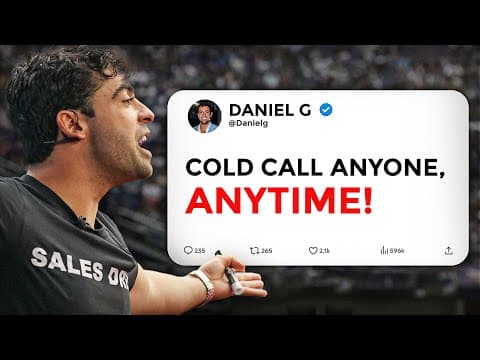
How To Cold Call Anyone, Anytime | Daniel G
Daniel G
15m 15s3,272 words~17 min read
YouTube auto captions
Transcript source
YouTube auto captions
This transcript was extracted from YouTube's auto-generated caption track. The transcript below is server-rendered so it can be read, searched, cited, and shared without opening the original YouTube player.
Pull quotes
[0:00]I've trained well over 2 million plus sales people at this point from all around the world.
[0:00]spoken over 700 plus events worldwide across so many freaking different industries.
[0:00]And I'm happy to say that this YouTube channel, you don't have to pay me a dollar to come to one of my virtual events or show up to one of my events at this video right now, it's completely free.
[0:00]So all I ask you to do, and I get right to the chase, no fluff, no BS, I want to get right inside of the training.
Use this transcript
Related transcript hubs
Watch on YouTube
Share
MORE TRANSCRIPTS


